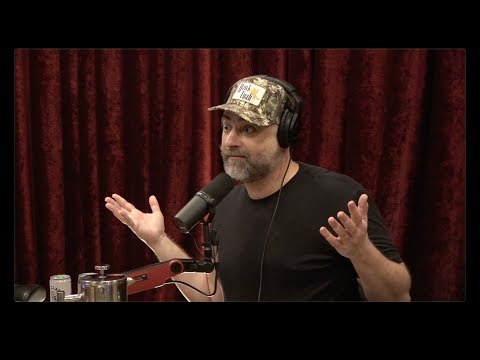
Joe Rogan Experience #2265 - Kurt Metzger
Narrator, Kurt Metzger (guest), Joe Rogan (host), Guest's in-studio assistant (guest), Narrator, Narrator, Narrator, Narrator, Narrator, Narrator, Narrator, Narrator
In this episode of The Joe Rogan Experience, featuring Narrator and Kurt Metzger, Joe Rogan Experience #2265 - Kurt Metzger explores conspiracies, crypto, and control: Rogan and Metzger dissect manipulation Joe Rogan and Kurt Metzger jump between historical and modern examples of manipulation, arguing that governments, intelligence agencies, corporations, and elites systematically shape public perception and behavior. They discuss CIA propaganda, MKUltra, education as social programming, COVID policies, climate narratives, and UFO disclosure as different faces of the same control architecture. A long tangent on meme coins, Trump coin, and NFTs frames crypto as legalized, gamified speculation that mirrors broader financial and political pump‑and‑dump schemes. Throughout, they weave in dark humor, pop‑culture references, and fringe theories while questioning the legitimacy and motives of institutions that claim to protect or inform the public.
Conspiracies, crypto, and control: Rogan and Metzger dissect manipulation
Joe Rogan and Kurt Metzger jump between historical and modern examples of manipulation, arguing that governments, intelligence agencies, corporations, and elites systematically shape public perception and behavior. They discuss CIA propaganda, MKUltra, education as social programming, COVID policies, climate narratives, and UFO disclosure as different faces of the same control architecture. A long tangent on meme coins, Trump coin, and NFTs frames crypto as legalized, gamified speculation that mirrors broader financial and political pump‑and‑dump schemes. Throughout, they weave in dark humor, pop‑culture references, and fringe theories while questioning the legitimacy and motives of institutions that claim to protect or inform the public.
Key Takeaways
Mass manipulation is often openly documented, not just speculative.
They highlight declassified programs (e. ...
Get the full analysis with uListen AI
Crypto meme coins mirror casino logic and broader societal scams.
Trump coin, Hawk Tuah coin, Shiba Inu, and other tokens are described as pump‑and‑dump schemes where participants knowingly hope to be early enough to profit, reflecting a larger culture of speculative gambling and expectation that a greater fool will absorb the losses.
Get the full analysis with uListen AI
Schooling and media are framed as conditioning, not just education.
Referencing Prussian schooling, Rockefeller/Carnegie foundations, Common Core, and children’s entertainment, they argue the system is optimized to produce compliant, easily directed adults rather than independent thinkers, by separating kids from parents early and rewarding conformity.
Get the full analysis with uListen AI
Public health and climate narratives can be co‑opted by profit and control.
They question vaccine mandates, Fauci’s AIDS and COVID records, sugar and salt science, and apocalyptic climate predictions, suggesting these narratives sometimes prioritize pharmaceutical profits, political leverage, or guilt-based control over transparent risk–benefit discussion.
Get the full analysis with uListen AI
UFO/UAP discourse may mix real phenomena with strategic obfuscation.
They consider the possibility of advanced human tech decades ahead of public knowledge, genuine non‑human craft, and deliberate narrative “muddying” by intel figures appearing in documentaries, making it hard to distinguish authentic disclosure from controlled storytelling.
Get the full analysis with uListen AI
Elite power is maintained through networks, NGOs, and blackmail leverage.
From Roy Cohn, Epstein, and intelligence-linked honeypots to vast NGO funding webs and celebrity political payouts, they argue modern influence flows through opaque shells and kompromat, not just formal offices or elections.
Get the full analysis with uListen AI
Language changes and labels are themselves tools of persuasion.
They point to terms like “conspiracy theory,” “collusion,” “disinformation,” “FUD,” “vaccine” redefitions, and rebranding (UFO to UAP) as ways institutions reset public perception, stigmatize dissent, and distance current operations from tarnished narratives.
Get the full analysis with uListen AI
Notable Quotes
“Everything’s mafia. Education, media, pharma, it’s all just different rackets to control people.”
— Kurt Metzger
“Crypto is basically DraftKings for people who think they’re investors.”
— Joe Rogan
“They legalized propaganda on American citizens. That’s not a conspiracy theory—that’s legislation.”
— Kurt Metzger
“If you killed a million people on a false premise, how do you sleep at night? They medicate the fuck out of you and you’re fine.”
— Joe Rogan
“We know elites lied and experimented on people in the past, but somehow we don’t want to believe they’d still do it now.”
— Joe Rogan
Questions Answered in This Episode
Which of the historical operations they referenced (like MKUltra or domestic bioweapons tests) most changes your view of what governments are willing to do?
Joe Rogan and Kurt Metzger jump between historical and modern examples of manipulation, arguing that governments, intelligence agencies, corporations, and elites systematically shape public perception and behavior. ...
Get the full analysis with uListen AI
Is there any legitimate, socially beneficial version of meme coins and speculative crypto, or are they inherently exploitative pump‑and‑dump schemes?
Get the full analysis with uListen AI
Where do you personally draw the line between healthy skepticism of institutions and falling into unproductive or unfalsifiable conspiratorial thinking?
Get the full analysis with uListen AI
How could public health communication be structured so that people trust vaccine and climate science without it becoming a tool for top‑down control?
Get the full analysis with uListen AI
What evidence would you need to be convinced that at least some UFO/UAP incidents involve non‑human technology rather than advanced secret human projects or misperceptions?
Get the full analysis with uListen AI
Transcript Preview
(drum roll) Joe Rogan podcast, check it out. The Joe Rogan Experience.
Train by day, Joe Rogan podcast by night, all day.
(instrumental music)
(laughs)
Okay.
This- (laughs) It's got-
Meet the Cosby Kids. Oh my God-
(laughs)
... look at the s- the thing says, "Meet the Cosby Kids."
Who wrote this sketch? (laughs)
I don't know, but what's funny is that back then that was ridiculous.
Yes. A, I mean Phil Hartman's gone but, uh, all the rest of yous, thanks for speaking up. Uh, (laughs) hey, this reminds me of the sketch that we did.
Right.
I hear- how come I just heard of this now?
How come I just heard of this now?
Boy, SNL was funny.
Oh, SNL was great-
(laughs)
... when Phil Hartman was on it. The early days of SNL were amazing.
Yo, was Al Franken working there when they did that?
I don't know.
'Cause I would think Senator Franken would've said something.
Oh, he's not a senator anymore. He got caught hugging a girl.
Yeah, I would think after he got screwed over like that-
(laughs)
... you wouldn't still do Blue MAGA, but I guess you would.
(instrumental music)
Ah, he's just locked, locked in, you know?
Hey man, I-
That guy's great too. Al Franken's a great guy.
Yo, he had a funny... One time he was on Conan, just made me laugh so hard. He was talk- he was saying, uh, how the internet, how great it is for kids, you know, my, my son... Or my kid just did a, a, a third grade, uh, report on bestiality, and the other kids just loved it.
(laughs)
(laughs) You know he delivers...
(laughs) How crazy th- though that that was a preposterous sketch.
Well, you know, John Money, I'm sure whoever wrote that knew about John Money, right? The guy that came up with that. I seen on s-
I bet they didn't. I bet they just did it-
Ah, that's a bunch of lampoon-
... just-
... Harvard people, right?
Right.
So, you know, they go, "Oh, The Simpsons, oh they predict the future." No, they (sighs) you're near the people that pull the levers of power in college. Like, you're just gonna osmosis up their fucking plans. It ain't psychic. (laughs) Like-
Yeah, but they don't, like, broadcast their plans to students, undergrad students.
Yeah, they do. Why do you think we got-
What do you mean?
What do you think a Rhodes Scholar is? That's them broadcasting their plans. That's what the great Bill Clinton, I b- I believe you had meaningful eye contact with. (laughs)
(laughs) What do you mean by broadcaster plans?
Um, the, the plans have never been se- you know, like, we're, uh-
Install uListen to search the full transcript and get AI-powered insights
Get Full TranscriptGet more from every podcast
AI summaries, searchable transcripts, and fact-checking. Free forever.
Add to Chrome