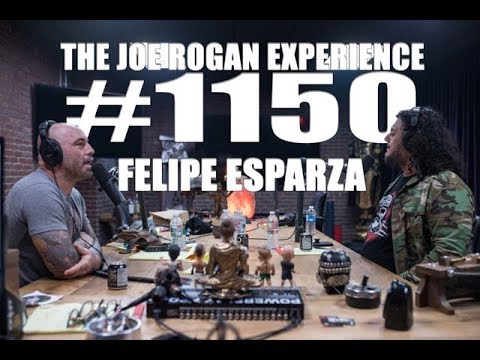
Joe Rogan Experience #1150 - Felipe Esparza
Joe Rogan (host), Felipe Esparza (guest), Narrator, Jamie Vernon (guest), Jamie Vernon (guest), Jamie Vernon (guest), Felipe Esparza (guest), Jamie Vernon (guest), Jamie Vernon (guest), Narrator, Felipe Esparza (guest), Narrator
In this episode of The Joe Rogan Experience, featuring Joe Rogan and Felipe Esparza, Joe Rogan Experience #1150 - Felipe Esparza explores felipe Esparza, Immigration, Comedy, and Humanity on Joe Rogan Joe Rogan and comedian Felipe Esparza cover Felipe’s life story, from being tied to a stump as a child in Sinaloa to crossing the U.S.–Mexico border multiple times with a coyote, including his brother disguising as a girl using borrowed passports. They use Felipe’s experience to talk about immigration, the absurdity of the border wall, and how Americans think about “good spots” versus “bad spots” and scarcity. The conversation branches into language, culture, poverty, informal community finance systems, diet, drugs, prisons, comedy censorship, and human psychology around risk, disease, and death. Throughout, they keep looping back to how people adapt to harsh conditions—whether in Mexican barrios, U.S. prisons, or brutal historical contexts like Genghis Khan—using humor, hustle, and community.
Felipe Esparza, Immigration, Comedy, and Humanity on Joe Rogan
Joe Rogan and comedian Felipe Esparza cover Felipe’s life story, from being tied to a stump as a child in Sinaloa to crossing the U.S.–Mexico border multiple times with a coyote, including his brother disguising as a girl using borrowed passports. They use Felipe’s experience to talk about immigration, the absurdity of the border wall, and how Americans think about “good spots” versus “bad spots” and scarcity. The conversation branches into language, culture, poverty, informal community finance systems, diet, drugs, prisons, comedy censorship, and human psychology around risk, disease, and death. Throughout, they keep looping back to how people adapt to harsh conditions—whether in Mexican barrios, U.S. prisons, or brutal historical contexts like Genghis Khan—using humor, hustle, and community.
Key Takeaways
Immigration policy debates often ignore lived experience at the border.
Felipe’s firsthand stories—being separated from his mother as a child, repeatedly crossing with smugglers, his brother crossing dressed as a girl—show how abstract talk about “walls” and “security” can miss the human stakes and ingenuity people deploy when desperate.
Get the full analysis with uListen AI
Walls and borders are about managing fear of scarcity, not just security.
Rogan points out that opposition to open borders is often rooted in fear that “good spots” will be overrun and degrade, using Boulder, CO as an example; the real problem is how people behave under crowding and stress, not the wall itself.
Get the full analysis with uListen AI
Kids can acquire language astonishingly fast through immersion and context.
Felipe arrived speaking no English, learned purely from TV and playground interactions, with no formal ESL help, underscoring how early exposure and the brain’s plasticity make natural acquisition possible without grammar instruction.
Get the full analysis with uListen AI
Communities often create their own financial safety nets when banks exclude them.
Felipe describes a rotating savings pool (“condina”) where 10 families each put in $100 weekly and take turns receiving the $1,000 pot, illustrating grassroots mutual aid as a practical response to lack of credit access.
Get the full analysis with uListen AI
Comedy depends on context and patience; cutting it off mid-setup distorts intent.
Felipe recounts being labeled “problematic” or literally cut off onstage because audiences reacted to trigger words before the punchline, showing how pre‑judging a joke can shut down nuanced or critical commentary.
Get the full analysis with uListen AI
Extreme inequality coexists with solvable global poverty, but incentives block change.
They note that billionaire wealth gains in a single year could end extreme poverty multiple times over; yet without systemic incentives or rules, capital continues to concentrate rather than redistribute.
Get the full analysis with uListen AI
Our fears about health threats are emotional, not proportional.
They compare panic over AIDS (especially because it’s sex-associated and “new”) with relative indifference to the flu or smoking, which kill far more people annually, highlighting how stigma and narrative shape what we treat as dangerous.
Get the full analysis with uListen AI
Notable Quotes
““Anytime you have a wall, historically, shit goes down. People want to get over that wall.””
— Joe Rogan
““We crossed with a coyote. My mom paid him money. We got caught, separated from my mom, and I was four just watching American cartoons in a holding cell.””
— Felipe Esparza
““I picked up English from TV. Nobody said, ‘This is a noun, this is a verb.’ The teacher was like, ‘You’re gonna pick it up or not.’””
— Felipe Esparza
““If you’re gonna have a game where one thing lets you do everything, you have to ask: is there such a thing as too much [money]?””
— Joe Rogan
““When you’re talking about stand‑up comedy, you’re taking them for a ride. They don’t know what you’re gonna say next. To stop that because of a subject word is crazy.””
— Joe Rogan
Questions Answered in This Episode
How should immigration policy change if it fully accounted for stories like Felipe’s childhood separations and dangerous crossings?
Joe Rogan and comedian Felipe Esparza cover Felipe’s life story, from being tied to a stump as a child in Sinaloa to crossing the U. ...
Get the full analysis with uListen AI
Is there a morally acceptable upper limit to personal wealth in a world where extreme poverty is technically solvable?
Get the full analysis with uListen AI
How can comedians and audiences strike a balance between avoiding genuine harm and allowing edgy material that needs context and a punchline?
Get the full analysis with uListen AI
What informal financial or social-support systems, like Felipe’s neighborhood savings pool, could be adapted more broadly to help marginalized communities today?
Get the full analysis with uListen AI
If humans are wired for risk‑taking and tribal protection, how can we consciously redirect those instincts away from violence and exclusion toward constructive challenges?
Get the full analysis with uListen AI
Transcript Preview
(sniffs) Here we go. F- three, two, one. Fucking, yee-haw, Felipe. How are you, sir?
What's up, fool? Good, man.
(coughs) You ha-
Thanks for having me.
... do you have to say that?
I don't know.
It seems like it ha- it, like-
Ah.
... you said, "What's up, dude?" And then you said, (snaps fingers) "What's up, fool?" You corrected yourself.
Yeah.
Like I s- I'm slipping. Is that, like... When you have such a cool saying, like you do, you almost feel compelled to use it.
Yeah. It all started, like-
(coughs)
... people in my neighborhood would answer the phone like that.
Oh, really?
Like I wa- I was dating this girl, and I called her up, and her brother answered the phone, "What's up, fool?" Like-
Yeah. It's normal, right?
Yeah.
That is a, uh, a cool Mexican thing to say.
No, probably more, more like the hood. Like it's a-
The hood?
More like the West Coast hoody. West Coast-
West Coast hood, like not necessarily Mexican?
South Central. Mexican and s- and Blacks. Like we took it from the Blacks.
Oh, okay.
But, uh, mostly, like, uh, West Coast, South Central, East LA, Boyle Heights.
Boyle Heights in the house.
Yeah, man.
For sure. Yeah. What... That's a, you know... This is a contentious time for fucking people when it comes to, like, um, Mexicans and Americans with this whole wall thing.
Yeah. And I, I, I went to-
s-
I went to go, um, to look at the walls, 'cause I went to, uh, Mexico, Tijuana.
Yeah.
And I was, like, and, uh, right at the border of the gate, like, the gate-
Right.
... it's not a wall, it's just a gate. And across from the gate they have, like, eight wall prototypes. Like, the ones to... Like, eight wall prototypes. Like, there's one wall that's like a, it's a wall with cement and it has, um, concrete. Then there's another wall that's different, and then another wall. It's like they have... You know when you, when you go buy tile for your house?
Yeah.
And they show you all the tiles?
Oh, wow.
Those are the, what the walls are.
Like those little Home Depot-
Yes.
... uh, like a sign, like a placard with different... Wow, look at that.
That, that's it. I was right, I was there. I was right in front of that.
(inhales deeply)
Each one of those, I think it cost 25 million, each wall, each, each one.
Each little fake one?
Yeah.
What? Someone's getting robbed.
(laughs)
(laughs)
There's some, there's some contractors right now in New Jersey going, "Wait, wait. Hey, hey. What the fuck?"
Install uListen to search the full transcript and get AI-powered insights
Get Full TranscriptGet more from every podcast
AI summaries, searchable transcripts, and fact-checking. Free forever.
Add to Chrome