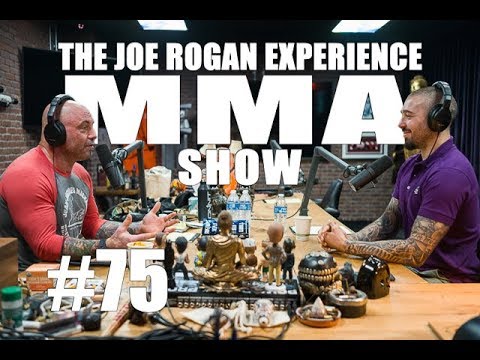
JRE MMA Show #75 with Dan Hardy
Dan Hardy (guest), Joe Rogan (host), Guest (likely a brief third-party commentator or producer) (guest)
In this episode of The Joe Rogan Experience, featuring Dan Hardy and Joe Rogan, JRE MMA Show #75 with Dan Hardy explores dan Hardy and Joe Rogan Explore Fighting, Ideas, and Human Limits Joe Rogan and Dan Hardy have a long-form conversation that moves from creativity and consciousness to the realities of combat sports, training, and commentary. They discuss how ideas arise, the importance of capturing them, and whether human minds might share a collective field of thought.
Dan Hardy and Joe Rogan Explore Fighting, Ideas, and Human Limits
Joe Rogan and Dan Hardy have a long-form conversation that moves from creativity and consciousness to the realities of combat sports, training, and commentary. They discuss how ideas arise, the importance of capturing them, and whether human minds might share a collective field of thought.
A large portion centers on MMA: the value of wrestling, judging criteria, bare-knuckle vs. gloved fighting, legendary fighters and coaches, and Hardy’s detailed technical breakdowns of specific bouts and styles. They also examine the psychological side of fighting—ego, suffering, monotony, and the mental grind that builds toughness.
Hardy opens up about his heart diagnosis, forced retirement, life as an analyst, and his concrete plan to re-enter the USADA testing pool for one more UFC fight. Interspersed are digressions on biology, parasites, consciousness, and how extreme effort (in training or otherwise) reveals character and shapes a meaningful life.
Key Takeaways
Capture ideas the moment they appear or lose them forever.
Rogan and Hardy stress using notebooks, voice memos, or any tool available—especially during driving or walking—because good ideas fade quickly if not ‘netted’ immediately.
Get the full analysis with uListen AI
Deliberately doing hard physical things is a powerful BS-filter on your character.
They argue that intense training—whether jiu-jitsu, running hills, or hard sparring—exposes when you coast, quit, or push through, giving brutally honest feedback on who you really are.
Get the full analysis with uListen AI
Early life (ages 0–6) imprints patterns that can silently drive adult behavior.
Hardy notes psychedelics helped him uncover buried memories and beliefs that shaped lifelong decisions, echoing the idea that early programming filters all later relationships and choices.
Get the full analysis with uListen AI
Wrestling is the structural “glue” of MMA, not just another discipline.
Both contend that elite wrestlers dominate most men’s divisions because wrestling controls where the fight happens—standing or on the ground—and amplifies whatever other skills you have.
Get the full analysis with uListen AI
Current MMA judging and the 10–9 system often misvalue what matters most.
They argue that a near-submission or severe rocking shot should count far more than a tame round scored the same 10–9, and suggest more nuanced scoring that distinguishes impact, control, and real damage.
Get the full analysis with uListen AI
Charisma and narrative can be strategic weapons in combat sports.
Fighters like Colby Covington, Henry Cejudo, and the Diaz brothers use personas, trash talk, and theatrics to get in opponents’ heads, draw attention, and sometimes subtly tilt performance and judging.
Get the full analysis with uListen AI
Forced retirement doesn’t have to be final if evidence changes.
Hardy explains his irregular heartbeat diagnosis, later clearance from a sports cardiologist, and his plan to re-enter USADA testing for four months so he can choose one more high-profile fight on his terms.
Get the full analysis with uListen AI
Notable Quotes
“I look at my notebook like a net for catching ideas.”
— Joe Rogan (crediting Neal Brennan)
“There is great value spiritually in doing something hard.”
— Joe Rogan
“Wrestling is the foundation, the glue that holds everything together.”
— Dan Hardy
“All my favorite people can fucking push themselves. All my favorite people work out hard.”
— Joe Rogan
“I want one more fight. I want someone that everyone knows.”
— Dan Hardy
Questions Answered in This Episode
How much of creativity is individual brainwork versus tapping into some kind of collective or ‘morphic’ field, as they speculate?
Joe Rogan and Dan Hardy have a long-form conversation that moves from creativity and consciousness to the realities of combat sports, training, and commentary. ...
Get the full analysis with uListen AI
If MMA judging were redesigned from scratch, what concrete scoring framework would best capture actual damage, control, and finishing threats?
A large portion centers on MMA: the value of wrestling, judging criteria, bare-knuckle vs. ...
Get the full analysis with uListen AI
To what extent do early childhood experiences and trauma shape who becomes a fighter, a coach, or a ‘life coach’ later in life?
Hardy opens up about his heart diagnosis, forced retirement, life as an analyst, and his concrete plan to re-enter the USADA testing pool for one more UFC fight. ...
Get the full analysis with uListen AI
Where is the ethical line between smart performance enhancement, dangerous self-experimentation, and unfair competitive advantage in modern combat sports?
Get the full analysis with uListen AI
How should a fighter like Dan Hardy weigh the personal meaning of ‘one more fight’ against family concerns, long-term health, and a successful post-fighting career?
Get the full analysis with uListen AI
Transcript Preview
... who'll might bring notes.
No. Sometimes you remember things. Boom, and we're live. Sometimes, like you, uh, y- I have to remember things.
Ah.
Duh. Like, if there's a thought that popped in my head or something I just forgot, I, I need to write things down. Too many ideas just slip away.
Yeah. Yeah.
They slip away.
But one thing you said a while ago, which I've tried to start using, are the voice memos on my phone, and I'm not very good at it. You say you record straight into your phone all the time.
Oh, yeah. It's really good. Yeah, it's really good.
I'm, I'm trying to make it fun. I've got, like, an old school Elvis microphone and, like, a 1950s style cord into an old recorder, and I'm trying to use that a bit more because we were talking about Hunter S. Thompson.
Mm-hmm.
I like the idea of recording stuff as I'm moving-
(laughs)
... but it's, it's a habit I'm not getting into right now.
Well, the, uh, I think recording anything, like, when you have an idea that you go, "Goddammit, this is a good idea." Like, grab it.
Mm-hmm.
Grab it.
There you go.
I think it was Neal Brennan said it best, that he looks at his notebook like a net for catching ideas.
I like that.
I love that.
Why am I always driving, though? I'm always driving.
Always. Always. 'Cause I think when you're in the zone, like, you're driving, there's something about th- like... You, you know how sometimes you could be, like, miles away and you're like, "How the fuck did I get here?"
(laughs)
Like, you're sober.
Yeah. That's terrifying.
And you're driving and you're like, "How did I drive miles? I, I, I evidently changed lanes."
(laughs)
"I, you know, I know where I'm going. Everything was in- inside the lanes, but I was- I'm barely there."
Mm-hmm.
"What is that?"
I don't know. I don't know.
You get in the zone 'cause you're so accustomed to doing it and you're tuning into everybody around you, and sometimes you're probably a better driver when you're doing that because you're not being conscious. You're just, just, just being aware and just being in the moment.
Mm-hmm. Feeling the road.
Yes.
Being present. It's very nice, but my best ideas come then, and-
Yes.
... I have no way to record them.
But I think it's 'cause you're in that weird mind state. A lot of people also get the same thing when they walk. Um, a lot of writers, what they like to do is they like to write and then they like to go on walks and think about the writing.
Mm-hmm.
And the idea is that when you're on the walk, you just get, you know, left, right, left, getting a little bit of cardio in going up hills, and y- all you're thinking about is you're, you're, like, breathing and you're moving, and those eyes just sort of bounce around the back of your head and get washed.
Install uListen to search the full transcript and get AI-powered insights
Get Full TranscriptGet more from every podcast
AI summaries, searchable transcripts, and fact-checking. Free forever.
Add to Chrome