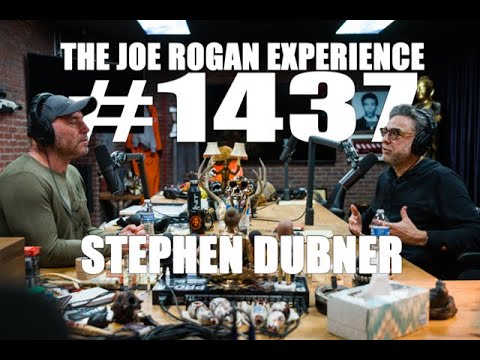
Joe Rogan Experience #1437 - Stephen Dubner
Joe Rogan (host), Narrator, Stephen Dubner (guest)
In this episode of The Joe Rogan Experience, featuring Joe Rogan and Narrator, Joe Rogan Experience #1437 - Stephen Dubner explores joe Rogan and Stephen Dubner Deconstruct Noise, Risk, Faith, and Progress Joe Rogan and Freakonomics host Stephen Dubner range across topics from noise pollution, drugs, and creativity, to tribal politics, religion, technology, and combat sports. They examine how people seek altered states—through cannabis, breathing, walking, or alcohol—and how modern noise and screens erode solitude and attention. Dubner brings an economist’s lens to externalities, health, social media, climate, and incentives, while Rogan counters with lived experience and cultural observation. Throughout, they return to how humans change their minds, form tribes, handle risk, and remain oddly optimistic amid unprecedented prosperity and confusion.
Joe Rogan and Stephen Dubner Deconstruct Noise, Risk, Faith, and Progress
Joe Rogan and Freakonomics host Stephen Dubner range across topics from noise pollution, drugs, and creativity, to tribal politics, religion, technology, and combat sports. They examine how people seek altered states—through cannabis, breathing, walking, or alcohol—and how modern noise and screens erode solitude and attention. Dubner brings an economist’s lens to externalities, health, social media, climate, and incentives, while Rogan counters with lived experience and cultural observation. Throughout, they return to how humans change their minds, form tribes, handle risk, and remain oddly optimistic amid unprecedented prosperity and confusion.
Key Takeaways
Noise is an invisible externality that affects people very differently.
Dubner frames noise as a 'negative externality' like pollution: one person creates it, another pays the cost. ...
Get the full analysis with uListen AI
Altered states can spur creativity, but they’re unpredictable and risky.
Rogan describes intentionally taking heavy cannabis edibles before flights to induce intense, sometimes scary introspection that fuels writing and insight. ...
Get the full analysis with uListen AI
Moderate drinking may correlate with longer life due to stress relief and social benefits.
Dubner cites research and his physician’s view that people who drink a small amount daily often outlive both heavy drinkers and abstainers, possibly because alcohol eases stress and helps social connection—though causality isn’t fully understood.
Get the full analysis with uListen AI
Religion provides community, moral scaffolding, and humility, despite logical flaws.
Using his parents’ conversion from Judaism to Catholicism and the painful family rupture that followed, Dubner argues religion has real social and psychological benefits (community, ethics, humility, incentives for good behavior) even if its doctrines are scientifically dubious.
Get the full analysis with uListen AI
Tribal identity makes changing one’s mind socially costly and politically dangerous.
They discuss how party and community identities lock people into bundles of positions (on guns, abortion, climate) because dissent can mean ostracism. ...
Get the full analysis with uListen AI
Modern politics rewards entertainment value over competence and nuance.
Rogan characterizes Trump as effectively doing standup—branding opponents with nicknames, improvising, and commanding attention—while noting that having a popularity contest to control nuclear weapons is 'fucking stupid. ...
Get the full analysis with uListen AI
We’re richer, healthier, and safer than ever, yet many remain unhappy.
Dubner points out global gains in longevity, literacy, and material well-being, then explores theories of rising suicide in rich societies (like the 'no one left to blame' idea) where personal suffering can feel like a solely individual failure rather than a circumstantial one.
Get the full analysis with uListen AI
Notable Quotes
“Noise is what economists call a negative externality, meaning you can produce it and it affects me, but I can’t charge you for it.”
— Stephen Dubner
“I oftentimes take a heavy dose of edibles and then get on a plane… It fires up whatever it is that creates creativity for me.”
— Joe Rogan
“Religion is like a scaffolding to live your life by… it gives people a benefit and a real sense of community.”
— Joe Rogan
“I love changing my mind. I love hearing somebody make an argument that makes me say, ‘Oh, the way I thought about that before… now I appreciate the opportunity to change my mind.’”
— Stephen Dubner
“You shouldn’t have a goddamn popularity contest to see who controls thermonuclear weapons. That’s fucking stupid.”
— Joe Rogan
Questions Answered in This Episode
How can individuals deliberately build more silence and boredom into their lives to counter constant digital stimulation and recover deeper thinking?
Joe Rogan and Freakonomics host Stephen Dubner range across topics from noise pollution, drugs, and creativity, to tribal politics, religion, technology, and combat sports. ...
Get the full analysis with uListen AI
If we accept that moderate alcohol and strong community both improve health, how should public health messaging and policy balance discouraging abuse with preserving these benefits?
Get the full analysis with uListen AI
What practical strategies can help people loosen tribal identities so they can change their minds without losing their social world?
Get the full analysis with uListen AI
Given the clear risks of sports like football and MMA, where should society draw the line between protecting people and respecting their freedom to choose dangerous careers?
Get the full analysis with uListen AI
As technology advances toward life extension and brain–machine interfaces, how can we avoid creating an unbridgeable gap between the enhanced 'haves' and the unenhanced 'have-nots'?
Get the full analysis with uListen AI
Transcript Preview
... ready, young Jamie.
Three, two-
Here we go. (slaps desk) How are you, sir?
I'm great, thanks.
(laughs) Good. Nice to meet you.
Nice to meet you.
Um, we were talking before, uh, about Adam Curry, who was just here, who has these crazy ear enhancements that are these, uh, software-based, so he can tweak it and change levels and stuff like that. And you were saying that you also have h- hearing, but you get it from rock and roll.
Yeah, I, I mean, honestly, I've never been tested. I just know that when I'm out eating with my family or friends, that everybody can hear everything, and I can't hear anything. (laughs)
Yeah.
So, uh, but no, I, yeah, I played r- loud rock music for, mm, six, seven, eight, nine years. And, uh, yeah, it- it- it- it does what they say it does. (laughs)
Yeah, they- they know what they're doing-
(laughs)
... those, those people that tell you not to do that.
But look, I like the technology. Like, I have older relatives who have a hearing aid, or whatever they're called now, hearing enhancement devices that are, like, lightyears better than they used to be.
Oh, yeah, yeah, yeah.
So I figure if I can hold out a couple more years, mine are gonna, like, be so good they'll take out the garbage too.
Well, the ones that Adam has sound pretty fucking amazing. Um, he said it, it just sounds incredible and that he can actually tune into people that are 50 feet away, 50 feet away having a conversation, he can hear them.
And can you tune out people you don't like?
That's a good question. I bet there is a way. I bet he ... Well, he has various settings, but I bet there's, like, a tone the world out setting.
(laughs) I don't need to tone the world, there are just some people-
Sometimes.
... you know?
Yeah. Have you used any of those AirPods that have the noise-canceling technology?
Oh, uh, not AirPods, but I wear Bose noise-cancelers-
The head- headphones?
... almost-
Yeah.
... every day. Um, I wear them a lot. Oh, you know, when I started, uh, as a journalist in newsrooms, uh, this was, whatever, early, late 80s, early 90s, um, I didn't ... Like, a- a newsroom is an open place, and a lot of people back then were on the phone doing your reporting. It was pre-internet reporting, right? And, uh, I didn't ... You're a writer, you're writing and you're editing, and I, I didn't understand how people could think with all this din going on. I c- I couldn't do it.
Yeah.
So I started wearing just the good foam earplugs. They're made by, uh, Flance, I think is the brand that I use. They're kinda non-tapered, and they're very thick. And if you compress them and put them in, it'll block out, like, you know, 70, 80%. So I've been shutting out the world for, like, 25 years now.
Install uListen to search the full transcript and get AI-powered insights
Get Full TranscriptGet more from every podcast
AI summaries, searchable transcripts, and fact-checking. Free forever.
Add to Chrome