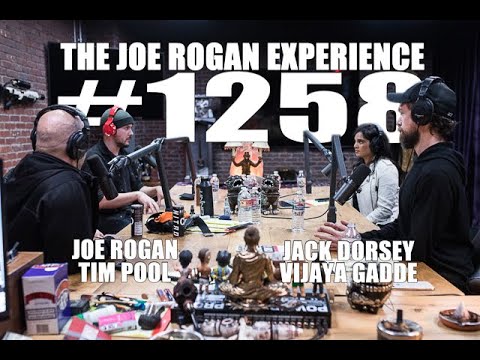
Joe Rogan Experience #1258 - Jack Dorsey, Vijaya Gadde & Tim Pool
Joe Rogan (host), Jack Dorsey (guest), Tim Pool (guest), Vijaya Gadde (guest), Vijaya Gadde (guest)
In this episode of The Joe Rogan Experience, featuring Joe Rogan and Jack Dorsey, Joe Rogan Experience #1258 - Jack Dorsey, Vijaya Gadde & Tim Pool explores twitter’s Power, Bias, And Free Speech Clash In Three-Hour Showdown Joe Rogan hosts Twitter CEO Jack Dorsey, policy chief Vijaya Gadde, and journalist Tim Pool for an extended, confrontational but civil debate about Twitter’s content moderation and perceived political bias. They dissect high‑profile bans (Milo Yiannopoulos, Alex Jones, Meghan Murphy, Proud Boys), controversial policies like misgendering rules, and mob‑driven reporting and “dogpiling.” Gadde and Dorsey argue their aim is protecting users from harassment and real‑world harm, while Pool insists Twitter’s rules and enforcement align with a progressive ideology and are undermining U.S. free‑speech norms. The conversation ends with no resolution but clearer articulation of Twitter’s thinking, promises of more transparency and possible “paths to redemption,” and Pool’s warning that current trends are driving polarization and could invite heavy-handed government regulation.
Twitter’s Power, Bias, And Free Speech Clash In Three-Hour Showdown
Joe Rogan hosts Twitter CEO Jack Dorsey, policy chief Vijaya Gadde, and journalist Tim Pool for an extended, confrontational but civil debate about Twitter’s content moderation and perceived political bias. They dissect high‑profile bans (Milo Yiannopoulos, Alex Jones, Meghan Murphy, Proud Boys), controversial policies like misgendering rules, and mob‑driven reporting and “dogpiling.” Gadde and Dorsey argue their aim is protecting users from harassment and real‑world harm, while Pool insists Twitter’s rules and enforcement align with a progressive ideology and are undermining U.S. free‑speech norms. The conversation ends with no resolution but clearer articulation of Twitter’s thinking, promises of more transparency and possible “paths to redemption,” and Pool’s warning that current trends are driving polarization and could invite heavy-handed government regulation.
Key Takeaways
Twitter frames moderation as behavior-based harm reduction, not viewpoint policing.
Gadde and Dorsey repeatedly say rules target abuse, harassment, and threats that drive users off the platform, not specific ideologies—though Pool argues the behavior rules themselves encode left‑leaning assumptions.
Get the full analysis with uListen AI
Enforcement at scale is messy, inconsistent, and highly context-dependent.
Hundreds of millions of tweets and relatively few reviewers, plus imperfect algorithms, mean errors, uneven prioritization, and reliance on reporting queues—fueling perceptions of bias when similar cases get different outcomes.
Get the full analysis with uListen AI
The misgendering/deadnaming rule is a clear ideological flashpoint.
Twitter justifies it with suicide and bullying data about trans youth, but Pool and Rogan argue it directly conflicts with many conservatives’ beliefs and even basic biological framing, making it feel like an imposed worldview rather than neutral safety policy.
Get the full analysis with uListen AI
High-profile bans emerge from “pattern and practice,” not single tweets—at least in Twitter’s account.
In cases like Milo Yiannopoulos and Alex Jones, Gadde cites multiple past violations, doxxing, doctored-content incitement, and repeated harassment to argue bans followed cumulative behavior, not one controversial moment.
Get the full analysis with uListen AI
Perceived asymmetry (Proud Boys banned, Antifa active; threats against right tolerated) drives conservative distrust.
Pool presents numerous examples where right‑wing figures are permanently banned while left‑wing or Antifa‑aligned accounts making threats or doxxing appear to receive lighter penalties or none, reinforcing a one‑directional bias narrative.
Get the full analysis with uListen AI
Deplatforming may push extremists into more radical, isolated ecosystems.
Pool warns that bans don’t make bad ideas disappear; they concentrate them on fringe platforms, help build parallel financial and social infrastructure, and intensify grievance and polarization beyond mainstream scrutiny.
Get the full analysis with uListen AI
Twitter expects more transparency and “paths to redemption” will be necessary.
Gadde says permanent bans are too blunt, outlines plans for clearer, simpler rules, public case studies of enforcement decisions, and internal work on time‑bound suspensions and potential reinstatement mechanisms.
Get the full analysis with uListen AI
Notable Quotes
““Do you really want corporations to police what’s true and not true?””
— Jack Dorsey
““Twitter, by definition, is a biased platform in favor of the left, period.””
— Tim Pool
““Our intent is not to police ideology; our intent is to police behaviors that we view as abuse and harassment.””
— Vijaya Gadde
““Sunlight is the best disinfectant… If we banned that account early on, she would have never left the church.””
— Jack Dorsey (on Megan Phelps-Roper leaving Westboro Baptist Church after engaging on Twitter)
““I think what you’re doing is wrong and it’s oppressive and ideologically driven… but nothing’s going to change.””
— Tim Pool
Questions Answered in This Episode
Does any large social platform have a realistic way to moderate abuse at scale without being perceived as politically biased?
Joe Rogan hosts Twitter CEO Jack Dorsey, policy chief Vijaya Gadde, and journalist Tim Pool for an extended, confrontational but civil debate about Twitter’s content moderation and perceived political bias. ...
Get the full analysis with uListen AI
Should private tech companies with outsized influence on public discourse be bound by First Amendment-like standards, or do they need broader leeway to police harm?
Get the full analysis with uListen AI
Is Twitter’s misgendering policy a necessary protection for a vulnerable group or an enforced ideological position that undermines open debate?
Get the full analysis with uListen AI
Do deplatforming and payment bans actually reduce harm, or do they accelerate radicalization and create dangerous parallel ecosystems?
Get the full analysis with uListen AI
What kind of independent oversight or “jury” system, if any, could fairly review major moderation decisions and rebuild public trust in platforms like Twitter?
Get the full analysis with uListen AI
Transcript Preview
Five, four, three, dos, uno. Come on, TriCaster.
Yeah.
Live?
Yes. So-
All right. We're live, ladies and gentlemen. To my left, uh, Tim, Tim Pool.
(clears throat)
Everybody knows and loves him. Vijaya, what is it, how do you, how do I pronounce your last name?
Vijaya.
Vijaya Gadde.
Vijaya, not Vijaya, Vijaya.
Yes.
Vijaya...
Gadde.
Gadde. And your position at Twitter is?
I lead trust and safety, legal, and public policy.
That's a lot. That's a lot. And Jack Dorsey, ladies and gentlemen. Um, first of all, thank you everybody for doing this. Appreciate it.
Thank you.
Thank you.
Feels, th- there feels-
(clears throat)
... all of a sudden there's tension in the room.
(laughs)
(laughs)
We were all loose, we were all loosey-goosey just a few minutes ago.
There's no tension. There's no tension.
And everyone's like, "Uh-oh, this is really happening." Here we go. Um, before we get started, we should say, because there were some, uh, things that people wanted to, uh, have us talk about. Um, one, that the Cash App is one of the sponsors of the podcast. It's been a sponsor for a long time and also a giant supporter of my good friend, Justin Wren's, Fight for the Forgotten Charity, building wells for the Pygmies in the Congo. This is very important to me and I'm very happy that you guys are a part of that, and you are connected to that. I don't, uh, that's, I mean, it's easy for someone to say that doesn't have an influence on the way we discuss things, but it doesn't. So, if it does, I don't know what to tell you. Um...
I'm gonna mention too, just 'cause I don't want people to come out and freak out later, I actually have like 80 shares in Square, which isn't really that much, and you know, but...
But it's something.
It is, it is. So I don't want people to think, you know, whatever, you, you're the CEO of Square, I think, right?
Yep.
Yeah, there you go.
Okay. Yeah.
Yeah, we own-
There you go.
Okay.
We own the Cash App too.
And the reason why we decided to come together is, um, we had a, I thought, a great conversation last time. But there's a lot of people that were upset that there were some issues that we didn't discuss, or didn't discuss in depth enough, or they felt that I didn't press you enough. I talked to Tim because, uh, you know, Tim and I have talked before and he-
(clears throat)
... made a video about it, and I felt like his criticism was very valid. So we got on the phone and we talked about it, and I knew immediately within the first few minutes of the conversation that he was far more educated about this than I was. So I said, "Would you be willing to do a podcast, and perhaps do a podcast with Jack?" And he said, "Absolutely." So we did a podcast toge- together. It was really well received. People felt like we covered a lot of the issues that, um, they felt like I didn't bring up. And so then Jack and I discussed it and we said, "Well, let's bring Tim on and then have Vijaya on as well." I said that right?
Install uListen to search the full transcript and get AI-powered insights
Get Full TranscriptGet more from every podcast
AI summaries, searchable transcripts, and fact-checking. Free forever.
Add to Chrome