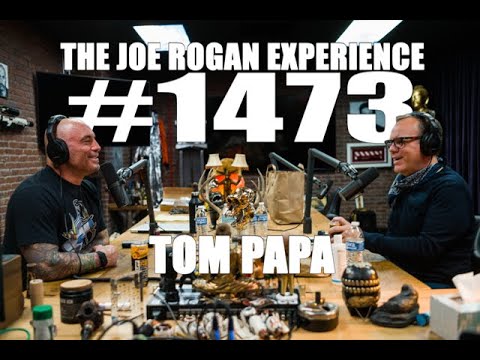
Joe Rogan Experience #1473 - Tom Papa
Joe Rogan (host), Tom Papa (guest), Jamie Vernon (guest), Robin Black (guest), Joey Diaz (guest), Narrator, Weijia Jiang (guest), Donald Trump (guest), Narrator
In this episode of The Joe Rogan Experience, featuring Joe Rogan and Tom Papa, Joe Rogan Experience #1473 - Tom Papa explores joe Rogan and Tom Papa Debate Lockdowns, Health, and Human Resilience Joe Rogan and Tom Papa spend the episode wrestling with the COVID-19 lockdowns: how long they can realistically last, what they’re doing to the economy, and how officials are balancing public health against financial collapse.
Joe Rogan and Tom Papa Debate Lockdowns, Health, and Human Resilience
Joe Rogan and Tom Papa spend the episode wrestling with the COVID-19 lockdowns: how long they can realistically last, what they’re doing to the economy, and how officials are balancing public health against financial collapse.
They argue that broad stay-at-home orders are unsustainable, advocating instead for better protection of high‑risk groups, more personal responsibility, and public education on strengthening the immune system.
The conversation expands into cultural side paths: absurd pandemic rules, stand‑up comedy’s shutdown, fighting sports, old boxing legends returning, hunting and food, and the psychological impact of uncertainty.
Underlying it all is a tension between fear and freedom: how much risk a free society should accept, and how much control government should exercise in a crisis.
Key Takeaways
Blanket lockdowns are economically and socially unsustainable.
Rogan and Papa note that even optimistic reopening estimates leave a huge portion of the population out of work, devastate small businesses, and create long‑term economic damage that policymakers seem ill‑equipped to solve.
Get the full analysis with uListen AI
Targeted protection of high‑risk groups may be a better strategy.
They argue it makes more sense to strongly shield older, obese, or medically vulnerable people while allowing the low‑risk majority to work and move more freely, rather than freezing the entire population indefinitely.
Get the full analysis with uListen AI
Public health messaging is confused and sometimes counterproductive.
They highlight shifting guidance on masks and the absence of official messaging about proven health basics—sleep, exercise, vitamin D/C, zinc, weight control—while governments expend energy on detailed but arbitrary activity lists.
Get the full analysis with uListen AI
Immune system strength is a modifiable factor that’s being ignored.
Drawing on examples from prisons and everyday life, they speculate that constant, low‑level microbial exposure and healthy habits fortify immunity, and worry that extreme isolation may ‘atrophy’ immune systems for future threats.
Get the full analysis with uListen AI
Government power, once expanded, is hard to roll back.
Rogan is wary that officials are getting comfortable dictating minutiae of daily life, and questions how easily they will relinquish that control once people are used to being told what they can and cannot do.
Get the full analysis with uListen AI
The pandemic is forcing a reevaluation of careers and lifestyles.
Both comics admit that nonstop touring and travel were physically brutal; with everything paused, they’re reconsidering residencies, reduced travel, and more sustainable ways to perform—if live events ever fully return.
Get the full analysis with uListen AI
Crises reveal how fragile and unequal modern systems are.
From empty grocery shelves and meat shortages to universities going online and entire service industries collapsing, the conversation underlines how quickly a shock can upend lives, especially for those who ‘did everything right’ but had no cushion.
Get the full analysis with uListen AI
Notable Quotes
“I don't understand how we could take three more months off.”
— Joe Rogan
“With the herd, you've gotta tell them, 'No, dummy. Fish, no chair.'”
— Tom Papa
“If we say, ‘Save lives at all costs,’ we should all stop driving.”
— Joe Rogan
“I think we need to quarantine people that are at risk… and then let people make their own choices.”
— Joe Rogan
“This is a country where my government doesn't represent me. I have no recourse here.”
— Brian Callen (via phone, quoted by Joe Rogan)
Questions Answered in This Episode
Is a strategy of heavily protecting high‑risk groups while loosening restrictions for others ethically and practically workable, or does it create unacceptable inequality and danger?
Joe Rogan and Tom Papa spend the episode wrestling with the COVID-19 lockdowns: how long they can realistically last, what they’re doing to the economy, and how officials are balancing public health against financial collapse.
Get the full analysis with uListen AI
What specific, evidence‑based guidance on immune health and lifestyle could governments realistically promote without overstepping or spreading false hope?
They argue that broad stay-at-home orders are unsustainable, advocating instead for better protection of high‑risk groups, more personal responsibility, and public education on strengthening the immune system.
Get the full analysis with uListen AI
How much economic damage and small‑business loss is an acceptable trade‑off for reducing COVID‑19 deaths, and who should be empowered to make that calculation?
The conversation expands into cultural side paths: absurd pandemic rules, stand‑up comedy’s shutdown, fighting sports, old boxing legends returning, hunting and food, and the psychological impact of uncertainty.
Get the full analysis with uListen AI
In what ways might the normalization of emergency powers and granular behavioral rules during the pandemic permanently shift the relationship between citizens and the state?
Underlying it all is a tension between fear and freedom: how much risk a free society should accept, and how much control government should exercise in a crisis.
Get the full analysis with uListen AI
How will the disappearance or reshaping of live events, travel, and communal spaces change cultural life, creativity, and mental health over the next decade?
Get the full analysis with uListen AI
Transcript Preview
(sighs) Okay.
Mm-hmm.
So, what were you just saying, Jamie?
(sighs) We have LA's stay-at-home order will likely remain in place for the next three months unless there is a, quote, "dramatic change to the virus and tools at hand," officials say.
How are people supposed to feed themselves? Like, r- really, realistically, how do they expect this to work?
You go out to work, and then you skitter back home.
That's not what they're saying. That's not what stay at home means. Stay at home means you don't go to work.
Yeah. But at the same time, they're opening up businesses, right?
They're opening up very few businesses, and you have to get curbside for retail.
I heard our governor in the state of California say that 70% of businesses are open now.
Well, if that's the case, even if that was the case, let's say 30% of people are out of work.
Yes.
That's catastrophic.
Yeah., It's a lot.
And I don't think it's true. I don't- I don't think 70% of the places are open.
That's what he said, 70% of the businesses.
Well, even if they're open, they're not open at 100% capacity.
Or they're probably working from home, like offices, he's probably counting offices.
Hmm.
And those people are still working and getting paid, but they're doing it from home.
So, this is just LA?
LA County. Just LA, yeah, yeah.
So, that means, uh, like, Comedy Store has no chance?
(clicks tongue) Yeah, I believe it's for the county, yeah, so till July.
This is the same fuck-up who thought it would be a good idea to have people rat on people for money.
Technically, this was not coming from the mayor. This is coming from a health... someone in the Health Department talking at a supervisor meeting or something.
(sighs)
So, it was a suggestion, it wasn't a...
This is not-
Not an official order, but it's how it was coming, yeah.
Right. Right.
So, it's not an official order? Not an official order, but LA is the densest county in America. How about that?
Is it really?
Yeah.
More than New York?
Yeah. A- a- as a county.
Hmm. That seems odd, doesn't it?
It does seem odd. It seems like a lot of people.
Seems like New York City is... New York City is denser.
Yeah.
It's just... New York City is... The- the- the thing about New York City that makes it great is that everybody sort of mingles together.
Mm-hmm.
Everybody gets on the subway together, everybody walks together on the streets.
Yeah.
It's also the reason why everybody is getting sick together.
Yeah. But I saw an interesting thing, that the highest... This guy wrote an editorial about, uh, the reasons for New York, and he lives in New York, and he says Staten Island had the highest number. This was written before... I think Brooklyn has now edged it, but at the time, uh, that Staten Island was the highest and it was the least densely populated. And Manhattan, which is the most densely populated, had the fewer number of cases.
Install uListen to search the full transcript and get AI-powered insights
Get Full TranscriptGet more from every podcast
AI summaries, searchable transcripts, and fact-checking. Free forever.
Add to Chrome