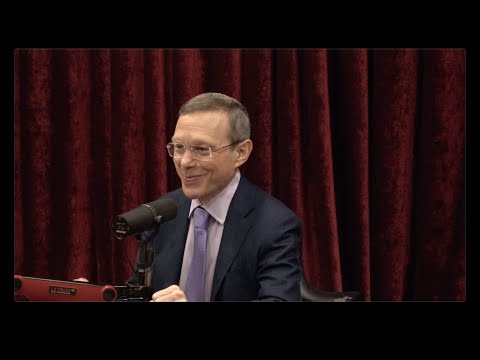
Joe Rogan Experience #2401 - Avi Loeb
Joe Rogan (host), Avi Loeb (guest), Narrator
In this episode of The Joe Rogan Experience, featuring Joe Rogan and Avi Loeb, Joe Rogan Experience #2401 - Avi Loeb explores avi Loeb argues interstellar object 3I Atlas may be alien tech Astrophysicist Avi Loeb joins Joe Rogan to discuss 3I Atlas, the third known interstellar object, and why he believes its size, trajectory, outgassing, and composition are anomalous compared to known comets. He argues that the scientific community and governments are irrationally conservative and politically driven, blocking open consideration of extraterrestrial technology despite potentially civilization‑level implications. Loeb outlines his Galileo Project, new observatories (including one atop the Las Vegas Sphere), and ideas for interceptor missions to study future interstellar visitors up close. The conversation broadens into AI risks, scientific jealousy, dark matter, Mars structures, panspermia, and how discovering alien intelligence could reshape humanity’s self‑image and priorities.
Avi Loeb argues interstellar object 3I Atlas may be alien tech
Astrophysicist Avi Loeb joins Joe Rogan to discuss 3I Atlas, the third known interstellar object, and why he believes its size, trajectory, outgassing, and composition are anomalous compared to known comets. He argues that the scientific community and governments are irrationally conservative and politically driven, blocking open consideration of extraterrestrial technology despite potentially civilization‑level implications. Loeb outlines his Galileo Project, new observatories (including one atop the Las Vegas Sphere), and ideas for interceptor missions to study future interstellar visitors up close. The conversation broadens into AI risks, scientific jealousy, dark matter, Mars structures, panspermia, and how discovering alien intelligence could reshape humanity’s self‑image and priorities.
Key Takeaways
Treat anomalous interstellar objects as potential black swan events.
Loeb argues that while the probability any single object is alien tech may be low, the impact on finance, politics, and human history could be enormous, so intelligence agencies and scientists should investigate anomalies like 3I Atlas with the same seriousness they apply to rare but catastrophic risks.
Get the full analysis with uListen AI
3I Atlas shows multiple anomalies inconsistent with a standard comet.
He cites its enormous inferred mass (~33 billion tons, ~5+ km diameter), trajectory aligned with the planetary plane, unusual sun‑facing jet/anti‑tail, low water content, and nickel‑rich but iron‑poor plume—features unlike typical comets and suggestive (to him) of possible technological or industrial origin.
Get the full analysis with uListen AI
We need dedicated, systematic sky monitoring and intercept missions.
Loeb proposes building Rubin‑like survey telescopes in both hemispheres plus a fleet of space interceptors to closely image or even land on future interstellar objects, arguing that a single clear encounter would instantly justify reallocating a fraction of the $2. ...
Get the full analysis with uListen AI
Search for intelligence deserves funding comparable to search for microbes.
He notes that astronomy is committing $10B+ to find biosignatures of microbial life on exoplanets but virtually nothing to technosignatures or interstellar artifacts, calling this an oversight given how much more transformative an encounter with advanced intelligence would be.
Get the full analysis with uListen AI
Scientific gatekeeping and jealousy can suppress novel interpretations.
Loeb recounts editors forcing removal of a sentence about possible artificial targeting in a 3I Atlas paper and public/media attacks on his interstellar meteor expedition, framing this as a cultural problem where risk‑averse, status‑protective scientists stifle imaginative but testable hypotheses.
Get the full analysis with uListen AI
Independent, instrument‑based UAP studies are essential beyond government data.
Skeptical of stories without hard evidence, Loeb is building the Galileo Project’s sensor arrays (e. ...
Get the full analysis with uListen AI
Long‑term human survival requires interstellar thinking, not just Mars.
He argues Mars is a harsh “banana‑less jungle” compared to purpose‑built space habitats with artificial gravity and robust shielding, and that truly “fit” civilizations in a cosmic Darwinian sense will become interstellar, leaving durable technological monuments that outlast planets and stars.
Get the full analysis with uListen AI
Notable Quotes
“Common sense is not common in academia.”
— Avi Loeb
“Extraordinary evidence requires extraordinary funding.”
— Avi Loeb
“This is a blind date of interstellar proportions.”
— Avi Loeb
“One reason I’m seeking intelligence in interstellar space is I don’t often find it in academia.”
— Avi Loeb
“We don’t need the government to tell us what is up there in the sky because astronomy is all about that.”
— Avi Loeb
Questions Answered in This Episode
What concrete observational or experimental test would most decisively distinguish a strange natural comet from genuine alien technology in the case of 3I Atlas?
Astrophysicist Avi Loeb joins Joe Rogan to discuss 3I Atlas, the third known interstellar object, and why he believes its size, trajectory, outgassing, and composition are anomalous compared to known comets. ...
Get the full analysis with uListen AI
How should the scientific community balance skepticism with openness when the potential payoff—evidence of extraterrestrial intelligence—is so high but the data are ambiguous?
Get the full analysis with uListen AI
If the best Mars and lunar images revealed clear artificial structures, how should global governments and institutions manage dissemination and response?
Get the full analysis with uListen AI
What governance and ethical framework would be needed for a well‑funded, Manhattan‑Project‑style effort to monitor and intercept interstellar objects?
Get the full analysis with uListen AI
Given the parallel risks from AI and potential alien intelligence, how should humanity prioritize investments between defending against threats and learning from superior civilizations?
Get the full analysis with uListen AI
Transcript Preview
(drumming music plays) Joe Rogan podcast, check it out.
The Joe Rogan Experience.
Train by day, Joe Rogan podcast by night, all day. (rock music plays) All right. Good to see you, sir.
Great to be with you, Joe.
It's a perfect time to bring you on because, uh, things are getting very wild.
Yeah, there is a lot of misinformation. You know, some people said I invented 3I Atlas, this object, uh, in order to distract attention from the Epstein files.
Is that what-
And, and-
... people are saying?
(laughs) Yeah. And I said, "Look, this object-"
(laughs)
"... is the size of Manhattan Island. It's at, uh, four and a half times the earth-sun separation. Um, if I was able to put it out there, you know, the, uh, I would be more powerful than the Pope."
(laughs)
And because we're talking about-
(sighs)
... a giant object that you can see from any place on earth, you know, you can buy online, uh, uh, uh, a telescope that, uh, will allow you, uh, l- half a meter in size, that will allow you to see it. It's out there. Uh, it cannot be faked.
Well, those people are fools. You can't listen to those people.
I don't listen to those ... I d- I don't listen to many people, you know.
Uh, initially, a lot of people were dismissing your concerns and they were saying that this object is nothing but a comet and it's very normal. Uh, but then as it got closer and as we got more data, it seems like you're correct.
Well, I, I have-
This is a very unusual object.
There is something really important to recognize here that d- usually when you deal with scientific matters, they have very little impact on the future of humanity, very little. You know, if the neutrino has a little bit of a mass, doesn't really matter, you know, when we discovered the Higgs boson, the biggest impact was to confirm some idea we had back in the '60s and, uh, uh, you know, obviously that affected, uh, you know, the, those people who got the Nobel Prize, but m- most of us continued, uh, as if nothing happened. However, here, if we ever encounter alien technology, everything will change. It will affect the financial markets. It will affect politics in a major way. So my point is simple. This is different than other scientific matters, and the intelligence agencies know very well that events with very small probability have to be considered seriously because they have m- they could have major implications. Just think about October 7th. The Israeli intelligence agencies had a theory that the Hamas will do nothing, and they got data that indicated something is going on out there, but they dismissed it because of their theory. Now, because as a result of their mistake, which was clearly a blunder, a lot of people died on both sides for... that... This could have been avoided if they were to consider a black swan event, an event that you put a small probability for it happening, but you look at anomalies in the data and say, "Look, the implications are so huge, we have to consider it." And, you know, this idea was already considered by the philosopher-mathematician Blaise Pascal. He talked about God, and he said, "Look, of course you might think that God doesn't exist, the probability for that is small, but the implications, if God exists, the implications are so huge that we have to discuss it." That was the argument, Pascal's wager, and the intelligence agencies know that. Believe me, the Israeli intelligence agencies will not make that mistake again. Now, here comes an object from outside the solar system and it shows anomalies. The scientist would say, "We should be as careful as possible at talking a- about anything other than a rock." Now, they say that when they know that we launched, humanity launched a lot of space junk, you know, a lot of technological objects through space, and we also know that there are a hundred billion stars like the sun in the Milky Way galaxy alone. Most of them formed billions of years before the sun, and there are billions of earth-sun analogs. Now, we all believe that we came out of a soup of chemicals. You know, that's the scientific narrative of how human intelligence came on this earth. And so it's quite likely that, you know, we are not the first one. Sorry to break the news, uh, Elon Musk was probably not the most accomplished space entrepreneur since the Big Bang 13.8 billion years ago, and therefore, we should consider the possibility that things like us existed long before us. And you can ask the question, how long does it take our own technology, the Voyager spacecraft that we launched out of the solar system, how long does it take it to move to the opposite side of the Milky Way galaxy? You know, thousands of light years away, takes less than a billion years. And that means that all these civilizations that had their history initiated billions of years before ours could have done it. And all we need to do as responsible scientists is to check if among all the rocks that come from outside of our backyard are really rocks or maybe one of these objects might be a tennis ball that was thrown by a neighbor. And the reason I say that is, you know, we live at our home, at our, uh, uh, at the, uh, on earth, uh, next to the sun, we look around us in the cosmic street, and we see a lot of houses just like ours. There are billions of them probably. Now, my colleagues, those scientists who think traditionally, they say, "Well, you know, microbes came to earth very early, therefore they must be everywhere. So let's define our highest priority searching for microbes on other houses in our cosmic street." And I say-Good. You can do that from the vantage point of your home. You can look through the window and search for microbes in your neighbors' yards. But you would need to put $10 billion to develop a big enough instrument that would be able to detect the chemical fingerprints of microbes, you know, on exoplanets. Uh, and think about the possibility that there was actually, there is a resident in one of those houses. You know, that resident might show up in your front door-
Install uListen to search the full transcript and get AI-powered insights
Get Full TranscriptGet more from every podcast
AI summaries, searchable transcripts, and fact-checking. Free forever.
Add to Chrome