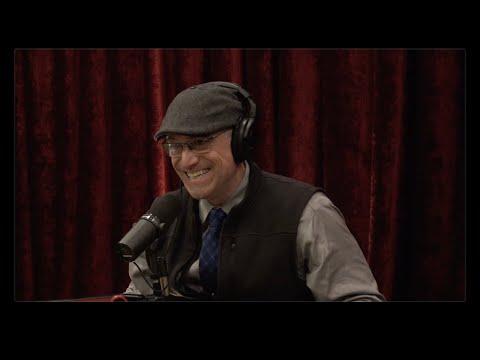
Joe Rogan Experience #2357 - Sarko Gergerian
Sarko Gergerian (guest), Joe Rogan (host), Narrator
In this episode of The Joe Rogan Experience, featuring Sarko Gergerian and Joe Rogan, Joe Rogan Experience #2357 - Sarko Gergerian explores police Lieutenant Champions Psychedelics To Heal Trauma And Reform Policing Joe Rogan speaks with Massachusetts police lieutenant and therapist Sarko Gergerian about using psychedelics to treat first-responder trauma and rethinking the war on drugs. Gergerian recounts discovering MDMA-assisted therapy through Rick Doblin and MAPS, his own mystical treatment experience, and the staggering PTSD and suicide rates among law enforcement. They critique Schedule I drug laws, trace the political and economic roots of prohibition from cannabis to psychedelics, and argue for regulated safe supply rather than cartel-controlled black markets. The conversation closes with concrete examples of “recovery-oriented community policing” and a call to reorient law enforcement toward guardianship and public health.
Police Lieutenant Champions Psychedelics To Heal Trauma And Reform Policing
Joe Rogan speaks with Massachusetts police lieutenant and therapist Sarko Gergerian about using psychedelics to treat first-responder trauma and rethinking the war on drugs. Gergerian recounts discovering MDMA-assisted therapy through Rick Doblin and MAPS, his own mystical treatment experience, and the staggering PTSD and suicide rates among law enforcement. They critique Schedule I drug laws, trace the political and economic roots of prohibition from cannabis to psychedelics, and argue for regulated safe supply rather than cartel-controlled black markets. The conversation closes with concrete examples of “recovery-oriented community policing” and a call to reorient law enforcement toward guardianship and public health.
Key Takeaways
Psychedelics can be powerful tools for healing first-responder trauma.
Gergerian highlights MDMA’s high efficacy in treating severe, treatment-resistant PTSD and shares his own mystical experience, arguing that denying these tools to police and veterans during a suicide epidemic is ethically indefensible.
Get the full analysis with uListen AI
Schedule I drug policy is scientifically and morally misaligned.
Both speakers stress that classifying substances like psilocybin and MDMA as having “no medical use” is a proven lie, maintained by outdated narratives and political fear rather than current evidence.
Get the full analysis with uListen AI
The war on drugs harms both communities and law enforcement.
Criminalizing nonviolent drug use, especially around plants like cannabis, inflicts “moral injury” on officers enforcing laws they know are unjust and disproportionately cages Black and brown communities.
Get the full analysis with uListen AI
Economic and political interests drove much of drug prohibition.
They recount how hemp was targeted by media baron William Randolph Hearst to protect his paper and timber interests, and how the 1970s drug crackdown was used to suppress civil rights and anti-war movements.
Get the full analysis with uListen AI
Safe, regulated supply is safer than prohibition-driven black markets.
Rogan and Gergerian argue that illegality creates dangerous, adulterated supply controlled by cartels or criminal organizations, as seen with fentanyl-laced cocaine, echoing lessons from alcohol Prohibition.
Get the full analysis with uListen AI
Decriminalization must be paired with structure, services, and clear rules.
They cite Oregon’s troubled rollout—public open-air use, encampments, and lack of support—as a warning that decriminalization without funding, public order norms, and treatment infrastructure can backfire.
Get the full analysis with uListen AI
Recovery-oriented community policing can transform the role of cops.
Gergerian describes Winthrop’s CLEAR program, where officers proactively follow up on public health-related calls to connect people with services instead of charges, reframing police as guardians and partners in recovery.
Get the full analysis with uListen AI
Notable Quotes
“Men and women are dying and suffering needlessly at the level of an epidemic, and we’re upholding a lie.”
— Sarko Gergerian
“Anyone who’s a law enforcement officer that’s arresting someone for weed, they know that they’re not doing anything good.”
— Joe Rogan
“We’ve been stripped of our power to define what medicine is.”
— Sarko Gergerian
“If the most dangerous, toxic, and carcinogenic is available, and the least dangerous, helpful, non-addictive is not available, let’s fix that.”
— Sarko Gergerian
“I think psychedelic-assisted talk therapy is going to allow talk therapy to live up to its promise as a talking cure.”
— Sarko Gergerian
Questions Answered in This Episode
How could police departments practically implement recovery-oriented community policing models like CLEAR at scale without compromising public safety?
Joe Rogan speaks with Massachusetts police lieutenant and therapist Sarko Gergerian about using psychedelics to treat first-responder trauma and rethinking the war on drugs. ...
Get the full analysis with uListen AI
What regulatory framework would allow for safe, legal access to psychedelics while minimizing misuse and commercialization harms?
Get the full analysis with uListen AI
How do we shift public and political narratives around drugs enough that elected officials can openly support psychedelic therapies?
Get the full analysis with uListen AI
What safeguards are needed to ensure that psychedelic-assisted therapy is accessible to first responders, veterans, and low-income communities, not just the wealthy?
Get the full analysis with uListen AI
Looking at Oregon’s experience, what specific policy and funding mistakes should other states avoid when pursuing decriminalization or legalization reforms?
Get the full analysis with uListen AI
Transcript Preview
(drumbeats) Joe Rogan podcast, check it out.
The Joe Rogan Experience.
Train by day, Joe Rogan podcast by night, all day. (instrumental music plays)
What's up, Sark? How are you?
Hey. (laughs) How are you, Joe?
Good to see you.
Oh, it's great to see you. It's great to be here, man.
How did you, uh, meet Paul? S- so Paul Stamets-
Yeah.
... introduced me to you.
Yeah.
So, how'd you meet Paul?
Yeah. Um, so I was aware of Paul for quite some time. Um, and this past Psychedelic Science, um, I was shadowing, uh, people and, uh, work- working to help the people that went to the conference feel safe, just because of the, like, the, the nature of the, uh, environment that, that, that we're in now.
In what way?
Um, you know, like, so Psychedelic Science had, um, a lot of, uh, Jewish practitioners. Uh, they had invited Palestinian practitioners in, there was Arab practitioners there. So, there was a lot of, um, um, education around sensitive topics happening. You know, and, um, I was invited in, uh, just to be available to help people feel secure.
What were they worried about?
Um, yeah, uh, a- any protests building up, um-
Just because there was Jewish people and Palestinian people?
Well, you know, the nature of the environment, right? There's like, wars going on across the world.
Right, but this is a psychedelic conference, right?
This is a psychedelic conference. Yeah. Yeah, yeah, yeah, yeah, yeah.
And they're worried about protests breaking out at psychedelic conferences?
Possible protests, possible-
Hmm.
... people getting overwhelmed with emotion. Um-
Hmm.
You know, 'cause in Psychedelic Science 2023, there was a situation where when Dick- Rick Doblin was on stage, um, a group came in and disrupted his presentation, and they were allowed on stage to speak.
Oh boy.
Right? But that's a type of disruption, right?
Yeah.
And it, and it should be handled carefully, and, and Rick handled it like a master.
What did he do?
He l- he, he made space for them.
Oh, well, is that really the way to do it?
Well, it depends. It depends. It depends.
Yeah.
There's a time and a place, right? And I think Psychedelic Science 2025 did, did a wonderful job, um, hearing all the groups that wanted to be there, and allowing them to have space to speak from their hearts and minds.
Why don't you tell everybody what your background is?
Sure, sure. Um, so I am currently a law enforcement professional at the rank of lieutenant, um, out of Massachusetts. Um, I've been in law en-
You can tell by the accent.
(laughs) I mean, my accent's gonna kick in in, uh, on-
Install uListen to search the full transcript and get AI-powered insights
Get Full TranscriptGet more from every podcast
AI summaries, searchable transcripts, and fact-checking. Free forever.
Add to Chrome