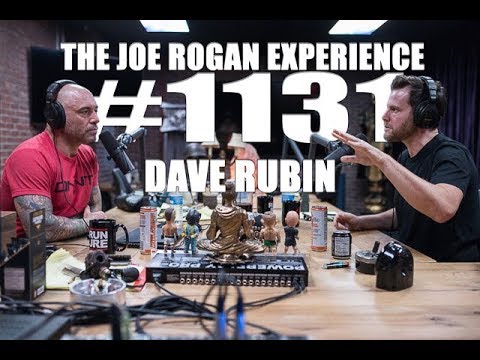
Joe Rogan Experience #1131 - Dave Rubin
Joe Rogan (host), Dave Rubin (guest), Narrator
In this episode of The Joe Rogan Experience, featuring Joe Rogan and Dave Rubin, Joe Rogan Experience #1131 - Dave Rubin explores dave Rubin And Joe Rogan Deconstruct Media, Politics, Outrage, And Masculinity Joe Rogan and Dave Rubin have a long-form, freewheeling conversation about post‑2016 politics, media dishonesty, identity politics, and the rise of figures like Jordan Peterson and the so‑called Intellectual Dark Web.
Dave Rubin And Joe Rogan Deconstruct Media, Politics, Outrage, And Masculinity
Joe Rogan and Dave Rubin have a long-form, freewheeling conversation about post‑2016 politics, media dishonesty, identity politics, and the rise of figures like Jordan Peterson and the so‑called Intellectual Dark Web.
They criticize mainstream journalism for click‑driven misrepresentation, especially around Jordan Peterson, and argue that long-form conversations are helping people bypass legacy media and think for themselves.
Rubin lays out a libertarian/classical liberal framework: pro‑individual rights, minimal federal government, strong states’ rights, and skepticism toward centralized economic and cultural control.
They also dive into campus protest culture, free speech, online outrage, personal responsibility, masculinity, and how podcasting and stand‑up have given them independent platforms outside traditional gatekeepers.
Key Takeaways
Long-form conversations are becoming an alternative to legacy media narratives.
Rubin and Rogan argue that podcasts and long interviews let people see full context instead of selectively edited clips, which is why figures like Peterson can survive hostile press and still grow.
Get the full analysis with uListen AI
Identity politics encourages prejudice by reducing people to demographic categories.
Rubin contends that judging people by race, gender, or sexuality—even in the name of social justice—is inherently racist/tribal and now more culturally dominant on the left than on the right.
Get the full analysis with uListen AI
A classical liberal/libertarian framework prioritizes the individual over the collective.
Rubin’s position is that government should primarily protect life and property, leave almost everything else to states and localities, and avoid central planning in economics and social life.
Get the full analysis with uListen AI
Campus activism often shuts down dialogue instead of engaging it.
Rubin recounts being shouted down and protested at universities, including by faculty, arguing many activists don’t want debate—they want to enforce ideological conformity through disruption.
Get the full analysis with uListen AI
Talking to controversial figures is not the same as endorsing them.
Rogan defends having guests like Alex Jones and Candace Owens, insisting that interviewing someone is about exploring ideas, not signing off on their entire worldview, and that refusing dialogue is dangerous.
Get the full analysis with uListen AI
Outrage and ‘cancel’ incentives distort public discourse.
They describe how journalists, Twitter users, and activists gain status and clicks by labeling opponents as racist/alt‑right and by weaponizing single tweets or consumer choices (e. ...
Get the full analysis with uListen AI
Personal responsibility, discipline, and competence are presented as antidotes to victimhood.
Echoing Peterson and Jocko Willink, Rogan and Rubin stress hard work, physical challenge, and building skills (e. ...
Get the full analysis with uListen AI
Notable Quotes
“You’re either basically for freedom… or you believe that the government should engineer things.”
— Dave Rubin
“The idea that you will look at people… and you’d go, ‘I have even the inkling of what you think because of that immutable characteristic,’ that is actual racism.”
— Dave Rubin
“When you stop talking to people, that’s when shit goes down.”
— Joe Rogan
“If things weren’t the way they are, there’d be no reason to be a libertarian.”
— Dave Rubin
“My drive is for the people that enjoy my work… We made an exchange. They came to see me, I made them laugh. Everybody’s happy.”
— Joe Rogan
Questions Answered in This Episode
How fair is Rubin’s claim that contemporary left‑wing identity politics is ‘more racist’ than the right, and what empirical evidence would actually settle that?
Joe Rogan and Dave Rubin have a long-form, freewheeling conversation about post‑2016 politics, media dishonesty, identity politics, and the rise of figures like Jordan Peterson and the so‑called Intellectual Dark Web.
Get the full analysis with uListen AI
Where should the line be drawn between a business owner’s freedom of conscience and anti‑discrimination protections (e.g., the baker and the gay wedding cake case)?
They criticize mainstream journalism for click‑driven misrepresentation, especially around Jordan Peterson, and argue that long-form conversations are helping people bypass legacy media and think for themselves.
Get the full analysis with uListen AI
Is it realistic—or even desirable—to push most policy decisions down to the state and local level in an interconnected, highly mobile country like the U.S.?
Rubin lays out a libertarian/classical liberal framework: pro‑individual rights, minimal federal government, strong states’ rights, and skepticism toward centralized economic and cultural control.
Get the full analysis with uListen AI
Does giving controversial figures large platforms ultimately reduce extremism by exposing ideas to scrutiny, or can it legitimize and spread harmful beliefs?
They also dive into campus protest culture, free speech, online outrage, personal responsibility, masculinity, and how podcasting and stand‑up have given them independent platforms outside traditional gatekeepers.
Get the full analysis with uListen AI
To what extent are men’s issues like incel culture and ‘toxic masculinity’ better addressed through cultural shifts (e.g., monogamy norms) versus individual development (skills, fitness, character)?
Get the full analysis with uListen AI
Transcript Preview
Five, four, three, two... (claps) Dave Rubin, ladies and gentlemen. How are you, buddy?
What's up, brother?
Dude, I haven't seen you, uh... Well, the last time we saw each other was just now. But before that was right before the election.
The day before the world changed-
Squirrely times.
... forever.
Squirrely.
Does not... Literally, it seems like a lifetime ago. Not even a lifetime ago, it, it, it's like a different life for me, I think it's a different life for you. Think about how much has changed for both of us in that time. But it seems like another planet-
Yeah.
... like an alternate universe the day before the election.
It is, in a lot of ways, right? I mean, people are... The world's going... Well, people are... The world's trying to find its footing.
Yes.
You know? It's a lot of craziness.
Well, I hate to tell you, Joe-
Uh-oh.
... but you are a little piece of the finding of the footing.
Hmm.
Because people are finding the footing. You know, I'm on tour with Peterson right now. I just got in this morning from Atlanta. And it's like, there is, without being hyperbolic, there is some kind of awakening happening right now. People are kinda getting their shit together. They're kinda sorting out things. They're... Through long form conversations, like we're all having and all these people that we're now connected with, there's something happening where people are going, "There's another way to make sense."
Mm-hmm.
"And, and let me figure out what that is." It doesn't mean we have all the answers, and I (laughs) sure as hell know I don't, and I don't think you think you do either. But we're at least giving them a little room to figure it out. And it's pretty cool.
Well, the thing about Peterson that's r- been fascinating is how many people misrepresent what he says to try to frame him, uh, him in a way that makes him evil and makes their position seem more ethical or more moral or better or more intellectual. There's so many articles being written about him almost on a daily basis-
It is-
... that misrepresent what he's saying.
... it's epic bullshit. I mean-
It's weird.
... that's all it is. These guys want clicks. That's all they want. I mean, I've... We've done about 20 shows in the last six weeks or so, bounced around from Nashville and Houston and Atlanta and Chicago and everywhere else. The crowds have been incredible. It's, it's probably split... You know, first off, they always go, "Oh, it's angry white men." That's the main thing. "It's all angry white men." Now, first off, let's say it was all angry white men there. That, in and of itself, doesn't mean it's bad. Let's say there was, like, a really disaffected group of angry white men that really felt like either masculinity had been compromised, or they couldn't get jobs, or they didn't feel good about their lives. Like, if there was someone talking to them that was helping them-
Install uListen to search the full transcript and get AI-powered insights
Get Full TranscriptGet more from every podcast
AI summaries, searchable transcripts, and fact-checking. Free forever.
Add to Chrome