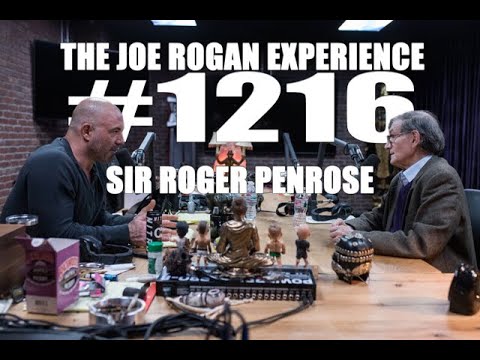
Joe Rogan Experience #1216 - Sir Roger Penrose
Joe Rogan (host), Sir Roger Penrose (guest)
In this episode of The Joe Rogan Experience, featuring Joe Rogan and Sir Roger Penrose, Joe Rogan Experience #1216 - Sir Roger Penrose explores roger Penrose Challenges Computation, Explores Consciousness, Black Holes, Eternity Roger Penrose explains why he believes human consciousness cannot be reduced to computation, drawing on Gödel’s incompleteness theorem, quantum mechanics, and open problems in physics.
Roger Penrose Challenges Computation, Explores Consciousness, Black Holes, Eternity
Roger Penrose explains why he believes human consciousness cannot be reduced to computation, drawing on Gödel’s incompleteness theorem, quantum mechanics, and open problems in physics.
He outlines the Penrose–Hameroff theory that quantum processes in neuronal microtubules may underlie conscious experience, while acknowledging its speculative and controversial status.
Penrose then shifts to cosmology: black holes, singularities, Hawking radiation, and his conformal cyclic cosmology, in which our Big Bang is the compressed future of a previous universe (eon).
He also discusses dark matter/energy, the limits of multiverse and many‑worlds explanations, the tenuous search for extraterrestrial intelligence, and the difficulty of doing serious but non‑mainstream science without drifting into ‘woo’.
Key Takeaways
Conscious understanding appears to go beyond rule‑following algorithms.
Using Gödel’s theorem, Penrose argues that humans can see the truth of certain mathematical statements that no fixed formal system (and thus no standard computer program) can prove, suggesting that conscious insight is non‑computational.
Get the full analysis with uListen AI
The main mystery in quantum mechanics is the measurement/collapse process.
Penrose distinguishes between the ‘weird but coherent’ part of quantum theory (like entanglement) and the unresolved problem of wavefunction collapse during measurement, which he thinks requires new physics rather than just new interpretations.
Get the full analysis with uListen AI
Microtubules and related cellular structures are serious candidates for quantum substrates of consciousness.
Penrose and anesthesiologist Stuart Hameroff propose that ordered structures such as microtubules and clathrin lattices in certain neurons may sustain quantum states long enough to influence brain function and conscious moments, though this remains controversial and unproven.
Get the full analysis with uListen AI
Not all brain regions contribute equally to consciousness.
Penrose notes that structures like the cerebellum have massive neuron counts yet seem to handle unconscious, automatic control, implying that specific cell types (e. ...
Get the full analysis with uListen AI
Singularities and black holes are robust predictions of general relativity.
Through topological ‘singularity theorems,’ Penrose showed that, once gravitational collapse passes a point of no return, a singularity (breakdown of spacetime) is essentially inevitable, making black holes central, not fringe, in modern cosmology.
Get the full analysis with uListen AI
Penrose’s conformal cyclic cosmology posits an infinite sequence of eons.
He suggests our Big Bang is the conformally compressed future infinity of a previous universe; he and collaborators claim to see possible ‘Hawking points’—hot spots in the cosmic microwave background—consistent with evaporating black holes from a prior eon.
Get the full analysis with uListen AI
Bold ideas must be testable to avoid slipping into ‘woo.’
Penrose stresses the importance of experiments—e. ...
Get the full analysis with uListen AI
Notable Quotes
“When we understand something, what's going on in our heads is not an algorithm; it's something else.”
— Roger Penrose
“Consciousness is something different from computation.”
— Roger Penrose
“Quantum mechanics is crazy, but it's coherent. The part that involves the collapse of the wavefunction is not coherent—we don't have the right theory yet.”
— Roger Penrose
“It's pretty hard to bore a photon.”
— Roger Penrose
“Provable reality is so titanically bizarre that it's almost like, why bother with the woo?”
— Joe Rogan
Questions Answered in This Episode
If human understanding is non‑computational, what physical process or structure in the brain could implement this, and how could we test it experimentally?
Roger Penrose explains why he believes human consciousness cannot be reduced to computation, drawing on Gödel’s incompleteness theorem, quantum mechanics, and open problems in physics.
Get the full analysis with uListen AI
What kind of decisive experiment would most strongly support or refute the Penrose–Hameroff microtubule theory of consciousness?
He outlines the Penrose–Hameroff theory that quantum processes in neuronal microtubules may underlie conscious experience, while acknowledging its speculative and controversial status.
Get the full analysis with uListen AI
How might a future, improved theory of quantum gravity change our picture of wavefunction collapse and its possible relation to conscious experience?
Penrose then shifts to cosmology: black holes, singularities, Hawking radiation, and his conformal cyclic cosmology, in which our Big Bang is the compressed future of a previous universe (eon).
Get the full analysis with uListen AI
What specific observational signatures in the cosmic microwave background would convince mainstream cosmologists that conformal cyclic cosmology is more accurate than inflationary models?
He also discusses dark matter/energy, the limits of multiverse and many‑worlds explanations, the tenuous search for extraterrestrial intelligence, and the difficulty of doing serious but non‑mainstream science without drifting into ‘woo’.
Get the full analysis with uListen AI
Given the tension between the need for radical ideas and the risk of pseudoscience, how should the scientific community evaluate and support non‑mainstream theories like Penrose’s without lowering evidential standards?
Get the full analysis with uListen AI
Transcript Preview
All right, here we go. Three... (clears throat) Boom, and we're live. How are you, sir?
I'm fine, pretty good.
Thank you for doing this. I appreciate it.
That's fine. My pleasure.
Who roped you into this?
I think, I suppose James Tagg, probably. (laughs)
(laughs) I, uh, am a big fan of your work. I've read much of your work. I've seen many of your interviews and videos online. And, uh, one of the things that I really wanted to talk to you about, that I find quite interesting is consciousness.
Mm-hmm.
And your belief that consciousness is not simply calculation, but that there's something more to it, and what, what you think this more could possibly be from a scientific perspective, which is unusual 'cause a lot of people have some theories about consciousness, but they're usually crazy people like myself.
(laughs) Well, I mean, we're all conscious, and so we may have theories about it.
Yeah.
But, uh, no, the ideas came by somewhat roundabout route. Uh, I, I went to Cambridge to do graduate work. It was mathematics. I was working on pure mathematical subjects, algebra, geometry. But I thought, you know, "We got three years, I'll spend some of the time going to other talks that might be interesting." So I went to three talks particularly, which had a big influence on me. One was a talk by Hermann Bondi. It was on general relativity, cosmology. Wonderful talk with very sort of animated presentation he had. And then there was a talk by Paul Dirac, one of the founders of quantum mechanics. And his talk... well, his complete... wonderful talk, too. It was... Wonderful lectures as well, but in a completely different style. He was very quiet and precise in what he said and everything. And in the very first lecture, he was talking about the superposition principle in quantum mechanics. So if you have a particle and it could be in one spot, or it could be in another spot, then you have all sorts of states where it can be in both places at once. And he... That's sort of strange, but you got to get used to that idea. And he illustrated with this piece, a piece of chalk, and I think he broke it in two to illustrate it could be in one spot or in the other. And my mind sort of wandered at that point. I don't know what I was thinking about, but I wasn't concentrating. And about a few minutes later, he'd finished his description, his explanation, and I had some vague memory of something about energy, but I didn't understand what he said and I've been totally mystified by this ever since. So I, I suppose if I'd heard what he said, he would have said something to calm me down and, and make you sort of accept it in one way or another. But as it was, it seemed to me this was a, a major issue. How on earth do you have things that don't behave according to what quantum mechanic says? Like cricket balls and baseballs and things like that. Anyway, that's two of the talks. The other course was a course by a man called Steane, who talked on mathematical logic and he explained things like Godel's theorem and Turing machines, Turing machines being the mathematical notion upon which modern computers are based, or all computers basically. And, uh... (clears throat) Uh, the thing about Godel's theorem... You see, I'd heard... I used to have a colleague when I was an undergraduate, Ian Percival, who also became a scientist later on, and we talked about, uh, logic and, you know, how you could make these kind of mathematical systems which worked out logic. And I'd heard about this Godel's theorem, which seemed to say that there were things in mathematics that you just couldn't prove, and I didn't like that idea. But I... when I heard the... when I went to this course by Steane, and he explained what it really says. And what it says is, suppose you've got a method of proving things in mathematics, and when I say things, I mean things with numbers. The one famous example is Fermat's Last Theorem. Uh, there's the Goldbach conjecture, which isn't yet proved, that every even number bigger than two is the sum of two prime numbers. That's the sort of example of the thing. It's just sort of mathematical things about numbers, which you can see what they mean, uh, but it may be very difficult to see whether it's true or untrue. But the idea i- often is in mathematics, you've got a system of methods of proof, and the key thing about these methods of proof is that you can have a computer check whether you've done it right. So you... these rules, you know, they could be adding A and B, it's the same as B and A and things like that.
Install uListen to search the full transcript and get AI-powered insights
Get Full TranscriptGet more from every podcast
AI summaries, searchable transcripts, and fact-checking. Free forever.
Add to Chrome