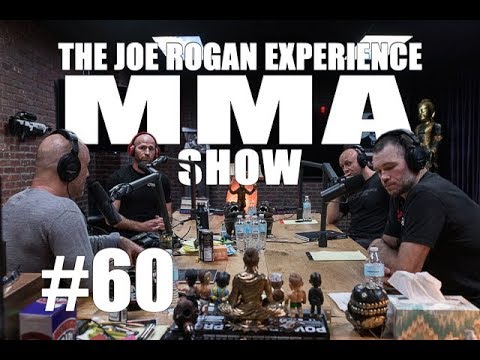
JRE MMA Show #60 with Forrest Griffin, Clint Wattenberg & Dr. Duncan French
Joe Rogan (host), Forrest Griffin (guest), Dr. Duncan French (guest), Clint Wattenberg (guest), Narrator, Dr. Duncan French (guest)
In this episode of The Joe Rogan Experience, featuring Joe Rogan and Forrest Griffin, JRE MMA Show #60 with Forrest Griffin, Clint Wattenberg & Dr. Duncan French explores inside UFC’s Performance Institute: Science, Recovery, And Safer Weight Cuts Joe Rogan speaks with Forrest Griffin, Clint Wattenberg, and Dr. Duncan French about the UFC Performance Institute (PI), a state-of-the-art facility built to optimize fighter performance, health, and longevity.
Inside UFC’s Performance Institute: Science, Recovery, And Safer Weight Cuts
Joe Rogan speaks with Forrest Griffin, Clint Wattenberg, and Dr. Duncan French about the UFC Performance Institute (PI), a state-of-the-art facility built to optimize fighter performance, health, and longevity.
They explain the PI’s philosophy: individualized, science-driven support in strength and conditioning, nutrition, sports science, and physical therapy—without getting involved in game-planning or technique.
The conversation dives into technologies like OmegaWave, force plates, recovery protocols, and advanced nutrition planning, plus how the PI is collecting data across the roster to benchmark performance and guide safer weight cutting.
They also explore broader issues: the evolution of MMA, the role of wrestling, the dangers and politics of weight cutting, the challenge of influencing athletic commissions, and plans for global expansion, including a developmental institute in Shanghai.
Key Takeaways
MMA preparation must be individualized, not one-size-fits-all.
The PI treats every fighter as a unique case, assessing physiology, training response, and injury history to tailor strength, conditioning, nutrition, and recovery rather than imposing a generic MMA program.
Get the full analysis with uListen AI
Recovery is as strategically important as hard training.
Tools like OmegaWave, force plates, hot/cold immersion, compression, and manual therapy are used to decide when and how hard fighters can train, with the goal of maintaining high-quality sessions and reducing injury risk.
Get the full analysis with uListen AI
Fueling must match training intensity and phase.
Wattenberg stresses that fighters often underfuel high-intensity sessions or diet the same way every day; instead, carbohydrate and fat intake are adjusted to session intensity and camp phase to drive adaptation without overtraining.
Get the full analysis with uListen AI
Weight cutting is dangerous and structurally hard to fix, but can be made safer.
They acknowledge extreme cuts are unnecessary risk, describe fight-week support (meal prep, rehydration, supplement control), and ongoing data collection to influence commissions—but emphasize the UFC can’t unilaterally change rules.
Get the full analysis with uListen AI
Objective data helps fighters choose optimal weight classes.
By benchmarking body composition, strength, power, and metabolic rate against divisional norms, the PI can advise whether an athlete fits, should move up, or is overcutting relative to their frame and physiology.
Get the full analysis with uListen AI
Career longevity depends on smarter training, not just toughness.
Forrest contrasts his own era’s over-sparring and self-coaching with today’s integrated, data-informed approach, arguing that better planning, recovery, and medical support can extend peak years and reduce breakdown.
Get the full analysis with uListen AI
The PI aims to raise global standards and share best practices.
Beyond serving current UFC fighters, the team is publishing data, advising external coaches, partnering on fight-week nutrition, and building new institutes (e. ...
Get the full analysis with uListen AI
Notable Quotes
“We always talk about mixed martial arts as the decathlon of combat sports.”
— Dr. Duncan French
“Anything that doesn’t make you better in the octagon is pretty pointless.”
— Forrest Griffin
“This should be a 52‑week fight camp.”
— Clint Wattenberg
“We’re not trying to take the wild out of the stallion; you can train and shape the stallion and it still has the wild at heart.”
— Dr. Duncan French
“If you’re 20% over your fight weight, that’s not your fight weight.”
— Forrest Griffin
Questions Answered in This Episode
How could athletic commissions and promotions realistically collaborate to phase out extreme weight cutting without crippling existing divisions?
Joe Rogan speaks with Forrest Griffin, Clint Wattenberg, and Dr. ...
Get the full analysis with uListen AI
What specific metrics from OmegaWave, force plates, and DEXA scans have turned out to be the most predictive of success or risk in MMA?
They explain the PI’s philosophy: individualized, science-driven support in strength and conditioning, nutrition, sports science, and physical therapy—without getting involved in game-planning or technique.
Get the full analysis with uListen AI
How might a true, structured global development pathway for MMA (like Olympic sports have) change the type of athletes who reach the UFC?
The conversation dives into technologies like OmegaWave, force plates, recovery protocols, and advanced nutrition planning, plus how the PI is collecting data across the roster to benchmark performance and guide safer weight cutting.
Get the full analysis with uListen AI
Where is the line between beneficial, science-based recovery and overusing modalities that might blunt adaptation or create dependency?
They also explore broader issues: the evolution of MMA, the role of wrestling, the dangers and politics of weight cutting, the challenge of influencing athletic commissions, and plans for global expansion, including a developmental institute in Shanghai.
Get the full analysis with uListen AI
As more fighters grow up training MMA from childhood, how will the PI’s model for individualizing training and load management need to evolve?
Get the full analysis with uListen AI
Transcript Preview
From wild pig.
Or a boar or something, yeah.
Yeah. My buddy from, uh, Australia gave me those and that head. It's a Asian water buffalo. It's an invasive species, and-
We are live. Yeah.
Are we live?
Yes, it worked.
Oh, it worked. Jesus Christ. Ladies and gentlemen, the UFC Performance Institute boys.
Hey, hey. What's up?
Right, Duncan, Forrest Griff- hey, Forrest Griffin. Good to see you.
We've already talked over each other, so-
Yeah.
... we've already blown it.
Geez.
No, we've got it. We, we've got it nailed. Um, well, I'm really glad you guys are here because I've, I was blown away when I went to visit the, you know, you hear the Performance Institute and you go, "Well, what is this going to be like?" And you go there and you're like, "Oh my God, they thought of everything." It's like the ultimate state-of-the-art facility for training, for recovery, for, for nutrition. It's fucking amazing. I mean, I was, I was so happy that-
All right, we're, we're s- we're posting, we're posting a link to that shit right there.
Say it.
(laughs)
Dude, I mean, it's, it's amazing. When, when we went on tour and checked that place out, uh, I think, was it with- DellaGrasse was with me?
Yeah.
Yeah.
Yeah.
We were like, "Holy shit." Like, can you imagine? You have access to this fucking place?
Mm-hmm.
Like, you guys have really created something special. It's very interesting and, and, and I don't know much about other sports, but I know this never really existed in combat sports before. Something like this that's... I mean, you guys have athletes from all sorts of different walks of life come through there. When I was there, there was many, many, uh, top level fighters-
Mm-hmm.
... that were training out of there. It's really, really interesting.
Yeah, cool. Well, well, we appreciate the kind words, obviously. Um, I mean, ultimately, yeah, the, the, the vision of the UFC was to build a Performance Institute that was truly a, uh, a world-class high performance center that had everything that fighters would, would need. Um, but not only are we trying to, uh, align ourselves as the leaders in mixed martial arts, but certainly leaders, uh, in human high performance. So-
Yeah. Duncan, tell people what you do there. Like, explain around-
Yeah, so my, my role is the Vice President of Performance. Um, I essentially, um, direct the, the, the philosophy of how we're going to interact with the fighters, how we're going to support the fighters, and obviously manage n- our, our world class staff that are, that are working within the performance facility.
Right.
And Clint, you, you came from a background in, uh, amateur wrestling.
Yep.
And, uh, tell everybody, like, what your job is over there.
Install uListen to search the full transcript and get AI-powered insights
Get Full TranscriptGet more from every podcast
AI summaries, searchable transcripts, and fact-checking. Free forever.
Add to Chrome