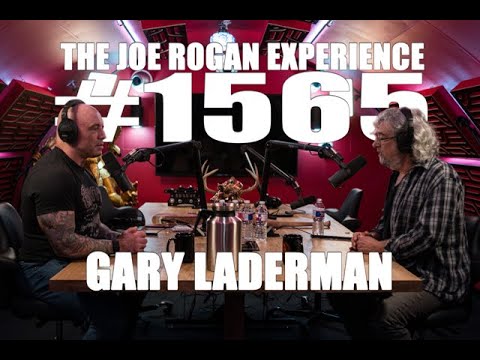
Joe Rogan Experience #1565 - Gary Laderman
Gary Laderman (guest), Joe Rogan (host), Jamie Vernon (guest)
In this episode of The Joe Rogan Experience, featuring Gary Laderman and Joe Rogan, Joe Rogan Experience #1565 - Gary Laderman explores psychedelics, Death, and Modern Religion: Rethinking What’s Sacred Today Joe Rogan and Emory religion professor Gary Laderman explore how drugs, death, sexuality, and celebrity culture function as modern forms of religion and meaning-making. Laderman argues that psychedelics and even everyday substances like pharmaceuticals and caffeine shape contemporary spirituality and reduce fear of death, often more than traditional churches. They discuss the erosion of institutional religious authority, the rise of “spiritual but not religious” identities, and how popular culture, social media, and celebrity worship now carry many religious functions. The conversation also covers teaching taboo topics like suicide and sexuality, the impact of social media and addiction, and the need for new frameworks to navigate modern life’s psychological and existential challenges.
Psychedelics, Death, and Modern Religion: Rethinking What’s Sacred Today
Joe Rogan and Emory religion professor Gary Laderman explore how drugs, death, sexuality, and celebrity culture function as modern forms of religion and meaning-making. Laderman argues that psychedelics and even everyday substances like pharmaceuticals and caffeine shape contemporary spirituality and reduce fear of death, often more than traditional churches. They discuss the erosion of institutional religious authority, the rise of “spiritual but not religious” identities, and how popular culture, social media, and celebrity worship now carry many religious functions. The conversation also covers teaching taboo topics like suicide and sexuality, the impact of social media and addiction, and the need for new frameworks to navigate modern life’s psychological and existential challenges.
Key Takeaways
Psychedelics are deeply tied to modern spirituality and reduced fear of death.
Laderman connects contemporary psychedelic experiences—including clinical psilocybin and MDMA trials—to classic religious language (mystical, spiritual, transcendent) and notes research showing decreased death anxiety, increased compassion, and lasting life changes.
Get the full analysis with uListen AI
Traditional religion is losing authority, but religious impulses are simply moving elsewhere.
He contends that as institutional Christianity and organized religions erode, people channel religious energies into other systems—celebrity worship, politics, social media, festivals, and personal spirituality—rather than becoming truly non-religious.
Get the full analysis with uListen AI
Everyday drugs, especially pharmaceuticals, now function as religious objects for many.
Prescription psychoactives (like anti-anxiety meds) are ritualized, trusted, and invested with salvific power—the promise to restore order, identity, and community—much like traditional religious sacraments.
Get the full analysis with uListen AI
Popular culture and social media teach more about values than churches do.
Laderman argues that music, movies, influencers, and platforms like Instagram and Twitter shape people’s moral outlooks, identities, and sense of the sacred far more than sermons, even though this influence is driven by attention and money rather than reflection.
Get the full analysis with uListen AI
Addiction is broader than substances, encompassing gambling, social media, capitalism, and even religion.
They compare gambling addicts, social media dependency, and obsessive materialism to drug addiction, suggesting that many modern “fixes” hijack the same human reward systems and can become life-defining and destructive.
Get the full analysis with uListen AI
Confronting death, suicide, and taboo topics in an academic setting is crucial but delicate.
In his death and dying course, Laderman now includes suicide despite past reluctance, aiming to depersonalize it enough to study historically and culturally while acknowledging its psychological weight and the rising suicide rates among young people.
Get the full analysis with uListen AI
Community and ritual matter, even for non-religious people.
Rogan compares church to the community at comedy clubs, while Laderman points to concerts, Burning Man, and psychedelic churches as places where people find belonging, emotional catharsis, and shared meaning outside traditional congregations.
Get the full analysis with uListen AI
Notable Quotes
“My goal is to confuse the hell out of them… what they think is religion is not the only game in town.”
— Gary Laderman
“Drugs are really the sort of source of spiritual life in America. That’s the future, as well as the past.”
— Gary Laderman
“The act of interpretation is very much obviously a part of the study of religion… too much literalism is really counterproductive, if not destructive.”
— Gary Laderman
“The most non-psychedelic thing is the way people communicate on Twitter. It’s like a bunch of mental patients throwing shit at each other.”
— Joe Rogan
“I don’t think you need a creator to be religious… you need some access to transcendence, a way of understanding your own self and identity, a system of values, and community.”
— Gary Laderman
Questions Answered in This Episode
If psychedelics reliably reduce fear of death and increase compassion, should they be integrated into mainstream spiritual or therapeutic practices—and who should control that process?
Joe Rogan and Emory religion professor Gary Laderman explore how drugs, death, sexuality, and celebrity culture function as modern forms of religion and meaning-making. ...
Get the full analysis with uListen AI
Are we being honest with ourselves when we say we’re ‘not religious’ if we still invest ultimate meaning in things like celebrity, politics, or money?
Get the full analysis with uListen AI
How might redefining religion more broadly—to include drugs, media, and consumer culture—change public debates about separation of church and state or religious freedom?
Get the full analysis with uListen AI
What responsibilities do educators have when teaching taboo topics like suicide, sexuality, and drugs to young adults who may be personally vulnerable?
Get the full analysis with uListen AI
Given how powerfully social media and celebrity shape values, is it possible to design a new kind of ‘religion’ or communal framework better suited to modern psychological and technological realities?
Get the full analysis with uListen AI
Transcript Preview
(drumbeats) Joe Rogan podcast, check it out. The Joe Rogan Experience.
Train by day, Joe Rogan podcast by night. All day. (instrumental music plays) Hello, Gary.
Hey. How you doing?
What's up, man? Thanks for coming. Appreciate it.
I'm happy to be here.
Why don't you tell everybody what you do?
Well, um, for work? (laughs)
(laughs)
Yeah. I, um, I teach at Emory University so I'm a professor. I've been, I've been there for about 25 years and I, um, I also write. I write some, some books and, um, teach a variety of classes.
But you study, like, um, what I've s- read of your study is, uh, some of, of it is on death and some of it is on drugs.
That is correct.
Those are two very heavy subjects.
Th- maybe the heaviest. Uh-
Yeah. (laughs)
Well, the other course I teach is religion and sexuality.
Yeah.
So I mean, that, that can be a heavy-
That's another really heavy one.
Yeah.
You look like a guy who would study both death and drugs, so it fits.
Well, this is the pandemic hair.
(laughs)
I mean, really, I'm usually-
But it, but you-
... I'm much, I'm much more, uh, you know ... Well, I'm not really. (laughs)
Have you, have you thought of doing this? Just doing the full buzz?
Uh, one of my students told me I should do-
Yeah.
... before I came in here.
I'm telling you, man, once you, once you do it, it's so freeing not having to go to a barber shop or a hairdresser.
Well, what's weird is I feel really free with all this hair. (laughs)
Yeah. Well-
You know?
Yeah. Well, again, the hair fits the subjects-
(laughs) Okay, right.
... that you study. Um, how did you get involved in ... What, w- when, when you talk about drugs, like, you, uh, y- you studied all sorts of psychedelic drugs but also common drugs like, like caffeine, like we were talking about before. I was telling you before that I make some ridiculous French press coffee with far too much coffee in it and it, it's become a bit of a problem lately. (laughs)
Well, uh, but it's probably keeping you healthy and keeping you going-
I don't- I don't know if it is.
... and, uh, well-
I don't know. At the end of the day I'm really tired and-
Yeah.
... I'm not usually really tired and I think it's because I've been on speed all day.
Mm.
(laughs)
(laughs) It could tire you out, uh, that's for sure.
Yeah.
Um, but yeah, I mean, my interest in, in, in studying the connection between religion and drugs, I'm in a department of religion at Emory, um, uh, really spans the spectrum so I'm interested, yeah, for sure, in psychedelics but also, as you're saying, in the more, um, ordinary, uh, psychoactive drugs that bring order to our lives and, um, you know, allow us to tap into our true identity, um, maintain, um, some semblance of stability in our lives. You know, things that, y- religion often can do.
Install uListen to search the full transcript and get AI-powered insights
Get Full TranscriptGet more from every podcast
AI summaries, searchable transcripts, and fact-checking. Free forever.
Add to Chrome