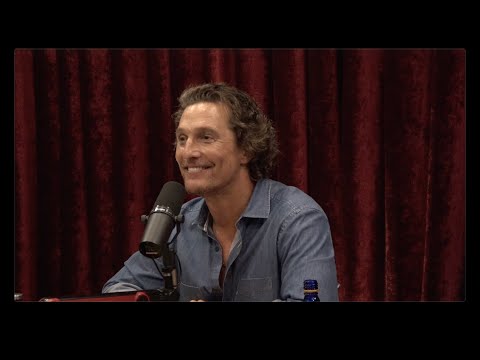
Joe Rogan Experience #2379 - Matthew McConaughey
Narrator, Joe Rogan (host), Matthew McConaughey (guest), Narrator, Narrator, Narrator, Narrator, Narrator
In this episode of The Joe Rogan Experience, featuring Narrator and Joe Rogan, Joe Rogan Experience #2379 - Matthew McConaughey explores matthew McConaughey and Joe Rogan Explore Belief, AI, Purpose, and Grit Joe Rogan and Matthew McConaughey dive into McConaughey’s new book *Poems and Prayers* as a springboard to discuss belief, cynicism, and how to maintain ideals in a chaotic, morally confused world.
Matthew McConaughey and Joe Rogan Explore Belief, AI, Purpose, and Grit
Joe Rogan and Matthew McConaughey dive into McConaughey’s new book *Poems and Prayers* as a springboard to discuss belief, cynicism, and how to maintain ideals in a chaotic, morally confused world.
They range widely across topics: the corrosive effects of social media and constant bad news, the tradeoffs of wealth and minimalism, the coming transformation from AI, and the importance of preparation, discipline, and ‘selfish’ kindness.
The conversation also examines religion in public life, parenting, marriage, psychedelics, and elite performance in sports and acting—arguing that real fulfillment comes from struggle, responsibility, and doing work you “can’t not do.”
McConaughey closes by reading a poem critiquing participation-trophy culture, tying together their recurring theme that extra comfort and “tips included” living erode character, merit, and meaning.
Key Takeaways
Guard your belief before cynicism becomes a ‘living man’s disease.’
McConaughey describes noticing his own slide toward cynicism amid corrupt leaders and shameless behavior; he responds by intentionally turning back to ideals, “dreams,” and faith (broadly defined: God, kids, humanity, a better self) to keep from emotionally checking out.
Get the full analysis with uListen AI
We’re not built to ingest the world’s worst stories 24/7.
Rogan argues that constant exposure to global atrocities via phones and feeds distorts our perception, fuels hopelessness, and makes goodness feel pointless; managing information intake is now a moral and mental health task.
Get the full analysis with uListen AI
Wealth and success without ‘profit’—meaning and value—produce unhappy winners.
Both men note many billionaires and ultra-successful people are miserable; McConaughey distinguishes ‘success’ from ‘profit’ in life—the felt value and integrity of what you achieve—and suggests overabundance of options and status symbols often dilutes satisfaction.
Get the full analysis with uListen AI
Reducing options can dramatically increase peace and focus.
They praise minimalist living—McConaughey’s Airstream years, truck campers, log cabins—where having “one good pan, one good stereo, one good chair” eliminates decision fatigue and helps you drop into presence and craft.
Get the full analysis with uListen AI
AI will force a reckoning with privacy, work, and what makes us human.
They foresee AI as tastemaker, boss, and possibly ruler, likely wiping out entire professions (coding, law, accounting) and pressuring humans to integrate via wearables or implants; McConaughey is intrigued by a private, personal LLM to better understand himself but wary of cognitive atrophy and surveillance.
Get the full analysis with uListen AI
Kindness and integrity are deeply ‘selfish’—they pay you back.
Rogan admits he often edits guests’ mistakes to protect them, not from obligation but because it feels right; McConaughey reframes ‘selfish’ as building long-term reputation, allies, and inner peace—showing that being a good person is strategically beneficial, not just noble.
Get the full analysis with uListen AI
Struggle, responsibility, and controlled ego loss are keys to growth.
From psychedelics to cold plunges to elite training, they emphasize deliberately doing hard things, dissolving ego periodically, and preparing obsessively; champions, great performers, and healthy adults are usually those who contend directly with discomfort rather than avoiding it.
Get the full analysis with uListen AI
Notable Quotes
““My tank was getting low on belief… Cynicism is a living man's disease.””
— Matthew McConaughey
““We’re not supposed to have access to eight billion people’s bad stories.””
— Joe Rogan
““To be a fucking good dude is a selfish thing to do, man.””
— Matthew McConaughey
““As much as we think of selfless, I think selfish—the true definition—is to live a certain way.””
— Matthew McConaughey
““People want to think that people that are mentally strong don’t struggle. No—you do struggle. But you win every time.””
— Joe Rogan
Questions Answered in This Episode
In an age of constant bad news and algorithmic outrage, what practical steps can an individual take to rebuild genuine belief in people and in their own ideals?
Joe Rogan and Matthew McConaughey dive into McConaughey’s new book *Poems and Prayers* as a springboard to discuss belief, cynicism, and how to maintain ideals in a chaotic, morally confused world.
Get the full analysis with uListen AI
How can we design education or cultural ‘creeds’ that teach character and responsibility without entangling government schools in any specific religious doctrine?
They range widely across topics: the corrosive effects of social media and constant bad news, the tradeoffs of wealth and minimalism, the coming transformation from AI, and the importance of preparation, discipline, and ‘selfish’ kindness.
Get the full analysis with uListen AI
As AI rapidly replaces knowledge work and blurs the line between human and machine creativity, what should young people actually be training for over the next 10–20 years?
The conversation also examines religion in public life, parenting, marriage, psychedelics, and elite performance in sports and acting—arguing that real fulfillment comes from struggle, responsibility, and doing work you “can’t not do.”
Get the full analysis with uListen AI
If kindness and integrity are in fact ‘selfish’ long-term strategies, how could society reward those traits more visibly than short-term exploitation and deceit?
McConaughey closes by reading a poem critiquing participation-trophy culture, tying together their recurring theme that extra comfort and “tips included” living erode character, merit, and meaning.
Get the full analysis with uListen AI
Where is the line between using tools (AI, social media, psychedelics) for growth and letting them quietly erode our autonomy, memory, or capacity for real struggle?
Get the full analysis with uListen AI
Transcript Preview
(drumming music) Joe Rogan podcast, check it out. The Joe Rogan Experience.
Train by day, Joe Rogan podcast by night, all day. (rock music) Good bro. Cheers, cheers, sir.
Thanks. Good to see you on your home turf there.
My man. Yeah. Hey. You, um, you're a man of many talents, my friend. Tell me about this book.
Poems and Prayers, yeah. Um, so I've been kinda writing-
Try to keep this, like, these are a little bit directional. How's that? Yeah, perfect.
I've been kind of, I've been writing poems and prayers down for, since I was like 18. Um, and then this last, I don't know, couple years, I started looking around at life and the facts and evidence and people, and I was, like, not finding the amount of things or people to believe in that I was wanting to. And I was starting to have doubt to myself as well, and I started to see myself slip into a little bit of cynicism.
Mm.
Which I promised myself that's, that, no, that's a, that's a living man's disease. Don't go there.
Yeah.
You go from innocence to s- to, to naivete to skepticism, but let's stop there at skepticism.
Yeah.
And I kinda got scared and a little pissed off at myself and was like, "Well wait a minute. I'm not ready to give up. I'm not ready to wave the, wave the white flag and let myself off for certain things I was starting to even wanna let myself off on. You know? Or other people." And, um, I said, "All right, poems and prayers, those are ideals, those are pursuits. You know? That's going to the dream and saying let's go to the... Let's, let's, let's look at the dream and see if we can still believe in making that a reality."
Aspirational.
Instead of looking at reality and saying, "How do you turn that into a dream?" Which is what I usually do. I'm like art emulates life, man, not the other way around. But I flipped the script a little bit here and said, "No, no, let's, let's dive into the dreams and belief." Man, it's, I think it's in short supply. It was getting, it was, it, my, my tank was getting low on belief. And that's just in-
Well, what was bothering you so much? What specifically?
Maybe it's, man, maybe it's turning 50, something like that? Maybe it's that, where I start to project, uh, you know, what am I... What's the next half?
Right.
I don't know. Maybe subconsciously it was. I think, uh, I look around and there's a lot fewer leaders that I'm like, "Hey, son."
Yeah.
"I wanna grow up like that."
Right.
I look around, I see people not trusting. I see peop- I, I, I, I, I see people that aren't embarrassed for doing something shitty.
Install uListen to search the full transcript and get AI-powered insights
Get Full TranscriptGet more from every podcast
AI summaries, searchable transcripts, and fact-checking. Free forever.
Add to Chrome