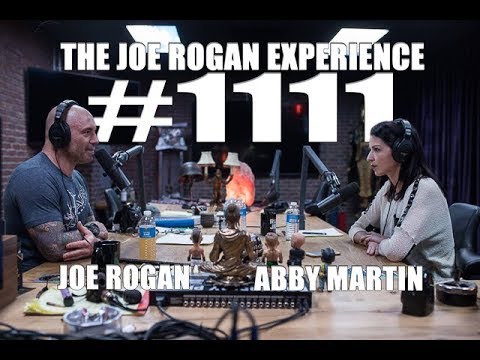
Joe Rogan Experience #1111 - Abby Martin
Joe Rogan (host), Abby Martin (guest), Jamie Vernon (guest), Narrator, Narrator, Joe Rogan (host), Narrator, Narrator, Narrator, Narrator, Narrator, Narrator, Narrator, Narrator, Narrator
In this episode of The Joe Rogan Experience, featuring Joe Rogan and Abby Martin, Joe Rogan Experience #1111 - Abby Martin explores abby Martin Dissects Empire, Media Propaganda, Palestine, Trump, and War Joe Rogan and Abby Martin range across topics from Bill Cosby and Trump’s scandals to U.S. foreign policy, media manipulation, and the Israeli–Palestinian conflict.
Abby Martin Dissects Empire, Media Propaganda, Palestine, Trump, and War
Joe Rogan and Abby Martin range across topics from Bill Cosby and Trump’s scandals to U.S. foreign policy, media manipulation, and the Israeli–Palestinian conflict.
Martin argues the U.S. is a global empire whose military‑industrial complex and allied media normalize endless war and intervention in places like Syria, Yemen, Venezuela, and Palestine.
She describes organized smear campaigns against her for criticizing Israel, details on‑the‑ground realities in the West Bank, Gaza, Venezuela, and Colombia, and how narratives in Western media are shaped by corporate and geopolitical interests.
The conversation also examines culture‑war absurdities (Kanye, NRA cooler boycotts, incel violence), the Trump–Russia saga, and the structural weaknesses of U.S. democracy revealed by Trump’s rise.
Key Takeaways
Interrogate media narratives, especially on foreign policy and war.
Martin argues coverage of Syria, Venezuela, Israel–Palestine and others is highly uniform and often comes from pundits tied to defense contractors or prior war propaganda. ...
Get the full analysis with uListen AI
Recognize the structural power of the military‑industrial complex.
Both guests frame the ‘deep state’ less as a shadow cabal against Trump and more as the entrenched military, intelligence, and corporate apparatus that continues its agenda regardless of who’s president. ...
Get the full analysis with uListen AI
Be wary of smear campaigns and coordinated online pressure.
Martin describes mass email and social campaigns organized by pro‑Israel groups to discredit critics. ...
Get the full analysis with uListen AI
Understand Gaza and the West Bank through a rights‑based lens, not slogans.
Martin portrays Gaza as an ‘open‑air prison’ under blockade and the West Bank as under military law with segregated infrastructure and discriminatory statutes. ...
Get the full analysis with uListen AI
Notice how identity and personality are used to sell the status quo.
They argue neoliberal politicians and media use identity (first Black president, first woman president, diverse TV hosts) to rebrand the same corporate and imperial policies. ...
Get the full analysis with uListen AI
Acknowledge how tribalism and algorithmic media fuel mass hallucinations.
From ‘Russian bots everywhere’ to QAnon, incels, and culture‑war boycotts, the discussion highlights how online echo chambers and outrage incentives make reasoned dialogue nearly impossible. ...
Get the full analysis with uListen AI
Support independent journalism financially if you want real dissenting work.
Martin notes that deeply reported documentaries and on‑the‑ground investigations are hard to fund without state or corporate backing, which often come with implicit red lines. ...
Get the full analysis with uListen AI
Notable Quotes
““The deep state is the military‑industrial complex. It’s the machine that churns on no matter who is the commander in chief.””
— Abby Martin
““We’re the world’s biggest empire, the world’s biggest polluter, exempt from climate treaties—and you’ll never hear that on mainstream media because it’s owned by oil corporations and defense contractors.””
— Abby Martin
““I think historians are gonna look at this time between ’94 and 2018 as this unprecedented explosion of change.””
— Joe Rogan
““Israel would not survive without the U.S., which is why I focus on ending the U.S. empire… we’re subsidizing the horrors and daily atrocities with our tax dollars.””
— Abby Martin
““We’re only three people ago from slavery… three people from now they’re gonna be like, ‘These apes were crazy.’””
— Joe Rogan
Questions Answered in This Episode
If mainstream U.S. media are structurally tied to corporate and defense interests, how can an average viewer realistically verify what’s happening in conflicts like Syria or Gaza?
Joe Rogan and Abby Martin range across topics from Bill Cosby and Trump’s scandals to U. ...
Get the full analysis with uListen AI
To what extent is the U.S. truly locked into permanent war by its military‑industrial complex, and what concrete political or economic reforms could actually reduce that momentum?
Martin argues the U. ...
Get the full analysis with uListen AI
Where is the ethical line between legitimate criticism of Israeli government policy and anti‑Semitism, and who should define that boundary in public debate?
She describes organized smear campaigns against her for criticizing Israel, details on‑the‑ground realities in the West Bank, Gaza, Venezuela, and Colombia, and how narratives in Western media are shaped by corporate and geopolitical interests.
Get the full analysis with uListen AI
How do we differentiate between genuine foreign influence operations (Russian, Chinese, etc.) and domestic propaganda or private firms like Cambridge Analytica manipulating us for profit and power?
The conversation also examines culture‑war absurdities (Kanye, NRA cooler boycotts, incel violence), the Trump–Russia saga, and the structural weaknesses of U. ...
Get the full analysis with uListen AI
Given how easily Trump won a “popularity contest” presidency, what alternative systems—or reforms to the current one—might produce leaders better suited to managing a nuclear superpower?
Get the full analysis with uListen AI
Transcript Preview
(humming) Five, four, three, two, one. (light switch clicking) Abby Martin, ladies and gentlemen. How are you?
Great. How are you?
Good day to be here.
Yes. (laughs)
A lot of crazy shit's going down.
Exactly.
It's a crazy day for Bill Cosby, whoopsies.
Hey, I'm, I'm reeling in that news, man.
Yeah. I th- I was, uh, I was wondering what was gonna happen, 'cause the first one was a mistrial? Is that what happened?
Yeah. But what ... So what's the difference between this one? Is this a civil suit or is this ...
I think these are ...
Yeah, he was-
These aren't civil.
... convicted of a- this was a, the retrial. So he got convicted of-
Yes.
Nine-
... felony-
Yeah.
... three charges, right?
... assault.
Felony sexual assault, three different counts. Each one carries, I think, at least 10 years. He could go to jail for 30 years, which is death for him.
Mm-hmm.
I mean, he's-
He's already blind.
Yeah. He's very ... Yeah. He's a ... He could barely see, right?
Good. I, I'm so happy that he's getting charged at the end of his life. That's amazing.
He's a creepy dude.
He liked to have sex with lifeless, dead bodies.
Yeah. We were trying to ... I mean, purely speculation, right? Like what would cause someone to want to do that? Like what-
Mm-hmm.
But I, I have this theory. I think a lot of people did that shit in the '60s. I think in the '60s, it was a normal thing to drug people. And I think they ... You know, remember the terms ... Have you ever ... I don't know if you've heard it, slipping someone a mickey?
Yeah.
They, I, I think they used to do that all the time back then and they didn't think anything of it. You know?
That's disgusting.
It's ... People are fucking gross. If you just go back a couple of hundred years. Like, I'm watching this show Vikings. It's a great show, by the way.
(laughs)
I don't know if you've ever watched it.
No.
But, uh, you know, they were obviously fucking crazy people. They did wild shit. But it was common. I mean, this was how people lived. They would storm into villages and kill everybody.
Mm-hmm.
This was normal shit just 1,000 years ago or so. And I think if you go back just 100 years, the way people treated each other was horrific.
Mm-hmm.
If you go back 50 years ago, that's Bill Cosby's era. I mean, I really think that people back then were different. They didn't have the internet. They didn't, they didn't understand how other people were viewing their activity. They thought they could hide this activity. And I think there was a group of people, specifically, you know, partiers, that would drug people. And I think it was a normal thing. I think there's probably a lot of people out there that are hearing this Bill Cosby thing and they're thinking about all the times that they did it.
Install uListen to search the full transcript and get AI-powered insights
Get Full TranscriptGet more from every podcast
AI summaries, searchable transcripts, and fact-checking. Free forever.
Add to Chrome