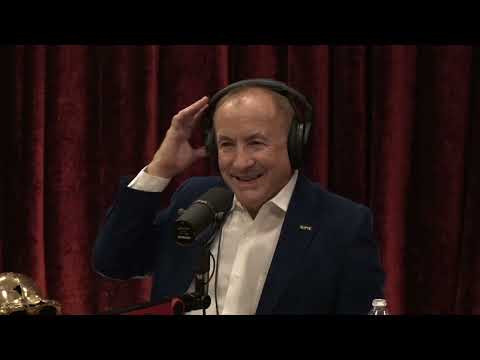
Joe Rogan Experience #1888 - Michael Shermer
Joe Rogan (host), Michael Shermer (guest)
In this episode of The Joe Rogan Experience, featuring Joe Rogan and Michael Shermer, Joe Rogan Experience #1888 - Michael Shermer explores skepticism, Conspiracies, Aliens, and Psychedelics: Shermer Debates Rogan Deeply Joe Rogan and skeptic Michael Shermer explore why intelligent people believe conspiracy theories, distinguishing between real conspiracies and unfounded narratives. They dig into JFK, 9/11, MKUltra, and government secrecy, arguing about what evidence would actually justify belief in a plot versus randomness and error. The conversation broadens into UFOs/UAPs, the likelihood of alien visitation, and how to judge extraordinary claims, then shifts to scientific fraud, moral progress, religion, and whether psychedelics reveal deeper realities or just brain chemistry. Throughout, Shermer stresses probabilistic reasoning and error costs, while Rogan pushes the importance of open-minded suspicion, unexplained anomalies, and direct experience.
Skepticism, Conspiracies, Aliens, and Psychedelics: Shermer Debates Rogan Deeply
Joe Rogan and skeptic Michael Shermer explore why intelligent people believe conspiracy theories, distinguishing between real conspiracies and unfounded narratives. They dig into JFK, 9/11, MKUltra, and government secrecy, arguing about what evidence would actually justify belief in a plot versus randomness and error. The conversation broadens into UFOs/UAPs, the likelihood of alien visitation, and how to judge extraordinary claims, then shifts to scientific fraud, moral progress, religion, and whether psychedelics reveal deeper realities or just brain chemistry. Throughout, Shermer stresses probabilistic reasoning and error costs, while Rogan pushes the importance of open-minded suspicion, unexplained anomalies, and direct experience.
Key Takeaways
Treat conspiracies as a signal-detection problem, not a binary belief.
Shermer frames conspiracies using hits, misses, false positives, and false negatives: it’s rational to be somewhat paranoid because missing a real conspiracy (like Tuskegee or MKUltra) can be very costly, but we should still demand converging evidence before accepting any specific theory.
Get the full analysis with uListen AI
The larger and more complex a proposed conspiracy, the less likely it is.
Shermer argues that grand plots requiring many coordinated actors (e. ...
Get the full analysis with uListen AI
Government secrecy and documented abuses justifiably fuel suspicion.
Examples like MKUltra, Operation Northwoods, COINTELPRO, Paperclip, and Tuskegee show that US agencies have committed serious covert abuses; this history rationally heightens public distrust, especially when records (like JFK files) are still withheld.
Get the full analysis with uListen AI
Eyewitness testimony and ‘weird details’ are weak foundations for big claims.
Both in crimes and disasters (JFK, 9/11, satanic panics, recovered memories), witnesses regularly misperceive and misremember under stress, and investigators can easily ‘lead’ narratives; anomalies and colorful details are common in large events and do not, by themselves, confirm conspiracies.
Get the full analysis with uListen AI
Extraordinary technological or alien claims demand proportionally strong evidence.
On UAPs, Shermer accepts credible military witnesses and odd sensor data but insists that blurry videos and anecdotes aren’t enough to jump to aliens or secret super-tech; he wants physical artifacts or clearly verifiable, high-quality data before revising his priors.
Get the full analysis with uListen AI
Science is powerful but fallible; structural incentives can distort results.
They discuss Alzheimer’s and SSRI research scandals, p-hacking, non-replicable findings, and career pressures, emphasizing the need for transparency, preregistration, replication, and whistleblowers to keep scientific knowledge trustworthy over time.
Get the full analysis with uListen AI
Moral progress tends to be incremental and pendulum-like, not utopian.
Using examples from slavery, civil rights, gay marriage, and current trans and culture-war debates, Shermer and Rogan suggest that norms do improve over centuries, but often overshoot and correct; trying to build a perfect ‘utopia’ typically creates new injustices.
Get the full analysis with uListen AI
Notable Quotes
“It’s not irrational to believe conspiracy theories, because enough of them are true.”
— Michael Shermer
“Smart people are better at rationalizing beliefs they hold for non-smart reasons.”
— Michael Shermer
“The grander the conspiracy theory, the less likely it is to be true.”
— Michael Shermer
“Why would a computer have wants? Wanting is a human emotion.”
— Michael Shermer
“Whether it’s real or a hallucination, the profundity of the psychedelic experience is the same.”
— Joe Rogan
Questions Answered in This Episode
How should ordinary people practically distinguish between a plausible conspiracy and a fringe theory without becoming either gullible or chronically cynical?
Joe Rogan and skeptic Michael Shermer explore why intelligent people believe conspiracy theories, distinguishing between real conspiracies and unfounded narratives. ...
Get the full analysis with uListen AI
If withheld JFK or UAP documents eventually reveal serious wrongdoing or revolutionary technology, how should that change our trust in current institutions and narratives?
Get the full analysis with uListen AI
At what threshold of evidence would you personally accept that at least some UAPs are non-human or that advanced secret human tech exists?
Get the full analysis with uListen AI
Given documented scientific fraud and replication problems, how can non-experts responsibly decide which medical or psychological findings to trust?
Get the full analysis with uListen AI
Do profound psychedelic experiences or religious visions count as a legitimate form of ‘truth’ even if they can’t be independently measured, and how should that influence public discourse about reality?
Get the full analysis with uListen AI
Transcript Preview
(drumming music plays) Joe Rogan podcast, check it out.
The Joe Rogan Experience.
Train by day, Joe Rogan podcast by night. All day. (rock music plays)
(laughs)
... Spears. Michael Shure.
Icon-bearing signed gifts for you, sir.
Thank you very much.
(laughs) I hope that's all right.
Why the Rational Believe the Irrational.
Right.
Why is that?
(laughs)
Is it simple? It wouldn't be this big of a book-
N- no.
... if it was simple.
Yeah, it's not that simple, but, uh ... Well, first of all, my argument is that it's not irrational to believe conspiracy theories, because enough of them are true that i- it pays to err on the side of assuming more of them are true than actually are than missing real conspiracy theories, and then that's a, a costlier err- error to make.
That's a rational perspective.
Yeah.
Uh, the, the term conspiracy theory got thrown about ... There was the first, the first introduction of it into the zeitgeist was during the Kennedy assassination, correct?
Yeah. Well, uh, around that time, right? It, it, uh ... Before that, before World War II really, conspiracy theories were kind of common knowledge. Everybody knew that things were going on behind, uh, closed doors and it was just ki- commonly known and we just kind of tried to figure it out. It didn't become really fringey until right after the JFK thing that it, it, it kinda got a, as a meme that you're crazy to think these conspiracy theories are true. It became pathologized.
Yeah.
You know, Richard Hofstadter's, you know, the Paranoid Style in American Politics kind of m- put that on the map as conspiracy theories are something delusional. You ... It's a, it's a pathology in your brain. Whereas, before that, it wasn't. It was just ... I mean, even the Declaration of Independence, it's a conspiracy theory. It's saying, "Look, the British are doing this whole train of abuses and usurpations, and here's what we think they're up to, and here's what we think they wanna do, and we're against that." That's printed right there in the Declaration.
Yeah.
So it's not fringey, right? It was, it was kind of commonly known that these things happened.
The term as a pejorative, though, was ... It was introduced into, like, sort of the American m- m- culture around the Kennedy assassination.
Yeah. Yeah, that's an interesting story, because, um, I'm, I'm convinced Lee Harvey Oswald acted alone. I'm not a-
Really?
Yes, I am. Yeah.
What makes you convinced of that?
(laughs) Uh, well, I have a whole chapter on it, and we can get into that in a second. But, uh, the, the, the twist about it where it seems like there was something up was that John ... President Johnson was worried that if it looks like there's a conspiracy afoot with the Cubans or the Russians, that that could lead to a nuclear exchange, so we don't want the American people to think that this is some kind of vast conspiracy of the, of the Russians so we can avoid war.
Install uListen to search the full transcript and get AI-powered insights
Get Full TranscriptGet more from every podcast
AI summaries, searchable transcripts, and fact-checking. Free forever.
Add to Chrome