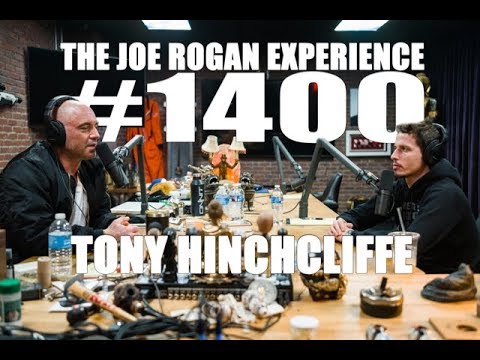
Joe Rogan Experience #1400 - Tony Hinchcliffe
Joe Rogan (host), Tony Hinchcliffe (guest), Jamie Vernon (guest), Tony Hinchcliffe (guest), Jamie Vernon (guest), Jamie Vernon (guest), Jamie Vernon (guest), Joe Rogan (host), Tony Hinchcliffe (guest), Narrator, Tony Hinchcliffe (guest)
In this episode of The Joe Rogan Experience, featuring Joe Rogan and Tony Hinchcliffe, Joe Rogan Experience #1400 - Tony Hinchcliffe explores joe Rogan, Tony Hinchcliffe Dive Into Comedy, Fame, and Conspiracies Joe Rogan and Tony Hinchcliffe start by reminiscing about legendary stand-up specials (Richard Pryor, Eddie Murphy), using them to frame how powerful and rare great comedy is. They move into the costs of early fame and body-image culture, discussing Macaulay Culkin, Justin Bieber, plastic surgery, and social media cruelty.
Joe Rogan, Tony Hinchcliffe Dive Into Comedy, Fame, and Conspiracies
Joe Rogan and Tony Hinchcliffe start by reminiscing about legendary stand-up specials (Richard Pryor, Eddie Murphy), using them to frame how powerful and rare great comedy is. They move into the costs of early fame and body-image culture, discussing Macaulay Culkin, Justin Bieber, plastic surgery, and social media cruelty.
The conversation then shifts to internet manipulation, bots, and Russian troll farms, exploring how online discourse is artificially inflamed for political purposes. From there they spiral into a long-form tour of conspiratorial and political topics: Bohemian Grove, Skull and Bones, JFK, 9/11 missing trillions, the military-industrial complex, and war spending.
Later, they pivot back to combat sports, breaking down UFC matchmaking, weight-cutting dangers, Colby Covington’s promo persona, and upcoming title fights. Throughout, Hinchcliffe plugs his show ‘Kill Tony’ as a live laboratory for stand-up, and Rogan repeatedly ties big themes back to human nature, incentives, and how media shapes what we believe.
Key Takeaways
Foundational stand-up specials can rewire how you understand comedy.
Rogan describes seeing Richard Pryor’s ‘Live on the Sunset Strip’ in a theater as the moment he realized a single person talking could be funnier than any film, proving how one great performance can permanently change your sense of what’s possible.
Get the full analysis with uListen AI
Early, extreme fame almost guarantees psychological distortion.
They argue that child stars like Justin Bieber and Macaulay Culkin grow up without normal boundaries or hardship, making later dysfunction almost inevitable; Culkin is cited as a rare example of someone who’s navigated it relatively well.
Get the full analysis with uListen AI
Body dysmorphia is amplified by social comparison and plastic surgery trends.
From oversized implants to extreme butt augmentations, they frame many cosmetic procedures as manifestations of not seeing oneself accurately, worsened by curated images and constant online criticism.
Get the full analysis with uListen AI
Social media discourse is heavily manipulated by bots and paid operatives.
Referencing researcher Renée DiResta and the Internet Research Agency, they describe how fake personas (e. ...
Get the full analysis with uListen AI
Large-scale systems create enormous opportunities for unaccountable power.
They connect Rumsfeld’s pre‑9/11 admission of $2. ...
Get the full analysis with uListen AI
Reality TV and daytime talk often manufacture ‘reality.’
Shows like Cheaters, Springer, and Maury are described as semi-scripted or cast with actors, revealing how many ‘authentic’ moments are engineered for spectacle rather than truth.
Get the full analysis with uListen AI
A strong persona can be as valuable as skill in combat sports.
Colby Covington is highlighted as a case study: he created a polarizing, pro‑Trump heel character to avoid being cut, then backed it up with elite cardio and wins over top contenders, illustrating how entertainment value and performance now intertwine.
Get the full analysis with uListen AI
Notable Quotes
“According to some estimates, we cannot track $2.3 trillion in transactions.”
— Donald Rumsfeld (quoted by Joe Rogan via CSPAN clip)
“The very word ‘secrecy’ is repugnant in a free and open society.”
— John F. Kennedy (speech clip, discussed by Joe Rogan)
“How is this guy so funny just talking? How is this possible?”
— Joe Rogan, recalling watching Richard Pryor as a teenager
“When you see some of these famous kids, you should look at it like a child abuse case.”
— Joe Rogan, on the psychological toll of child stardom
“We’re seeing a masterclass in promotion and adaptation with Colby Covington.”
— Joe Rogan, on Covington’s villain persona in the UFC
Questions Answered in This Episode
How much responsibility do platforms have to expose and limit organized disinformation campaigns and bot activity?
Joe Rogan and Tony Hinchcliffe start by reminiscing about legendary stand-up specials (Richard Pryor, Eddie Murphy), using them to frame how powerful and rare great comedy is. ...
Get the full analysis with uListen AI
Where is the line between healthy self-improvement and destructive body modification in a social media-driven culture?
The conversation then shifts to internet manipulation, bots, and Russian troll farms, exploring how online discourse is artificially inflamed for political purposes. ...
Get the full analysis with uListen AI
To what extent should we take seriously claims about secret societies and elite rituals, and how do we distinguish verifiable fact from conspiracy?
Later, they pivot back to combat sports, breaking down UFC matchmaking, weight-cutting dangers, Colby Covington’s promo persona, and upcoming title fights. ...
Get the full analysis with uListen AI
How should combat sports regulate extreme weight-cutting when both health risks and financial incentives are so high?
Get the full analysis with uListen AI
What does the success of formats like ‘Kill Tony’ reveal about how audiences want to see the creative process, not just polished end products?
Get the full analysis with uListen AI
Transcript Preview
Three, two, one. Boom. Check out this new Richard Pryor, Plastisel. Come on.
Yeah. Live on the Sunset Strip.
Iconic. That was, uh, really the first thing that I ever saw that made me truly understand the power of standup comedy. I was 13 years old, I think, maybe 14. My parents went m-... uh, took me to see it, and, uh, we were i- in the audience, and I remember thinking, "How is this guy so funny just talking? How is this possible?" I was thinking of all the movies that I'd seen that were really funny, like... I don't remember what was out back then. Maybe Stripes, like, which was a great movie that I loved. So funny, so funny. But this guy was way funnier, and all he was doing was talking, and I couldn't believe it. I remember there was a moment in the movie where he was killing, and I just turned and looked at the people in the audience, and people were just flailing up and down and, "Ah!" Like, they were just... Their whole body was laughing. Everything was like... They were throwing their bodies around. And I was like, "This is incredible. I've never seen anything like this."
Super powerful.
Dude, it hit me hard. It wasn't like I wanted to be a comic right then and there. I mean, I really didn't w- want to be a comic for another eight years. But fuck, that was crazy.
Yeah.
That was it.
What, what were those things on back in the day? I don't-
Movies, go to the movie theater.
Oh, you saw that in a movie theater?
Yeah.
Whoa.
Yeah, that's why there's so many people around.
Wow.
Yeah.
Man.
What'd you think, I just went to people's houses and there was a lot of people over there?
Yeah, I thought maybe it was on HBO or something like that.
No.
I thought you were talking about the audience in, in-
No.
... that crowd, like the reaction shots.
Dude, in 1981, this, this movie must have come out in '80 or '81, if I'm guessing correctly. I think we might have looked this up before.
Yeah.
Have we? Yeah. Is it '81? I think I was 14. Um, might have been '82.
It was recorded, it was recorded during '81 and '82, so-
Oh, okay.
... released March 24th, 1982.
Okay, there you go. So, beginning of '82. So, I was probably 15 then. Fuck, man. I just... I'll never forget, never forget being in that audience, being a young kid, just looking around at all these people laughing so hard.
That's so... Who took you to that?
My parents.
Wow.
This is how good this weed is. We just talked about who took me.
(laughs)
Install uListen to search the full transcript and get AI-powered insights
Get Full TranscriptGet more from every podcast
AI summaries, searchable transcripts, and fact-checking. Free forever.
Add to Chrome