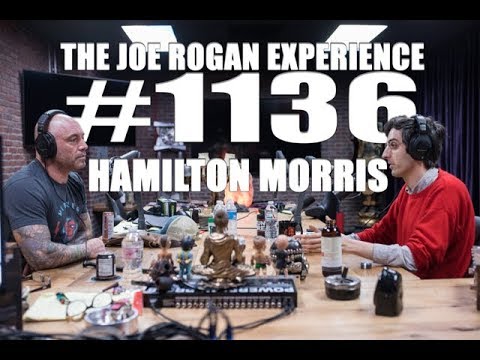
Joe Rogan Experience #1136 - Hamilton Morris
Joe Rogan (host), Hamilton Morris (guest)
In this episode of The Joe Rogan Experience, featuring Joe Rogan and Hamilton Morris, Joe Rogan Experience #1136 - Hamilton Morris explores hamilton Morris and Joe Rogan Deconstruct Drugs, Laws, and Consciousness Joe Rogan and chemist‑journalist Hamilton Morris have a wide‑ranging, three‑hour conversation about psychoactive drugs, media narratives, and personal freedom. They contrast nuanced, long‑form discussion with sensationalist TV and click‑driven journalism, especially around substances like kratom, opioids, synthetic cannabinoids, and fentanyl. Morris repeatedly argues that drugs themselves are neutral molecules and that harms come from policy, ignorance, supply chains, and human behavior—not inherent “evil” chemicals. They also explore psychedelics as tools for psychotherapy, spiritual insight, and perspective shifts, while acknowledging real risks such as psychotic breaks, cardiotoxicity, and ecological damage to plants like peyote.
Hamilton Morris and Joe Rogan Deconstruct Drugs, Laws, and Consciousness
Joe Rogan and chemist‑journalist Hamilton Morris have a wide‑ranging, three‑hour conversation about psychoactive drugs, media narratives, and personal freedom. They contrast nuanced, long‑form discussion with sensationalist TV and click‑driven journalism, especially around substances like kratom, opioids, synthetic cannabinoids, and fentanyl. Morris repeatedly argues that drugs themselves are neutral molecules and that harms come from policy, ignorance, supply chains, and human behavior—not inherent “evil” chemicals. They also explore psychedelics as tools for psychotherapy, spiritual insight, and perspective shifts, while acknowledging real risks such as psychotic breaks, cardiotoxicity, and ecological damage to plants like peyote.
Key Takeaways
Treat drugs as tools, not moral agents.
Morris emphasizes that molecules like fentanyl, kratom, or synthetic cannabinoids are inert; harms arise from dose, purity, context, policy, and human choices. ...
Get the full analysis with uListen AI
Cognitive liberty is a stronger foundation than “this drug is safe.”
Arguing for legalization purely on safety or medical utility is fragile, because any adverse event can be used to re‑justify bans. ...
Get the full analysis with uListen AI
Sensational journalism distorts drug policy and can erase useful compounds.
Historically, scare pieces about LSD, ibogaine, 2C‑T‑7, synthetic cannabinoids, and others helped push substances into Schedule I, often on thin or misinterpreted evidence. ...
Get the full analysis with uListen AI
Psychedelics’ hardest experiences can be the most therapeutic—within limits.
Morris argues that so‑called “bad trips” often function like psychological near‑death experiences, forcing people to confront core fears and patterns. ...
Get the full analysis with uListen AI
Set, setting, and culture largely shape what a drug ‘does.’
Anthropological evidence and examples like heroin‑using laborers, early PCP psychotherapy, and different alcohol cultures show that “pharmacological determinism” (drug X always causes behavior Y) is false. ...
Get the full analysis with uListen AI
Market forces and testing regimes create unintended drug trends.
Workplace urine tests and parole conditions helped drive demand for untested synthetic cannabinoids that don’t show up on screens. ...
Get the full analysis with uListen AI
Ecology and supply matter as much as chemistry.
Ultra‑slow‑growing peyote and toad‑derived 5‑MeO‑DMT illustrate how demand plus prohibition can threaten species and Indigenous practices. ...
Get the full analysis with uListen AI
Notable Quotes
“Drugs have never hurt anyone. They’re just inanimate constellations of carbon and hydrogen and nitrogen and oxygen.”
— Hamilton Morris
“If you want to live in a free society, you have to be allowed to take a certain amount of risk.”
— Hamilton Morris
“You don’t need to hate something to justify your love of cannabis.”
— Hamilton Morris
“We’ve all bought into a game and it’s a bad game to play.”
— Hamilton Morris
“One of the best things that psychedelic drugs provide is an escape from the momentum of this life that you’ve created.”
— Joe Rogan
Questions Answered in This Episode
How should drug policy shift if we started from the principle of cognitive liberty rather than harm avoidance or moral judgment?
Joe Rogan and chemist‑journalist Hamilton Morris have a wide‑ranging, three‑hour conversation about psychoactive drugs, media narratives, and personal freedom. ...
Get the full analysis with uListen AI
What concrete mechanisms could prevent journalists and editors from incentivizing sensationalism that directly shapes drug scheduling?
Get the full analysis with uListen AI
How can psychedelic therapies be scaled while screening for and protecting those vulnerable to psychosis or adverse reactions?
Get the full analysis with uListen AI
What regulatory and ecological frameworks would allow ethical, sustainable use of slow‑growing or animal‑derived psychoactives like peyote and toad venom?
Get the full analysis with uListen AI
In a culture saturated with phones and outrage‑driven media, can psychedelics realistically help people reorient toward empathy and long‑form thinking, or will they be co‑opted by the same systems?
Get the full analysis with uListen AI
Transcript Preview
(sighs) I try so hard. (laughs)
(laughs) Boom, and we're live, Hamilton Morris, (fingers snap) sober as fuck. How about you? Absolutely sober.
Yes, this time. So we did a podcast seven years ago and most people apparently didn't know how fucked up we were. But, uh, I figured, "Damn, we're here with Hamilton Morris, we should go deep." And we just kept hitting that joint till I lost most of my grasp on reality while we were talking. (laughs)
(laughs)
It was just a very slippery conversation. I was just too high to form coherent thoughts. It was just... Whatever I pieced together was just, uh, it was... You know, it was al- almost like miming a conversation.
(laughs) But now it's seven years later and you have a new place.
Yeah.
It's beautiful.
Yeah. Well, you were... At the early days, we did it at my house.
Yeah.
That was way, way, way back in the day.
I had no idea, really. I knew who you were, of course, but I didn't know about your podcast entirely. I'd seen clips of you on YouTube and it wasn't until I was driving home from that recording and my phone just filled with hundreds of emails that I realized, "Oh, wow, this is a, a serious phenomenon that I was not aware of."
(laughs)
And now I see it's just become huge.
It's a weird thing, dude. It, it's, uh, it's got the wheel. I just sort of have to show up. It's a very stran- uh, an- and it sounds like, um, false modesty or something like that, but I'm just being totally honest. Like, this thing does itself.
I think a lot of it might have to do with the long form.
Yeah.
Because people are so used to seeing people's opinions condensed and filtered into these soundbites and snippets, and to hear an extended conversation with someone where they can actually tell stories and articulate their opinions in a nuanced, careful way is so rare.
I agree. Um, uh, it's one of the reasons why I don't do those shows anymore, like panel shows and things like that.
Yeah.
It's just so frustrating.
Oh, it's insane. I have very little experience with that sort of thing, but I did Dr. Oz, um-
(laughs)
(laughs) ... last year.
One of the worst ones.
Yes. And I don't know how any normal person could function in that sort of environment. I mean, I have a, a TV show, so arguably, I'm well-trained for that sort of thing. But unless you're an actor who's prepared a line to say as soon as they point at you, there's no way that you could function because it's not a genuine conversation. It's just an opportunity to launch one-sentence soundbites and then audience applause.
Yeah. And also, the audience is such a strange element to add to a conversation. I mean, if you and I were having this conversation exactly in this r- this room, but to the left of us is an enormous group of people, we would feel weird. We would have to address them, we'd have to turn to them. It, it would be odd.
Install uListen to search the full transcript and get AI-powered insights
Get Full TranscriptGet more from every podcast
AI summaries, searchable transcripts, and fact-checking. Free forever.
Add to Chrome