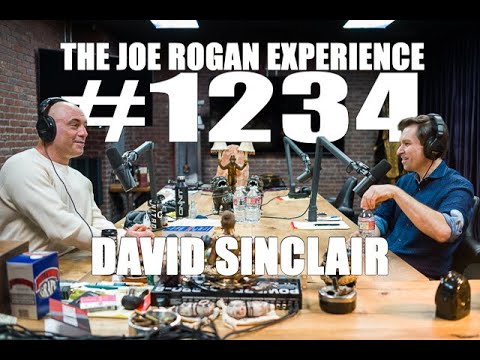
Joe Rogan Experience #1234 - David Sinclair
Joe Rogan (host), David Sinclair (guest)
In this episode of The Joe Rogan Experience, featuring Joe Rogan and David Sinclair, Joe Rogan Experience #1234 - David Sinclair explores harvard longevity scientist reveals real-world strategies to slow aging Joe Rogan interviews Harvard geneticist David Sinclair about emerging science that treats aging as a disease-like process that can be slowed and potentially reversed. Sinclair explains how pathways like sirtuins, AMPK, and mTOR respond to stressors such as fasting, exercise, heat, and cold—and how certain molecules (like NMN, resveratrol, and metformin) can pharmacologically tap into those systems. They cover Sinclair’s personal regimen, the ethics and economics of longevity drugs, and how epigenetic damage—not just DNA mutations—may underlie aging. The conversation ranges from diet, exercise, and blood testing to CRISPR, designer babies, Lyme disease diagnostics, and future therapies that may restore vision and rejuvenate tissues.
Harvard longevity scientist reveals real-world strategies to slow aging
Joe Rogan interviews Harvard geneticist David Sinclair about emerging science that treats aging as a disease-like process that can be slowed and potentially reversed. Sinclair explains how pathways like sirtuins, AMPK, and mTOR respond to stressors such as fasting, exercise, heat, and cold—and how certain molecules (like NMN, resveratrol, and metformin) can pharmacologically tap into those systems. They cover Sinclair’s personal regimen, the ethics and economics of longevity drugs, and how epigenetic damage—not just DNA mutations—may underlie aging. The conversation ranges from diet, exercise, and blood testing to CRISPR, designer babies, Lyme disease diagnostics, and future therapies that may restore vision and rejuvenate tissues.
Key Takeaways
Intermittent fasting and mild stressors activate built-in longevity pathways.
Periods of hunger, intense but not excessive exercise, sauna/cold exposure, and other hormetic stressors switch on protective systems (like sirtuins and AMPK) that repair damage and extend healthspan in animals.
Get the full analysis with uListen AI
Boosting NAD levels with precursors like NMN may restore youthful cellular function.
NAD declines sharply with age; precursors such as NMN (and NR) raise NAD back toward youthful levels in animals, improving endurance, blood vessel function, and overall metabolic health, with human trials underway.
Get the full analysis with uListen AI
Certain drugs with long safety records may slow age-related disease risk.
Metformin, a common diabetes drug, is associated in large human datasets with lower rates of cancer, heart disease, frailty, and possibly longer lifespan, leading many aging researchers (including Sinclair) to take it off-label.
Get the full analysis with uListen AI
Lower protein and amino acid intake—especially from red meat—may favor longevity.
High intake of certain amino acids and red meat activates mTOR and produces TMAO, both linked to shorter lifespan and heart disease in animal and epidemiological studies; shifting toward plant-based, fish, and modest white meat may help.
Get the full analysis with uListen AI
Aging may be driven more by epigenetic ‘noise’ than by DNA mutations alone.
Sinclair posits that repeated DNA damage and repair scratch the epigenetic ‘reader’ system, causing cells to misread genes over time; resetting that epigenetic program in animals can make tissues functionally younger again.
Get the full analysis with uListen AI
Regular, data-driven monitoring can personalize and optimize longevity strategies.
Frequent blood work, biological age tests, and tracking tools (e. ...
Get the full analysis with uListen AI
Next-generation therapies may rejuvenate specific organs, starting with the eye.
Sinclair’s team has used gene therapy to reprogram retinal cells in mice, restoring vision after optic nerve damage, glaucoma, and age-related decline, with human glaucoma trials targeted around 2020 and broader applications envisioned later.
Get the full analysis with uListen AI
Lifestyle still matters, even with powerful molecules.
In animal studies, compounds like resveratrol and NMN work best when layered on top of calorie control and exercise; they enhance, rather than replace, healthy habits.
Get the full analysis with uListen AI
Notable Quotes
““I absolutely think aging should be classified as a disease.””
— David Sinclair
““We can trick the body into being hungry and in adversity, even if you’re eating a lot or you’re not exercising.””
— David Sinclair
““What I think is causing aging is not the loss of the digital information but it’s the reader… like a DVD that’s scratched.””
— David Sinclair
““If I died from heart disease tomorrow, that’d be a bad look.””
— David Sinclair
““We’re so pathetic as a species, our answer would be, ‘You mean that’s a thing? You can do something about that?’””
— Joe Rogan
Questions Answered in This Episode
How strong is the current human evidence that NMN or NR truly improve healthspan, beyond raising NAD levels in blood tests?
Joe Rogan interviews Harvard geneticist David Sinclair about emerging science that treats aging as a disease-like process that can be slowed and potentially reversed. ...
Get the full analysis with uListen AI
If metformin and rapamycin affect similar aging pathways, how do their risk–benefit profiles compare for otherwise healthy people?
Get the full analysis with uListen AI
What are the biggest scientific and safety hurdles to using epigenetic reprogramming in whole humans rather than just localized tissues like the eye?
Get the full analysis with uListen AI
How should average people balance the trade-off between maximizing current performance (e.g., high protein, BCAAs) and maximizing long-term longevity?
Get the full analysis with uListen AI
What ethical and regulatory frameworks are needed to govern gene editing, designer babies, and life-extension therapies so they don’t widen inequality or trigger backlash?
Get the full analysis with uListen AI
Transcript Preview
Here we go. Five, four, three, two, one. David.
Joe.
How are you, sir?
Great. Thanks.
Thanks for being here, man. I appreciate it.
Hey, thanks for having me on.
Really looking forward to talking to you. Very much so.
Well...
Um, this is a fascinating subject for me. Anti-aging. The idea that you'll be able to stop aging, or even possibly pull it back, or at v- very least slow it down. What do you think?
I think that's all on the table. We've been doing this for years in the lab. Now we've just got to figure out how to do it in people.
When I talk to someone like you as an actual research scientist in this stuff, I always want to know, what are you doing to yourself?
Ah. How long have you got? (laughs)
(laughs) Like, what do you do on a daily basis?
What do I do? I'm-
First of all, are you 100 years old?
Uh, getting there.
How old are you?
Uh, turning 50. So...
Oh, you're turning 50? Hmm.
Yeah.
I wouldn't have thought you were 50. I would've figured you were for about 41, 42.
Oh, that's kind of you. Um-
Hmm.
Well, my brother's the negative control and he's, he's, uh...
Does he look like shit?
Well, I can't say that, but, uh...
(laughs)
People say that he doesn't look as young as me and he's about three and a half years younger.
Oh. So what are you doing personally?
Uh, well, you know, most of the time, I'm in the lab and trying to run a bunch of companies to make these drugs a reality. Uh, but daily, you know, I try to keep a healthy weight. I do intermittent fasting, uh, which is pretty easy, 'cause I'm so busy, I forget to eat.
How many hours do you give yourself per night?
Uh, well, I suffer from, uh, late night snacking, but I try to skip breakfast and, and even skip lunch if I'm busy. So I'm a night eater. Um, but that seemed to be good, 'cause a, a study came out about a couple of weeks ago, at least in mice, that it's not what you eat, it's when you eat that's most important for longevity.
Really?
Yeah.
And when, when being when? Like what's best?
Well, I, it doesn't actually matter, uh, if you eat a lot in the morning or a lot at night. I like nighttime eating. But you need a period during the day, at least if you're a mouse, probably if you're a human, where you're hungry. Um, and that puts your body in a defensive mode. And these, these are the things that we've been studying in my lab for the last 20 years. What are the processes that diet and exercise do for us that keep us healthy, and why does calorie restriction and intermittent fasting make animals live so much longer? And we think we've figured out a large part of how that works, and now we're mimicking that with molecules.
Install uListen to search the full transcript and get AI-powered insights
Get Full TranscriptGet more from every podcast
AI summaries, searchable transcripts, and fact-checking. Free forever.
Add to Chrome