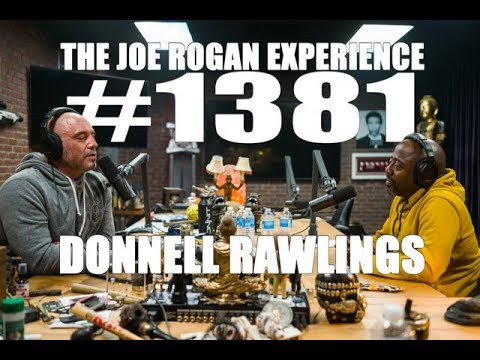
Joe Rogan Experience #1381 - Donnell Rawlings
Joe Rogan (host), Donnell Rawlings (guest), Narrator, Narrator, Narrator, Narrator, Narrator, Narrator
In this episode of The Joe Rogan Experience, featuring Joe Rogan and Donnell Rawlings, Joe Rogan Experience #1381 - Donnell Rawlings explores donnell Rawlings, Rogan Talk Comedy, Hip-Hop, Trauma, and Being Nice Joe Rogan and Donnell Rawlings riff through hip‑hop culture, military life, boxing, drugs, mental health, and the evolution of stand‑up comedy, weaving serious points into long stretches of storytelling and jokes.
Donnell Rawlings, Rogan Talk Comedy, Hip-Hop, Trauma, and Being Nice
Joe Rogan and Donnell Rawlings riff through hip‑hop culture, military life, boxing, drugs, mental health, and the evolution of stand‑up comedy, weaving serious points into long stretches of storytelling and jokes.
They examine how rap and Go-go shaped Black culture, how Eminem earned respect, and how Mike Tyson and George Foreman reinvented themselves after brutal careers.
The conversation turns to addiction, trauma, and the illusion of social media, stressing the importance of real community, honesty, and having at least one person who tells you the truth.
They close by breaking down the craft and grind of stand‑up, the legacy of Chappelle’s Show and Martin Lawrence, and Rogan pushes Rawlings into finally starting his own podcast as a way to own his voice.
Key Takeaways
Cultural fluency broadens your world and your material.
Rogan and Rawlings unpack rap slang (“spit a 16”) and Go-go music to show how knowing other subcultures (music, race, region) deepens both your understanding of people and your creative toolbox as a performer.
Get the full analysis with uListen AI
Trauma and addiction often sit under the surface of ‘bad decisions.’
From boxers with CTE making irrational life choices to people hooked on opioids or heroin seeking a ‘womb-like’ escape, they argue you can’t address self‑destructive behavior without acknowledging brain injury, abuse, and pain.
Get the full analysis with uListen AI
Strong community and one honest friend are protective factors.
They stress that people spiral when they feel alone and unvalued; having even one person who listens, tells you the truth, and wants nothing from you can be the difference between coping and collapsing.
Get the full analysis with uListen AI
Social media warps reality and fuels insecurity.
They describe Instagram as a fabricated highlight reel where people chase validation instead of real experiences, noting how phones ruin live shows and even vacations because people won’t do anything without documenting it.
Get the full analysis with uListen AI
Comedy must resist enforced ‘compliance’ to stay vital.
Discussing Chappelle and Burr, they argue that specials like Sticks & Stones are important because they set boundaries that comics speak honestly about taboo topics, rather than letting cultural critics dictate what’s acceptable.
Get the full analysis with uListen AI
Cycles in poor communities won’t break without both role models and self‑accountability.
They point to figures like Nipsey Hussle as blueprints for reinvestment and financial literacy while also bluntly saying communities must stop “fucking their own shit up” if they want outside help to matter.
Get the full analysis with uListen AI
Owning your platform (e.g., a podcast) is now essential for comics.
Rogan pushes Rawlings to launch his own show, arguing that a podcast is the one place a comic can control their voice, build direct audience connection, and not rely on TV or gatekeepers for relevance or income.
Get the full analysis with uListen AI
Notable Quotes
“Everybody has mental issues, but how do we cope with it?”
— Donnell Rawlings
“Our profession—we can’t comply. This is not a profession to comply in.”
— Joe Rogan
“If you don’t go on stage, that seed won’t blossom. You gotta water those seeds.”
— Donnell Rawlings
“What’s so hard about being nice?”
— Donnell Rawlings
“You really wanna change the gun laws? Have every Black person register to have a gun and see how quick the gun laws change.”
— Donnell Rawlings (paraphrasing Dave Chappelle’s joke)
Questions Answered in This Episode
How can communities practically balance ‘self-accountability’ with real structural investment when trying to reduce inner-city violence and poverty?
Joe Rogan and Donnell Rawlings riff through hip‑hop culture, military life, boxing, drugs, mental health, and the evolution of stand‑up comedy, weaving serious points into long stretches of storytelling and jokes.
Get the full analysis with uListen AI
Where should the line be drawn—if anywhere—between a comic’s responsibility to be sensitive and their need to ignore cultural ‘rules’ in order to be honest?
They examine how rap and Go-go shaped Black culture, how Eminem earned respect, and how Mike Tyson and George Foreman reinvented themselves after brutal careers.
Get the full analysis with uListen AI
In what ways can social media be used to foster genuine connection and mental health instead of worsening loneliness and comparison?
The conversation turns to addiction, trauma, and the illusion of social media, stressing the importance of real community, honesty, and having at least one person who tells you the truth.
Get the full analysis with uListen AI
How much responsibility do sports organizations and promoters have to protect fighters from long-term brain trauma, given stories like Riddick Bowe and Sugar Ray Leonard?
They close by breaking down the craft and grind of stand‑up, the legacy of Chappelle’s Show and Martin Lawrence, and Rogan pushes Rawlings into finally starting his own podcast as a way to own his voice.
Get the full analysis with uListen AI
What concrete mentorship or media models could help kids in neglected neighborhoods see realistic paths out, beyond the rare examples of athletes, rappers, or comics?
Get the full analysis with uListen AI
Transcript Preview
Why is that?
I don't know, it just feels... When you, it's, when you say, "Turn my shit up," the engineers and the producers feel like, oh, shit, this nigga just turned his shit up. He's about to go in.
Oh.
It gives you the impression that you're about to spit the hottest 16 of your life.
16? What does 16 mean?
16 bars-
Okay.
... in a song.
Okay.
Like a, like in, in ra- You don't know this?
No.
So, nobody's ever come up to you and say, um, uh-
(laughs)
Nobody's ever come up to you (laughs) and say-
(laughs)
... um, s- "Let me get your 16. Spit s- hot s- s-, uh, a hot 16." Nobody's ever said that to you?
Never in my life have I heard that expression.
You need to change the places you hang out, son.
(laughs)
(laughs)
For real, man. I mean, I mean, I don't know. (laughs)
(claps)
Ha!
I'm not trying, I'm just sayin' 'cause I'm pretty sure there are places you would've... All the people, all the Black people you know, all the rappers and nobody-
Nobody's ev- asked me to rap.
... nobody's ever asked you to spit?
No. No, never. I've never spit.
Have you ever practiced?
Never.
Come on, Joe. Don't lie, bruh.
Never. I'm not lying!
No, bruh. You don't-
No.
... you don't have-
I don't have any time.
If... You don't... Is that time for Black people or time for rap?
(laughs)
(laughs)
I'm just trying to figure out which-
Time for me to rap. I like listening.
Right.
But I've done zero rapping myself. (laughs)
So, you like, you like, you like (laughs) , you like ...
(laughs)
I don't know. People got s- little slick ways of saying stuff, man.
(laughs) No, I don't have any time to be rapping.
So, you, the, the, there's a f-
I limit my, uh, my, what I try to do.
Okay, you don't have time for rap?
I don't have time to do it. I like listening.
Okay, this is the point I'm making about spitting.
Okay.
If you listen to it, there's probably a song that you like and there's never been a time in your life, you've been in the mirror out of the shower, that it, it felt good to you and you tried to... Spitting is the same as repeating the, everything that the person said.
Right.
So, not one s- not one song that you like, you've never tried to sing a verse or, or, or a hook from that song?
I've definitely done that, but no one's ever asked me to spit.
Install uListen to search the full transcript and get AI-powered insights
Get Full TranscriptGet more from every podcast
AI summaries, searchable transcripts, and fact-checking. Free forever.
Add to Chrome