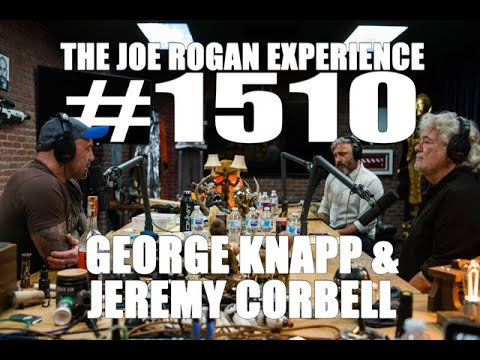
Joe Rogan Experience #1510 - George Knapp & Jeremy Corbell
Joe Rogan (host), George Knapp (guest), Jeremy Corbell (guest), Jeremy Corbell (guest), Narrator
In this episode of The Joe Rogan Experience, featuring Joe Rogan and George Knapp, Joe Rogan Experience #1510 - George Knapp & Jeremy Corbell explores uFO Journalism, Bob Lazar, And Government Secrets Confront Mainstream Reality Joe Rogan interviews veteran UFO journalist George Knapp and filmmaker Jeremy Corbell about decades of UFO reporting, with a heavy focus on Bob Lazar, Area 51/S4, and how those stories reshaped public and media discourse.
UFO Journalism, Bob Lazar, And Government Secrets Confront Mainstream Reality
Joe Rogan interviews veteran UFO journalist George Knapp and filmmaker Jeremy Corbell about decades of UFO reporting, with a heavy focus on Bob Lazar, Area 51/S4, and how those stories reshaped public and media discourse.
Knapp recounts how Lazar’s claims of working on reverse-engineered alien craft at S4 upended his career, triggered government pushback, and still provoke intense controversy despite many corroborating details and Lazar’s consistency over 30+ years.
They connect Lazar’s technical descriptions to modern Navy UFO encounters (like Commander Fravor’s Tic Tac case) and to recent Pentagon programs (AAWSAP/AATIP) and Senate interest, arguing that these validate that something with non-human-level technology is in our airspace.
The conversation broadens into cattle mutilations, Skinwalker Ranch, metamaterials, abduction cases, and philosophical speculation about what UFOs might be, while acknowledging the field’s disinformation, hoaxes, and lack of definitive proof.
Key Takeaways
Lazar’s story remains unusually consistent and partially corroborated, keeping it alive.
Over 30+ years, Bob Lazar has not materially changed his core account of working on non-human craft at S4, and several independent details (Los Alamos employment, S4 naming, element 115’s later confirmation) and witnesses align with his claims, which makes simple hoax explanations harder to sustain.
Get the full analysis with uListen AI
Recent Navy UFO cases tightly match Lazar’s old technical descriptions.
Commander Fravor’s Tic Tac encounter and the Gimbal and Go Fast videos show craft with apparent gravity-based propulsion, instantaneous acceleration, and inertia-defying maneuvers—in ways that Knapp and Corbell note parallel Lazar’s 1989 descriptions of how the S4 craft operated.
Get the full analysis with uListen AI
The U.S. government has quietly studied UFOs for years, now edging into the open.
Programs like AAWSAP and AATIP, initiated with Harry Reid’s backing and involving figures like Hal Puthoff and Robert Bigelow, produced technical reports and briefed Congress; the Pentagon has now admitted to ongoing UAP work and released videos, even while still obfuscating or denying key aspects.
Get the full analysis with uListen AI
Cattle mutilations and Skinwalker Ranch illustrate a broader ‘high-strangeness’ problem.
Knapp and Corbell describe meticulously investigated cases of bloodless cattle mutilations and bizarre phenomena at Skinwalker Ranch that resist prosaic explanation, suggesting that whatever underlies UFOs may connect to a wider spectrum of anomalous activity rather than just ‘craft in the sky.’
Get the full analysis with uListen AI
Physical “metamaterials” are being studied as potential non-human technology.
They discuss layered alloys and isotopically anomalous samples (referenced by Hal Puthoff and Jacques Vallée) now under military or research scrutiny; while not proven alien, some structures appear beyond known manufacturing methods, hinting at possible recovered hardware from unknown sources.
Get the full analysis with uListen AI
Disinformation, hoaxes, and fringe personalities make UFO research uniquely hazardous.
Knapp details targeted interference with sources, deliberate smears, role-players feeding him fake stories, and the general noise from “UFO experts” and schizophrenics, emphasizing that 90–95% of the field is garbage and that serious inquiry takes years of skeptical filtering.
Get the full analysis with uListen AI
If non-human intelligences are real, the implications for humanity are profound and unsettling.
The trio speculate that humans could be an experiment, an agricultural product, or a junior member in a larger cosmic neighborhood; whether we’re being monitored, protected from ourselves, or merely observed, they argue most people are far less “ready for disclosure” than they like to claim.
Get the full analysis with uListen AI
Notable Quotes
““Give me six months and I’ll have this figured out… 33 years later, I know less than I did then.””
— George Knapp
““Every time you turn over a stone, Bob’s proven right and it’s annoying.””
— Jeremy Corbell
““Our government does not tell members of Congress, ‘These are unidentified,’ if it isn’t.””
— George Knapp
““You’ve got to be dead to not be curious about this.””
— Jeremy Corbell
““Of course there’s something out there. It’s not if, it’s of course.””
— Joe Rogan
Questions Answered in This Episode
If the New York Times conclusively reported on crash-retrieval and reverse-engineering programs, how would that reshape public and scientific attitudes toward UFOs and Bob Lazar’s claims?
Joe Rogan interviews veteran UFO journalist George Knapp and filmmaker Jeremy Corbell about decades of UFO reporting, with a heavy focus on Bob Lazar, Area 51/S4, and how those stories reshaped public and media discourse.
Get the full analysis with uListen AI
Given the high percentage of hoaxes and misidentifications in the UFO field, what concrete standards of evidence should journalists and researchers insist on before taking a case seriously?
Knapp recounts how Lazar’s claims of working on reverse-engineered alien craft at S4 upended his career, triggered government pushback, and still provoke intense controversy despite many corroborating details and Lazar’s consistency over 30+ years.
Get the full analysis with uListen AI
Are Skinwalker Ranch–type ‘high-strangeness’ cases part of the same phenomenon as military UAP encounters, or are we conflating different categories of anomalies under the UFO umbrella?
They connect Lazar’s technical descriptions to modern Navy UFO encounters (like Commander Fravor’s Tic Tac case) and to recent Pentagon programs (AAWSAP/AATIP) and Senate interest, arguing that these validate that something with non-human-level technology is in our airspace.
Get the full analysis with uListen AI
If non-human intelligences are interfering with nuclear weapons systems, what motivations make the most sense: deterrence, experimentation, surveillance, or something we can’t yet frame?
The conversation broadens into cattle mutilations, Skinwalker Ranch, metamaterials, abduction cases, and philosophical speculation about what UFOs might be, while acknowledging the field’s disinformation, hoaxes, and lack of definitive proof.
Get the full analysis with uListen AI
How should democratic governments balance national security secrecy about advanced aerospace anomalies against the public’s right to know about potential non-human technology in our skies?
Get the full analysis with uListen AI
Transcript Preview
First of all, George, pleasure to meet you.
Joe, great to talk to you-
An honor.
... great- great to see you in person-
For real. Thank you.
... finally.
Great to see you too. And Jeremy, good to see you again, my friend. Hey Joe, good to see you, man. This is, uh, we're get- we're doing this often. Yeah. This is becoming a thing. Uh, George, uh, I think that you're probably, like, one of the most important figures when it comes to journalism and UFOs. And when you, uh, broke the Bog- Lazar story, was that... is that '89? When was that?
1989.
'89. 1989, um, I, I remember reading about it, I remember hearing about it, I remember watching clips on television and watching countless Bob Lazar interviews. It all came out of you. I mean, did you think at that time... I mean, what was your thoughts about UFOs before you had met Bob Lazar, and how much did it change while you got to know him and hear his story?
Uh, changed quite a bit. I had not really given it much thought at all. Uh, you know, probably the same level of curiosity as most people. You go about your life, you pay your bills, you go to work, you, you love your family, uh, and it's always out there somewhere, "Hey, I wonder what the deal is on that?"
Right.
But not- had not really dwelled on it until... There was a day in 1987. Into the studio comes a guy named, um, John Lear. And I had heard sort of a- a little bit about him. His family was famous. His dad developed the Learjet, the eight-track tape. John had run for the state senate and he had a certain amount of credibility with our news organization, KLAS-TV, because he had helped us break a really big story. And the story was the stealth fighter, the F-117. He had told my boss, Ned Day, managing editor, about this amazing plane that was invisible to radar flying up in Tonopah and Area 51. We had an interest in Area 51, not UFO-related, but Ned broke that story, it went national. So John Lear comes into the station one day with a stack of what turned out to be UFO documents, he plops 'em on Ned's desk, and says, "Ned, this is gonna be the next biggest story, the biggest story in history. It's a UFO cover-up. Aliens are here. Technology's been recovered." Ned takes a look at it and says, "I'm not doing this story. If it was true, I'd already know, know about it. Uh, this is crazy." Well, I'm eavesdropping, as I tend to do. I'm a curious person. So I's... As he's going out, I said, "Lear, let me take a look at this material." And I looked at it, and I thought, "Well, this is kind of interesting." I wa- at the time, I was, uh, producing and hosting this little public affairs show, 30-minute interview show. It would air Sunday morning at six o'clock. Nobody watches it. It would be, uh, interviewing a city councilman, a county commissioner. What the heck? I'll put Lear on there. And I let him go, and he told me this big sce- scenario about secret treaties with aliens and, uh, recovered technology and a giant cover-up. Some of the information sounded outrageous. Some of it seemed like it would be worth checking out. Suddenly, the phone starts ringing off the hook. I, I'm getting calls about people that, "W- who was that guy? What was the deal on that UFO stuff? Is it real?" I had him on again six months later, and the response was bigger. Had him on a third time with a guy named Bill Cooper, I regret that, um, and he told him an even more elaborate conspiracy-
Install uListen to search the full transcript and get AI-powered insights
Get Full TranscriptGet more from every podcast
AI summaries, searchable transcripts, and fact-checking. Free forever.
Add to Chrome