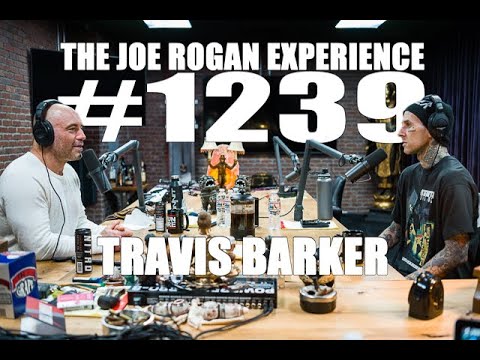
Joe Rogan Experience #1239 - Travis Barker
Joe Rogan (host), Travis Barker (guest), Narrator, Narrator
In this episode of The Joe Rogan Experience, featuring Joe Rogan and Travis Barker, Joe Rogan Experience #1239 - Travis Barker explores travis Barker on Survival, Discipline, Drumming, and Doing It All Travis Barker joins Joe Rogan to talk about the physical demands of drumming, how boxing and specific training keep him performing at full intensity, and why he avoids traditional weightlifting. He explains his long-standing vegetarian/vegan lifestyle, his role in acclaimed vegan restaurant Crossroads, and the LA vegan scene, including eccentric figures like a silent chef who hasn’t spoken in 22 years.
Travis Barker on Survival, Discipline, Drumming, and Doing It All
Travis Barker joins Joe Rogan to talk about the physical demands of drumming, how boxing and specific training keep him performing at full intensity, and why he avoids traditional weightlifting. He explains his long-standing vegetarian/vegan lifestyle, his role in acclaimed vegan restaurant Crossroads, and the LA vegan scene, including eccentric figures like a silent chef who hasn’t spoken in 22 years.
Barker details surviving his devastating plane crash, enduring severe burns and dozens of surgeries, quitting all drugs and prescriptions afterward, and rebuilding his life without flying by touring via bus and ship. He also discusses chronic conditions like trigeminal neuralgia, how CBD and diet changes help him manage pain, and his skepticism-turned-acceptance of issues like gluten sensitivity.
Beyond Blink-182, Barker describes his passion for producing rap and rock artists, constantly working in the studio, raising music-obsessed kids, and his need for multiple creative outlets to stay fulfilled. The conversation ranges into cars, Teslas, wildfires, coyotes, Bigfoot and UFOs, and how life-or-death experiences shaped his attitude toward risk, work ethic, and following a singular passion.
Key Takeaways
Train specifically for the demands of your craft, not general fitness ideals.
Barker avoids heavy, bodybuilder-style lifting because it made him stiff and slower on drums; instead he uses battle ropes, boxing, tempo-based “metronome workouts,” and fast-twitch training to build endurance and speed tailored to his playing.
Get the full analysis with uListen AI
Lifestyle changes often come from pivotal life moments—use them as leverage.
The impending birth of his son pushed Barker into boxing and a full lifestyle overhaul, while surviving the plane crash made him quit drugs and prescription meds without rehab and commit harder to health and family.
Get the full analysis with uListen AI
Diet tweaks can dramatically affect chronic conditions and performance.
Going vegan and later gluten-free reduced Barker’s pain and energy crashes; he also uses high-dose CBD (and sometimes gabapentin) to manage trigeminal neuralgia, showing how experimenting with diet and supplements can mitigate nerve and inflammation-related issues.
Get the full analysis with uListen AI
Passion plus focus beats “Plan B” thinking for creative careers.
Barker refused to develop a backup plan, believing it would dilute his effort; when he briefly considered a warehouse job, a friend convinced him to double down on drumming, leading to years of grinding in small bands that ultimately paid off.
Get the full analysis with uListen AI
Recovery from trauma is both physical and psychological—and often self-directed.
After severe burns, 30+ surgeries, and heavy hospital drug regimens, Barker ultimately ditched bipolar meds he was told he’d need for life, leaned on physical milestones like walking and showering alone, and used his kids and “second chance at life” as motivation instead of formal rehab.
Get the full analysis with uListen AI
Diversifying creative outlets can prevent burnout and keep you inspired.
Beyond Blink-182, Barker produces rap acts (Suicideboys, XXXTentacion, Vic Mensa), works on rock projects, and even film scores; shifting between genres and roles keeps him creatively energized instead of feeling trapped in one lane.
Get the full analysis with uListen AI
Success doesn’t remove risk; it just changes what you’re willing to risk.
Barker will drive days across the country or take a ship to Europe rather than fly, and he’s comfortable passing on certain opportunities to protect his mental health and be present for his kids—showing that boundaries can coexist with an intense work ethic.
Get the full analysis with uListen AI
Notable Quotes
“If I have a plan B, I’m not gonna try that hard.”
— Travis Barker
“I just wanted a lifestyle change. I needed to evolve and I needed to know how to protect this little human I was bringing into the world.”
— Travis Barker
“They told me I’d be on those meds for the rest of my life. I flushed them down the toilet and I’ve been fine.”
— Travis Barker
“Tour is a vacation. Home is way busier for me.”
— Travis Barker
“Don’t worry about being cool or being rich. Be passionate about what you’re passionate about and dedicate 100%.”
— Travis Barker
Questions Answered in This Episode
How did surviving the plane crash most fundamentally change the way you approach risk, both in life and in music?
Travis Barker joins Joe Rogan to talk about the physical demands of drumming, how boxing and specific training keep him performing at full intensity, and why he avoids traditional weightlifting. ...
Get the full analysis with uListen AI
Are there specific training protocols or recovery practices you’d recommend to other drummers or performers who face extreme repetitive stress?
Barker details surviving his devastating plane crash, enduring severe burns and dozens of surgeries, quitting all drugs and prescriptions afterward, and rebuilding his life without flying by touring via bus and ship. ...
Get the full analysis with uListen AI
What have you learned about pain management and mental health from using CBD, changing your diet, and rejecting long-term pharmaceuticals?
Beyond Blink-182, Barker describes his passion for producing rap and rock artists, constantly working in the studio, raising music-obsessed kids, and his need for multiple creative outlets to stay fulfilled. ...
Get the full analysis with uListen AI
How do you decide which projects to take on now—between producing, touring, family, and business—without burning out or overcommitting?
Get the full analysis with uListen AI
If you ever chose to fly again, what do you imagine would have to change in your mindset or circumstances to make that possible?
Get the full analysis with uListen AI
Transcript Preview
Let's do it. Four, one, boom. Hello, Travis.
What's going on?
Thanks, man. Thanks for doing this.
Oh, man.
I really appreciate it.
Stoked to be here.
S- s- cool to have you. Hey, so I wanted to talk about what we were talking about right before we started. I- I've always watched you play drums, and I'm like, "How the fuck does that guy's arms not fall off?" I mean, you, you have so much repetitive motion. I've never understood how you could do that.
Just barely. (laughs)
(laughs)
No, I, I kind of-
Pull this, pull this thing, like, right up, like a fist from your face. There we go.
I always do battle ropes.
Oh, okay. That h- that must do something.
Constantly, like, I'll do 30 minutes. Um, you know, not high intensity the whole time, but just keep my shoulders and arms moving as I prepare for a tour. But yeah, I think my wrists, my wrists probably have gone through the most hell over the years. Like, I just feel like just normal people's wrist strength, I probably don't have 'cause there's been so much grinding, like, they pop and-
Oh, Jesus.
... do all sorts of weird things. But yeah, but I'm still, you know, I feel like because I do battle ropes and because I box and the... kind of work out fast twitch muscles, I really don't get tired.
That's... uh, it's amazing. Like, uh, 'cause so many people have repetitive stress injuries.
Yeah.
You know, I mean, even secretaries, they get carpal tunnel. You know, people get... who write a lot, get carpal tunnel.
Yeah.
Kids are getting injuries on their thumbs from, you know, fucking around with their phone too much.
Yeah, I felt like when I smoked cigarettes a lot, I was feeling kind of the first symptoms of that stuff.
Ah.
And I wasn't drinking a lot. I was kind of a dumpster on tour, you know, not really taking care of my body, and I could really feel it.
And then y- y- are you still vegan?
Yeah.
And you run that restaurant, right? Um, uh, what is it? Crossroads or it's one of your-
S-
... your... one of the owners?
Running it is saying a lot.
Yeah, running. I mean-
I couldn't do that. (laughs)
(laughs) I shouldn't have said running it.
No, Tal, Tal Ronen is the man. He's like the illest vegan chef ever. And he's like an old punk rock hardcore guy, like new John Joseph forever.
Yeah, John Joseph keeps trying to get me to go there.
Yeah.
And I- I almost went last time he was in town with them. Next time, I'm gonna make it down there.
I think probably 80 to 90% of the people that eat there aren't vegan 'cause it's that good. Like-
Install uListen to search the full transcript and get AI-powered insights
Get Full TranscriptGet more from every podcast
AI summaries, searchable transcripts, and fact-checking. Free forever.
Add to Chrome