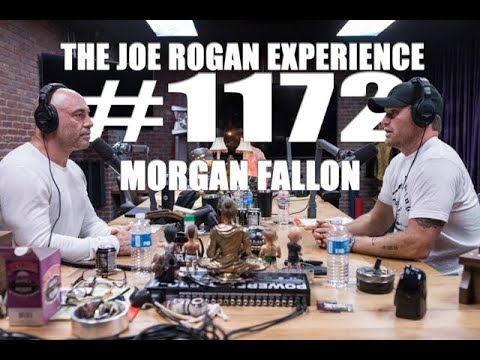
Joe Rogan Experience #1172 - Morgan Fallon
Joe Rogan (host), Morgan Fallon (guest)
In this episode of The Joe Rogan Experience, featuring Joe Rogan and Morgan Fallon, Joe Rogan Experience #1172 - Morgan Fallon explores inside Anthony Bourdain’s Legacy: Honesty, Food, Travel, and Truthful TV Joe Rogan and director Morgan Fallon reflect on Anthony Bourdain’s life, work, and impact, focusing on a decade of making No Reservations and Parts Unknown together.
Inside Anthony Bourdain’s Legacy: Honesty, Food, Travel, and Truthful TV
Joe Rogan and director Morgan Fallon reflect on Anthony Bourdain’s life, work, and impact, focusing on a decade of making No Reservations and Parts Unknown together.
They break down how Bourdain’s writing, narration, and punk-rock sensibility transformed a “food show” into deep storytelling about culture, politics, class, and human connection around the world.
Fallon explains the production process, ethics, and behind‑the‑scenes rules that kept the show authentic, from refusing staged scenes to letting failure and ambiguity stay in the final cut.
The conversation also explores Bourdain’s late‑life obsession with jiu-jitsu, the emotional aftermath of his death, and how his and Steve Rinella’s work reshaped public perceptions of cooking, travel, and hunting.
Key Takeaways
Bourdain’s narration was the creative engine that animated the show.
Episodes were rough-cut without voiceover, then sent to Bourdain, whose precise, poetic writing and delivery acted like a “Frankenstein lightning bolt,” bringing structure, emotion, and meaning to otherwise raw footage.
Get the full analysis with uListen AI
Food was used as a universal key to unlock deeper stories about people and places.
The show treated cuisine not just as pleasure or status but as an edible record of history, labor, politics, religion, and class, enabling conversations that went far beyond restaurants and recipes.
Get the full analysis with uListen AI
Radical authenticity—refusing to fake or over-produce reality—was a hard rule.
Fallon emphasizes that they would not stage hunts, reshoot “reality,” or manipulate scenes to manufacture drama, seeing that as an ethical line; even embarrassing incidents (like the fake octopus fiasco in Sicily) were exposed rather than hidden.
Get the full analysis with uListen AI
Letting failure and doubt stay on camera created more honest, compelling stories.
Both in Parts Unknown and MeatEater, they aired failed hunts, missed shots, and moral hesitation (e. ...
Get the full analysis with uListen AI
True creative partnership requires networks to tolerate risk and discomfort.
CNN is credited for letting Bourdain “be himself,” airing controversial content (Tokyo subcultures, cannabis in Seattle, politically sensitive regions) and trusting the team’s editorial judgment instead of forcing a safer, blander product.
Get the full analysis with uListen AI
Immersive travel expands, rather than shrinks, your sense of the world.
After years in places like Nigeria, DRC, and West Virginia, Fallon says you realize each city, town, and street contains endless untold stories; the more you travel, the bigger and more complex the world feels, countering fear‑based news narratives.
Get the full analysis with uListen AI
Strong, consistent ethics can redefine entire genres.
Bourdain changed how audiences value food and travel storytelling, while Rinella’s rigor and ethics shifted perceptions of hunting; both show that intelligent, morally grounded voices can transform “trash TV” categories into serious, respected work.
Get the full analysis with uListen AI
Notable Quotes
“It’s not a food show… Food is a jumping point for anything you wanna talk about.”
— Morgan Fallon
“We weren’t gonna interrupt the world. We weren’t gonna manipulate and control things.”
— Morgan Fallon
“He completely changed the way I thought about cooking. I realized it’s an art form you eat.”
— Joe Rogan
“Any mistakes he may have made in his life, I can honestly say he made them with his heart.”
— Morgan Fallon (on Anthony Bourdain)
“There’s before and there’s after, and it’s two different people. The more places you go, the bigger the world feels.”
— Morgan Fallon
Questions Answered in This Episode
How might food and travel shows today build on Bourdain’s model without simply imitating his persona?
Joe Rogan and director Morgan Fallon reflect on Anthony Bourdain’s life, work, and impact, focusing on a decade of making No Reservations and Parts Unknown together.
Get the full analysis with uListen AI
Where is the ethical line between shaping reality for television and deceiving viewers, and who should decide where that line sits?
They break down how Bourdain’s writing, narration, and punk-rock sensibility transformed a “food show” into deep storytelling about culture, politics, class, and human connection around the world.
Get the full analysis with uListen AI
In what ways has constant exposure to fear-driven news warped public perceptions of places like Africa, and how can storytelling repair that?
Fallon explains the production process, ethics, and behind‑the‑scenes rules that kept the show authentic, from refusing staged scenes to letting failure and ambiguity stay in the final cut.
Get the full analysis with uListen AI
Could a show with Bourdain-level creative autonomy and risk-taking be greenlit for the first time in today’s streaming landscape, or did he occupy a unique historical window?
The conversation also explores Bourdain’s late‑life obsession with jiu-jitsu, the emotional aftermath of his death, and how his and Steve Rinella’s work reshaped public perceptions of cooking, travel, and hunting.
Get the full analysis with uListen AI
What responsibilities do hunting and cooking shows have to change long-standing stereotypes about hunters, chefs, and the people whose stories they tell?
Get the full analysis with uListen AI
Transcript Preview
All right. Four, three, two, one. (claps) What's up, Mo?
What's up, man? How you doing?
How are you, buddy? Good to see you, man.
Good. It's good to see you.
Um, I'm glad we decided to get together and do this, you know, and, and talk and, um, you know, it's c- it's a crazy subject, right? I mean, uh, you and I have known each other for since 2012 when, uh, I did Meat Eater. You were there filming when I shot my first deer, which is a very important part of my life, man. And, um, then you went on to, uh, direct and produce Parts Unknown with our late friend, Anthony Bourdain. And, uh, we just thought it'd probably be a good thing to come in here and just talk, talk about him.
Yeah, man. And, uh, and I'm really grateful for it, you know. It's actually, you know, a lot of people, um, have been saying to me like, "Oh, it must be really hard to talk about that. It must really..." It's, I actually find it kind of the opposite. Like I wanna talk about him and I wanna talk about who he was and what that experience was, you know, so, um, thanks, man.
My pleasure, brother. Did you, did you know him before you guys started working together?
No. No. I met Tony, uh, 10 years ago and I was called in, uh, he had a, a DP on his show who, at the last minute, canceled and couldn't go to Egypt, so, uh, I got a call like a week before, you know. He's like, "Do you wanna go to Egypt with Anthony Bourdain?" I was like, "Y- yeah, fuck yeah, absolutely." (laughs)
Right.
You know. Um, and, uh, and so I met him in Cairo, man. Like, you know-
Wow.
... it was kinda like perfect, yeah.
Holy shit. That's like Indiana Jones type of shit. (laughs)
(laughs) Yeah, yeah. Exactly, man.
Is that the episode when you guys ate a camel?
No. No. We didn't eat a camel.
Oh, that was a different one?
No. But, um, you know, uh, I met him there. You know, we started filming. We were on the streets of Cairo and like, you know, it's just like all of a sudden, I was thrown into these kitchens where it's like, "We're eating pigeon." You know, it's like, "Go and cover them cooking pigeon." And, you know, I had-
Right.
... I had seen the show like maybe once before, but I had n- I knew who he was and I knew what that adventure was.
Right.
You know, and I was so amped for it. Um, and then there was like this seminal moment on that show where, uh, we go out and we, we go ripping across the desert with the Bedouin and go out and cook a goat, uh, in the ground, you know. Um, and so as we're driving out over the desert, we're like, "Well, we need to get, we need some shots from car to car," right? And I was like, "I'll get on the roof," you know. And, uh, and there's like this four, for some reason, there's a four-post bed tied to the roof of this, uh, Land Rover.
Install uListen to search the full transcript and get AI-powered insights
Get Full TranscriptGet more from every podcast
AI summaries, searchable transcripts, and fact-checking. Free forever.
Add to Chrome