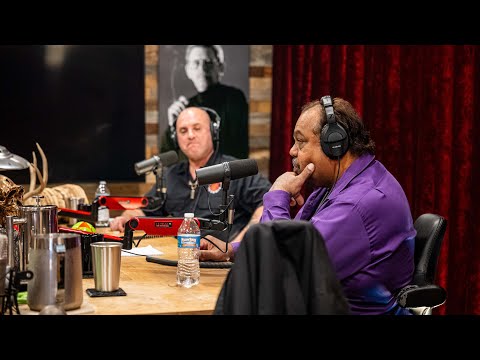
Joe Rogan Experience #2399 - Daryl Davis & Jeff Schoep
Jeff Schoep (guest), Joe Rogan (host), Daryl Davis (guest), Narrator, Jeff Schoep (guest), Narrator, Narrator
In this episode of The Joe Rogan Experience, featuring Jeff Schoep and Joe Rogan, Joe Rogan Experience #2399 - Daryl Davis & Jeff Schoep explores former Neo-Nazi Commander Reveals How Conversation Defeats Violent Extremism Joe Rogan speaks with Daryl Davis, a Black musician known for befriending Ku Klux Klan members, and Jeff Schoep, the former commander of the largest neo‑Nazi group in the U.S. They trace Jeff’s path from fourth‑grade fascination with Nazism to 27 years of leadership in the National Socialist Movement, and then his eventual de‑radicalization and public renunciation of hate. Daryl explains his method of engaging extremists through patience, curiosity, and respect, emphasizing shared human values rather than direct ideological combat. Together they outline how fear, identity loss, echo chambers, and demographic anxiety fuel extremism—and how genuine relationships and new purpose can pull people out.
Former Neo-Nazi Commander Reveals How Conversation Defeats Violent Extremism
Joe Rogan speaks with Daryl Davis, a Black musician known for befriending Ku Klux Klan members, and Jeff Schoep, the former commander of the largest neo‑Nazi group in the U.S. They trace Jeff’s path from fourth‑grade fascination with Nazism to 27 years of leadership in the National Socialist Movement, and then his eventual de‑radicalization and public renunciation of hate. Daryl explains his method of engaging extremists through patience, curiosity, and respect, emphasizing shared human values rather than direct ideological combat. Together they outline how fear, identity loss, echo chambers, and demographic anxiety fuel extremism—and how genuine relationships and new purpose can pull people out.
Key Takeaways
Hate is often learned, situational, and reversible—not an inherent trait.
Jeff wasn’t raised to hate; his racism and antisemitism were built through family history curiosity, propaganda, and echo chambers. ...
Get the full analysis with uListen AI
Direct, calm conversation can disarm extremists more effectively than confrontation.
Daryl’s method is to listen, stay emotionally steady, and offer new perspectives rather than yell or shame. ...
Get the full analysis with uListen AI
People join extremist movements seeking identity, purpose, and belonging.
Jeff describes the neo‑Nazi group filling the same role as a mission, job, and social circle—especially after he lost his band and was doxed. ...
Get the full analysis with uListen AI
Demographic anxiety and “replacement” fears are major drivers of modern white extremism.
Daryl recounts extremists’ obsession with the 2042–2050 period, when whites may become a numerical minority in the U. ...
Get the full analysis with uListen AI
Violent clashes and media coverage often strengthen extremist recruitment.
Both guests explain how Nazis and similar groups deliberately stage events to provoke riots and then repurpose TV footage as proof that “the system” and minorities are attacking them. ...
Get the full analysis with uListen AI
Stigma makes it hard for former extremists to leave and reintegrate.
Leaving means losing income, social networks, and status, and carrying the label “former neo‑Nazi” at every introduction. ...
Get the full analysis with uListen AI
Focusing on shared human values works better than purely ‘anti‑’ framing.
Daryl emphasizes five universal desires—love, respect, being heard, fairness, and family well‑being—and calls himself “pro‑human” rather than “anti‑racist” (in the sense of anti‑person). ...
Get the full analysis with uListen AI
Notable Quotes
“When you dehumanize another human being, you lose your humanity in that process.”
— Jeff Schoep
“What can be learned can be unlearned.”
— Daryl Davis
“I’m not anti‑racist. I’m anti the -ism. I am pro‑human.”
— Daryl Davis
“Hate is exhausting.”
— Daryl Davis
“It’s not a noble grand cause if it’s causing that kind of pain and suffering to other people.”
— Jeff Schoep
Questions Answered in This Episode
How can schools and communities safely create spaces where extremist ideas are openly challenged by better arguments rather than being censored into echo chambers?
Joe Rogan speaks with Daryl Davis, a Black musician known for befriending Ku Klux Klan members, and Jeff Schoep, the former commander of the largest neo‑Nazi group in the U. ...
Get the full analysis with uListen AI
What specific early warning signs should families or friends look for that someone is sliding into extremist ideology online?
Get the full analysis with uListen AI
How much forgiveness should society extend to former extremists, and what conditions (time, actions, reparations) should matter in deciding that?
Get the full analysis with uListen AI
Could Daryl’s relational, conversation‑based approach scale beyond individual meetings—e.g., into law enforcement, prisons, or online interventions?
Get the full analysis with uListen AI
How should we balance exposing young people to the reality of groups like Nazis and the KKK with the risk of glorifying or inadvertently recruiting for them?
Get the full analysis with uListen AI
Transcript Preview
(drumming music) Joe Rogan podcast, check it out.
The Joe Rogan Experience. Train by day, Joe Rogan podcast by night, all day. (rock music) Okay. Gentlemen. Good to see you, brother.
Hey, good to see you again too.
How you been? You good?
I've been hanging, man. How about yourself?
I'm good. I'm good. And Jeff, nice to meet you as well.
Nice to meet you, Joe.
This is, uh, another one of your very unusual friendships, Daryl. (laughs)
(laughs) I'm trying to make it the norm, you understand? (laughs)
Well, I mean, you're, you're a real example of what can be done bo- just by being a nice person.
Hey, thank you, man, for, for the mention with, um, um, Bono.
Oh, my pleasure.
I appreciate that.
My pleasure. Um, so for people that don't know, uh, Daryl has ... I mean, how many people now have you converted?
I, I, I stopped counting after 200 and something.
Daryl, his journey initially started, you're a musician, he met a Klansman at a bar.
Right.
And he couldn't believe what a nice guy you were, you struck up a friendship with this guy-
And I played like Jerry Lee Lewis and he didn't understand that.
(laughs)
(laughs)
That too, the talent. And then, um, this guy quit the Klan because of you, and handed you his outfit and said like, "I'm done." Um-
Yeah.
"Obviously I'm wrong, all this is wrong." And you then went on to start meeting a lot of other Klan members and a lot of other, you know, different neo-Nazi factions, and you got a lot of these people to quit these hateful organizations.
Well, I got them to, to rethink-
Mm-hmm.
... uh, because I gave them s- things, perspectives they had not considered before, or not been exposed to, and that caused them to quit.
Mm, yes, right.
You know, it wasn't like I was, I was, I wasn't trying to get them out, I was just trying to sh- show them a different path.
Right. But it's just, your patience and your ability to communicate to people is just very admirable, 'cause that's a very tough path. You know, you, for people just listening, you're a Black man, you're meeting a Klansman and you strike up a friendship. You know, you wind up having dinner at his house, hanging out with him, and he's like, "You're actually a really nice guy."
(laughs)
He's like, "Fuck. What the fuck am I doing with my life?" And just by your own personality and just being a, a good human, you, you converted them.
But, you know, an, an interesting component to that also happens, 'cause, you know, there are people who won't talk to me, you know, and they wanna fight me and stuff, and all the kind of crazy stuff. I've seen it all, right?
Install uListen to search the full transcript and get AI-powered insights
Get Full TranscriptGet more from every podcast
AI summaries, searchable transcripts, and fact-checking. Free forever.
Add to Chrome