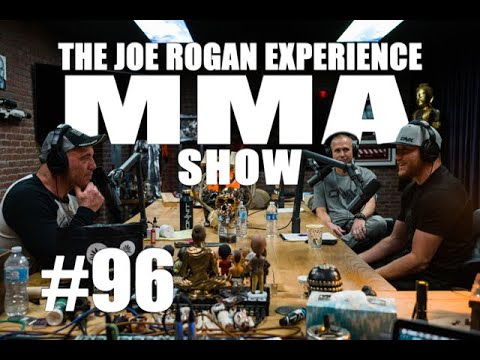
JRE MMA Show #96 with Justin Gaethje & Trevor Wittman
Joe Rogan (host), Trevor Wittman (guest), Justin Gaethje (guest), Justin Gaethje (guest), Justin Gaethje (guest), Justin Gaethje (guest), Justin Gaethje (guest), Trevor Wittman (guest), Joe Rogan (host)
In this episode of The Joe Rogan Experience, featuring Joe Rogan and Trevor Wittman, JRE MMA Show #96 with Justin Gaethje & Trevor Wittman explores justin Gaethje and Trevor Wittman Reveal Mindset, Training, and Innovation Justin Gaethje and coach Trevor Wittman break down Justin’s evolution from an all-action brawler into a calculated, championship-level striker, and how a tight one‑on‑one coach–fighter relationship made that possible.
Justin Gaethje and Trevor Wittman Reveal Mindset, Training, and Innovation
Justin Gaethje and coach Trevor Wittman break down Justin’s evolution from an all-action brawler into a calculated, championship-level striker, and how a tight one‑on‑one coach–fighter relationship made that possible.
They go deep on training structure, overtraining, weight cutting, and game-planning for elite opponents like Tony Ferguson and Khabib Nurmagomedov, emphasizing distance, footwork, and mental preparation.
Wittman also unveils his ONX equipment line, explaining how current MMA gloves and gear contribute to injuries and eye pokes, and why his patented designs are engineered to protect fighters and improve performance.
Throughout, they discuss fighter psychology, career longevity, money, and why clear goals and boundaries (like not taking short‑notice fights) are critical to surviving and thriving in MMA.
Key Takeaways
A small, focused stable can outperform big ‘super gyms’.
Wittman argues that coaching a few athletes intensely—seeing every session, managing load, and knowing their psyche—produces better results than spreading attention across dozens of fighters.
Get the full analysis with uListen AI
Fight style must evolve with goals—from ‘most exciting’ to ‘world champion’.
Gaethje shifted from seeking car-crash brawls to fighting in ‘spots’ with smarter defense and footwork once he decided he wanted to be champion, not just entertaining.
Get the full analysis with uListen AI
Overtraining and fragmented coaching are major, avoidable problems in MMA.
Many fighters get hard sessions from multiple coaches in different gyms, piling up fatigue and injuries; Wittman stresses centralized planning and knowing when to pull an athlete back.
Get the full analysis with uListen AI
Short-notice fights should align with a fighter’s own rules and mental readiness.
Gaethje initially refused short-notice Tony Ferguson fights to protect his preparation standards and confidence, then only accepted when timing and conditioning lined up with his own criteria.
Get the full analysis with uListen AI
Distance and footwork are central to neutralizing elite grapplers like Khabib.
Gaethje and Wittman outline a Khabib game plan built on staying off the fence, controlling distance, and forcing takedown attempts in open space, where Gaethje’s defensive wrestling excels.
Get the full analysis with uListen AI
Current MMA gloves and gear are poorly engineered and contribute to injuries.
Wittman details how standard gloves force hands open, misalign knuckles, use cheap foam, and vary wildly in weight, leading to hand breaks and eye pokes—issues his ONX designs explicitly target.
Get the full analysis with uListen AI
Fighters need clear exit plans and life structure beyond the cage.
They talk about how fame, relationships, and identity can derail athletes, and why setting timelines, financial goals, and having grounded support (like Wittman’s wife) are key to a healthy transition.
Get the full analysis with uListen AI
Notable Quotes
“I went from ‘I wanna be the most exciting fighter’ to ‘I wanna be the champion.’ Once that changed, everything about how I fight had to change.”
— Justin Gaethje
“If you’re not coachable, I’m just a water boy. I’m the co‑pilot—I draw the map and you have to trust me around the corners.”
— Trevor Wittman
“We didn’t change who he is. We just made him fight in spots. You can’t be the best fighter in the world without being the best defensive fighter.”
— Trevor Wittman (about Justin Gaethje)
“I don’t process physical versus mental separately. To fight the way I do, my mind has to be in a very, very special place—and that takes time.”
— Justin Gaethje
“Our sport has world‑class athletes using $60 gloves filled with seat‑cushion foam. Where’s the testing? Where’s the MMA equipment actually made for MMA?”
— Trevor Wittman
Questions Answered in This Episode
How much of Gaethje’s transformation was technical versus purely mental, and could another fighter realistically replicate that shift?
Justin Gaethje and coach Trevor Wittman break down Justin’s evolution from an all-action brawler into a calculated, championship-level striker, and how a tight one‑on‑one coach–fighter relationship made that possible.
Get the full analysis with uListen AI
If the UFC adopted Wittman’s glove design, how might that change fight outcomes, injury rates, and even career lengths over a decade?
They go deep on training structure, overtraining, weight cutting, and game-planning for elite opponents like Tony Ferguson and Khabib Nurmagomedov, emphasizing distance, footwork, and mental preparation.
Get the full analysis with uListen AI
Where is the line between productive toughness and self-destructive bravery in taking short-notice fights or fighting through injuries?
Wittman also unveils his ONX equipment line, explaining how current MMA gloves and gear contribute to injuries and eye pokes, and why his patented designs are engineered to protect fighters and improve performance.
Get the full analysis with uListen AI
Does the current win–show pay structure in MMA unintentionally encourage reckless styles and poor long-term decision-making from fighters?
Throughout, they discuss fighter psychology, career longevity, money, and why clear goals and boundaries (like not taking short‑notice fights) are critical to surviving and thriving in MMA.
Get the full analysis with uListen AI
For fighters like Gaethje who thrive on chaos, how do you preserve that killer instinct while imposing the discipline needed for championship longevity?
Get the full analysis with uListen AI
Transcript Preview
Boom! Trainer of the year, Trevor Whitman. You might be. You might get it.
We'll see. I mean, I- I- I don't have any-
It's ... You definitely-
You definitely have a short list.
I, I got, I got not that many athletes, so that's where ... You know, when I won it two years ago, that was, uh, unique to me, 'cause I went in there like, "Man, I don't deserve this." I, I remember having 40 athletes and the guys who have all these athletes, that's putting in so much time. I had three athletes at the time, so that was cool. But again, I think, uh, performing and doing good as a coach is one thing, but also, you know, putting in that full time. When you're running a gym and having 40 athletes, it's a nonstop, 60 hours. You're not doing anything with your children and-
Yeah.
... that's, that's, uh ... But then when I seen the, the athletes talking on the screen and talking about, you know, Rose talking about changing the world, but just being good people, then I was like, "Oh, yeah." And I remember re- repeating to myself when I went through a tough time and lost all my athletes, we kind of had to split. And it all happened through when Nate Marquardt had that issue with the, the TRT.
Mm.
And, uh, you know, I had talked about the gray area, you know. If you're gonna allow someone to do that, you have that space. Like, he-
Yeah.
... instantly got shunned for it.
Right.
And he, he's got children. He had a new kid on the way, and I was just like, "Man, he got shunned." We knew about it prior and I was just like, "They said you could do it, but they don't know how to test the levels." And that situation turned into a bigger situation, and then I ended up starting over with athletes. And I remember repeating to myself, "You're the best coach in the world. No one's better." And I remember just repeating that. I had a new gym that was big, 13,000 square feet. I was paying it by myself.
Wow.
But I just kept saying it over and over and over, and then when I was sitting there that night, I was looking at, looking at him. And we won like seven awards that night with just the three of us. And I was like, "Man, that's, that's super cool." That's when it kind of hit and I was like, "Oh, man."
There's something to be said for having a small stable of athletes versus like, there's some of these super gyms where a lot of guys wind up complaining. A lot of guys wind up saying they don't get the attention they deserve. They, they feel like they're staggering or they're, they're, they're stagnant there. And it's just, it's not ... I don't think it's the right way.
Install uListen to search the full transcript and get AI-powered insights
Get Full TranscriptGet more from every podcast
AI summaries, searchable transcripts, and fact-checking. Free forever.
Add to Chrome