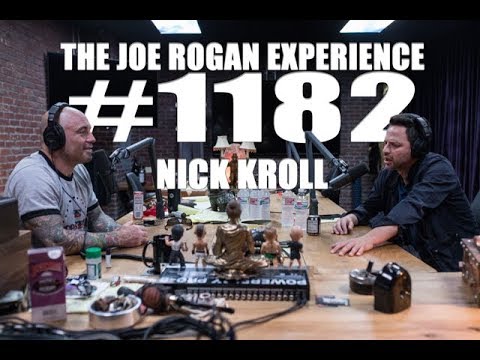
Joe Rogan Experience #1182 - Nick Kroll
Joe Rogan (host), Nick Kroll (guest), Narrator, Narrator, Narrator, Narrator, Narrator, Narrator, Narrator
In this episode of The Joe Rogan Experience, featuring Joe Rogan and Nick Kroll, Joe Rogan Experience #1182 - Nick Kroll explores nick Kroll, Big Mouth, Burning Man, and the Madness of Modern Life Joe Rogan and Nick Kroll bounce through a wide-ranging, informal conversation covering technology annoyances, animation freedom on Netflix, stand-up craft, drugs and Burning Man, combat sports, and the bizarre edges of celebrity culture. They dig into how shows like Big Mouth get made, why Netflix is uniquely hands-off, and how animation enables taboo humor you couldn’t do with child actors. Kroll recounts his first acid trip at Burning Man, while Rogan riffs on fitness, CTE, football, and the risks of boxing versus jiu-jitsu. Throughout, they weave in stories about Phil Hartman, Robin Williams, O.J. Simpson, Scientology, Cosby, and politics, using dark humor to process how strange and overloaded modern life feels.
Nick Kroll, Big Mouth, Burning Man, and the Madness of Modern Life
Joe Rogan and Nick Kroll bounce through a wide-ranging, informal conversation covering technology annoyances, animation freedom on Netflix, stand-up craft, drugs and Burning Man, combat sports, and the bizarre edges of celebrity culture. They dig into how shows like Big Mouth get made, why Netflix is uniquely hands-off, and how animation enables taboo humor you couldn’t do with child actors. Kroll recounts his first acid trip at Burning Man, while Rogan riffs on fitness, CTE, football, and the risks of boxing versus jiu-jitsu. Throughout, they weave in stories about Phil Hartman, Robin Williams, O.J. Simpson, Scientology, Cosby, and politics, using dark humor to process how strange and overloaded modern life feels.
Key Takeaways
Leverage platforms that give you maximum creative freedom and reach.
Kroll explains that Netflix lets Big Mouth be as filthy, specific, and oddly structured as it wants to be, with no notes on act breaks, length, or advertiser sensitivities—something traditional networks simply don’t offer.
Get the full analysis with uListen AI
Use multiple modes of writing to deepen stand-up material.
Rogan describes first developing bits onstage, then repeatedly rewriting them in detail on a computer and again by hand before sets; the extra written passes add tags, depth, and structure that pure improvisation often misses.
Get the full analysis with uListen AI
Animation is a powerful way to tackle taboo or extreme material.
They note that stories about kids’ sexuality, hormone monsters, and grotesque gags would feel unethical or unwatchable in live action with child actors, but work in cartoon form because the characters are drawn and stylized.
Get the full analysis with uListen AI
Protect your cognitive health by avoiding unnecessary head trauma.
Rogan has stopped sparring hard and argues that boxing and football are incredibly damaging, with concussions coming not only from head shots but also from body blows that whip the brain inside the skull.
Get the full analysis with uListen AI
Be conscious of how tech and media hijack your attention and memory.
Both describe 'goldfish brain' from constant phone use, news feeds, and social apps—wiping out downtime and leaving little space to think deeply, remember, or truly rest.
Get the full analysis with uListen AI
Recognize that old norms around drugs, sex, and power can mask systemic abuse.
They suggest Cosby’s drugging and rape likely began in an era when slipping women drugs was disturbingly normalized, and compare that to Catholic abuse scandals—arguing that institutional respectability can hide long-term predation.
Get the full analysis with uListen AI
Short, intense retreats can sustain forms of utopia that fail long term.
Kroll found Burning Man surprisingly functional: lightly policed, largely self-governed, and guided by shared norms like 'leave no trace'—but he and Rogan agree that such anarchic experiments only work because they end after a week.
Get the full analysis with uListen AI
Notable Quotes
“It’s all about bandwidth, right? What are you spending your thinking on?”
— Nick Kroll
“Animation just allows you to do it… you couldn’t do live-action stuff with kids the way we have, it would be unethical.”
— Nick Kroll
“Fighting is way better for you than football, and I think fighting’s terrible for you.”
— Joe Rogan
“I feel like I have a goldfish brain… I just like swim and five minutes later it’s gone.”
— Nick Kroll
“A joke doesn’t exist in a vacuum. It really needs an audience.”
— Joe Rogan
Questions Answered in This Episode
How does the freedom and lack of censorship on Netflix tangibly change the kind of stories and jokes a show like Big Mouth can tell?
Joe Rogan and Nick Kroll bounce through a wide-ranging, informal conversation covering technology annoyances, animation freedom on Netflix, stand-up craft, drugs and Burning Man, combat sports, and the bizarre edges of celebrity culture. ...
Get the full analysis with uListen AI
In what ways does writing comedy specifically for animation differ from writing for live-action, beyond just what’s 'allowed' with kids on screen?
Get the full analysis with uListen AI
Given what we now know about CTE and concussions, how should sports organizations and parents rethink youth football and other contact sports?
Get the full analysis with uListen AI
What are the psychological similarities between religion, cults like Scientology, and fandoms around celebrities or podcasters?
Get the full analysis with uListen AI
How can creatives balance the cognitive drain of constant phone and media use with the need for deep focus to write, perform, and generate original work?
Get the full analysis with uListen AI
Transcript Preview
Five, four, three, two... Hello, Nick.
(laughs) Hi, Joe. How you doing?
S- sorry for the delay.
(laughs)
We had a, a failure, ladies and gentlemen. A catastrophic failure of Windows updating. It sort of, uh, updated and hung on the, the TriCaster, but we're back.
And it seems to be fine. Ev- everything's working.
Allegedly.
(laughs)
Allegedly. We'll see.
There's that, there's that fear when you're like, "Fuck, I'm turning off the update. I'm gonna start again."
Yeah.
Then you lose everything.
That is the one annoying thing. We were talking about this before the podcast. I s- I've been using Windows to write on, and I like, uh, the ThinkPad. I really like it. I love the keyboard, it's great to write on. But Windows updates, like, two or three times a day sometimes. Not just Windows, but, like, Lenovo will update, and there's some s- firmware update, and a BIOS update.
Adobe Acrobat's checking in.
Yeah.
Wanna know if we can-
Bit Defender updates.
(laughs) Yeah, the, uh... I haven't used a ThinkPad. They, they got the... Still have that little, like, clip right in the middle?
Still got the little clip.
(laughs)
I don't use it-
No.
... but it's there. I guess it's for people that have been using it forever.
Right.
It's very accurate if you do use it.
Right.
It's like one of those things where you're just sorta used to muscle memory or used to doing it, and then they touch the other buttons with their thumb.
Right, g- they can still do shit. And it has the mouse at the, the keypad.
Mm-hmm.
I mean, it's so... It's-
It has both.
It's so weird how quickly you become accustomed to some new version of things. Like, I've, I've been using my iPad, and I d- and then I've gone back to my computer and my... Well, I have, like, a little MacBook, and I find even that weird. Like, I find myself just wanting to touch the screen.
Yeah.
And I have... My muscle memory's immediately shot.
That's one thing that's very odd about Mac computers, they still haven't embraced the touch screen laptop.
No.
Whereas the ThinkPad actually has a touch screen. You c-
Oh, you can straight up use the screen on it.
Yeah, you can... Yeah, the, it's an option.
Right.
I have one that has a touch screen and one that does not. But that's... A lot of Windows computers have touch screens, and they even have it so you can turn it into a tablet. You flip it over-
Yeah.
... and it f- they... I think they call it the Yoga, the ThinkPad Yoga.
Right.
And then Microsoft has one, the Surface or something like that.
Install uListen to search the full transcript and get AI-powered insights
Get Full TranscriptGet more from every podcast
AI summaries, searchable transcripts, and fact-checking. Free forever.
Add to Chrome