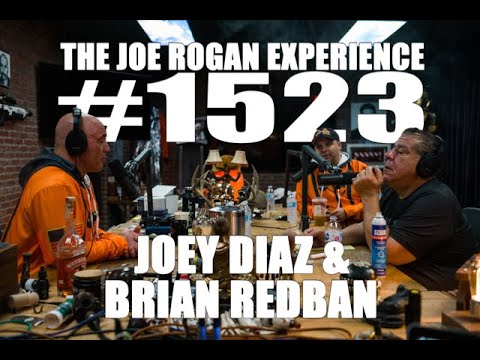
Joe Rogan Experience #1523 - Joey Diaz & Brian Redban
Joe Rogan (host), Joey Diaz (guest), Brian Redban (guest), Brian Redban (guest), Brian Redban (guest), Brian Redban (guest), Brian Redban (guest), Joey Diaz (guest), Brian Redban (guest), Brian Redban (guest), Brian Redban (guest), Brian Redban (guest), Brian Redban (guest), Brian Redban (guest), Brian Redban (guest), Brian Redban (guest), Brian Redban (guest), Brian Redban (guest), Brian Redban (guest)
In this episode of The Joe Rogan Experience, featuring Joe Rogan and Joey Diaz, Joe Rogan Experience #1523 - Joey Diaz & Brian Redban explores joe Rogan, Joey Diaz, Redban Debate COVID, Crime, Comedy, Escape From LA Joe Rogan, Joey Diaz, and Brian Redban spend a long, free‑flowing conversation bouncing between COVID, politics, crime, the collapse of Los Angeles, and the future of stand‑up comedy. They criticize how local and national leaders handled the pandemic, especially lockdowns that killed small business without parallel guidance on health and metabolic fitness. Rogan talks through why he’s leaving LA, while Diaz explains why he’s ending his long‑running podcast and moving back east, tying it to safety, schools, and a sense that the city and comedy scene are fundamentally changed. Throughout, they weave in war stories from crime and drugs, memories from The Comedy Store glory years, riffs on politics and media, and dark humor about how fragile social order really is.
Joe Rogan, Joey Diaz, Redban Debate COVID, Crime, Comedy, Escape From LA
Joe Rogan, Joey Diaz, and Brian Redban spend a long, free‑flowing conversation bouncing between COVID, politics, crime, the collapse of Los Angeles, and the future of stand‑up comedy. They criticize how local and national leaders handled the pandemic, especially lockdowns that killed small business without parallel guidance on health and metabolic fitness. Rogan talks through why he’s leaving LA, while Diaz explains why he’s ending his long‑running podcast and moving back east, tying it to safety, schools, and a sense that the city and comedy scene are fundamentally changed. Throughout, they weave in war stories from crime and drugs, memories from The Comedy Store glory years, riffs on politics and media, and dark humor about how fragile social order really is.
Key Takeaways
Lockdowns without a parallel health strategy are unsustainable.
They argue that shutting businesses while politicians keep getting paid was never going to hold, especially when almost no public messaging talked about vitamin D, exercise, weight loss, or metabolic health—only masks and closures.
Get the full analysis with uListen AI
Urban crime and social instability are driving decisions to leave big cities.
Rogan and Diaz cite shootings, random attacks, homelessness, looting, and boarded‑up storefronts in LA, New York, Chicago, and Portland as evidence that major cities feel more dangerous and less livable than just a few years ago.
Get the full analysis with uListen AI
Economic despair has psychological and social costs as real as the virus.
They stress that prolonged unemployment, shuttered small businesses, and people facing eviction fuel rage, addiction, and violence—costs that weren’t properly weighed against the direct health risks of COVID.
Get the full analysis with uListen AI
The comedy ecosystem in LA is broken for the foreseeable future.
They see at least an 18‑month road back for places like Melrose and The Comedy Store, note that many comics are unwilling to risk clubs and travel, and regard outdoor/drive‑in shows as “methadone comedy” rather than the real thing.
Get the full analysis with uListen AI
Trust in political institutions is eroded by hypocrisy and corruption.
Diaz recounts witnessing local political corruption as a kid and ties it to larger patterns—drug war complicity, election scams, and backroom deals—leaving him cynical about red vs. ...
Get the full analysis with uListen AI
Media incentives favor fear and outrage over clarity and solutions.
They frame major news networks as ratings‑driven disaster merchants, emphasizing that leading COVID shows by selling panic and political drama keeps people glued to the screen but rarely helps anyone get healthier or calmer.
Get the full analysis with uListen AI
Personal reinvention sometimes requires walking away at the top.
Diaz compares leaving LA and ending his long‑running podcast to Willie Mays retiring as a Giant instead of hanging on too long; he’d rather reset in a safer, saner environment and build something new than wait for the old life to return.
Get the full analysis with uListen AI
Notable Quotes
“You can’t tell people, ‘You can’t work, but I’m gonna keep getting paid, and I’ll tell you when you can go back to work again.’”
— Joe Rogan
“Right now is not a time to do comedy… People want to laugh, but their moral compass is off.”
— Joey Diaz
“We didn’t have a plan if everything went sideways like this… Governors got elected, they didn’t pass a battery of tests on how to handle a pandemic.”
— Joe Rogan
“I see a lot of despair, I see a lot of fear… I lost my faith in politics a long time ago.”
— Joey Diaz
“We’re the same people that lived on this planet two years ago when everything was amazing. We just got confronted with a problem we didn’t expect and we didn’t do a good job hitting it.”
— Joe Rogan
Questions Answered in This Episode
How should leaders balance preventing COVID deaths with avoiding economic and psychological collapse in future crises?
Joe Rogan, Joey Diaz, and Brian Redban spend a long, free‑flowing conversation bouncing between COVID, politics, crime, the collapse of Los Angeles, and the future of stand‑up comedy. ...
Get the full analysis with uListen AI
Are Rogan and Diaz overstating the danger and decay in cities like Los Angeles and New York, or are their anecdotes an early warning?
Get the full analysis with uListen AI
What specific role should public health officials play in promoting exercise, diet, and metabolic health alongside vaccines and masks?
Get the full analysis with uListen AI
How can stand-up comedy realistically adapt in the next 1–2 years without turning into a permanently watered‑down, ‘methadone’ version of itself?
Get the full analysis with uListen AI
Given Diaz’s stories about political corruption and drug‑war complicity, what reforms—if any—could rebuild trust in American institutions?
Get the full analysis with uListen AI
Transcript Preview
(thumping sound) (snaps fingers) Whoo! Salud, gentlemen. (glasses clinking)
Salud. Happy birthday, my brother.
Thank you so much. Thank you for being here.
To many more.
Thank you, Young Jamie. (glasses clinking)
Thanks, sweetie.
Thank you. Thank you all. Whoo. (sighs)
Tremendous.
53 spins around the sun.
I have not fucking had a drink the whole fucking-
The whole COVID?
... the whole COVID. Not an- and, you know, and I didn't drink before that either, I don't think.
No, you weren't much of a drinker.
It's fuck- every night I go home, I'm gonna have a make up 'cause that- the Heineken makes it light.
Yeah.
Five points.
Oh, yeah.
Tremendous. The last-
They make a double zero that actually tastes good.
The last-
Zero alcohol, it's the be- they- Heineken has, for sure, the best non-alcoholic beer.
Really?
It tastes like fucking beer. Like, you're- you- if you were a alcoholic, you'd be like, "Oh, my God. I fucked up." Like s- you know how you have those- like, I like O'Doul's. They taste good, but it doesn't taste like beer. A cold O'Doul's is delicious. I like those non-alcoh- I do. Some people don't like 'em. I like 'em. Like, a cold one is really nice. But it- you know what you're doing. With the Heineken, they kinda trick you. I don't know what the fuck they're doing. They're doing some weird shit 'cause it tastes like- it tastes like beer.
Well, beer is like a taste kind of.
Yeah.
That's- that's why O'Doul's work. It's kind of like s- that smoke juice you put in meat. Like, "Oh, that's the s- taste of smoke."
Right, or like watermelon gum.
Yeah.
That shit don't taste like watermelon.
Nah, but still good. (laughs)
But you know what it is.
Yeah.
It's so crazy how beer- like, I grew up on six-packs and eight-packs.
Hmm.
Eight-packs were the eight ounces.
Yeah.
Nips, you got a case of nips or a case of beer. And then you went out to Colorado and they had 3.2.
3.2?
Alcohol.
Low alcohol beer.
If you're under-
Like Utah.
... between 18 and 21.
Oh, really?
That's what you have to drink. Then when you turn 21-
Oh.
... they give you the full dose. There used to be a club on the hill. I for- uh, I forget what it was, in- in the University of Boulder downstairs, and that's what they served you, 3.2 beer.
Right around the time I was turning 18 was the time they made it 21 years old. I'm pretty sure. Find out when they did it in Massachusetts. When did Massachusetts make the drinking age from 18 to 21? I feel like I missed it by, like, a year or two, but probably for good. They were like, "Jesus Christ." Like-
Install uListen to search the full transcript and get AI-powered insights
Get Full TranscriptGet more from every podcast
AI summaries, searchable transcripts, and fact-checking. Free forever.
Add to Chrome