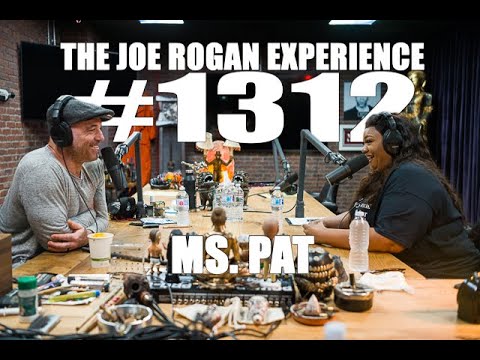
Joe Rogan Experience #1312 - Ms Pat
Joe Rogan (host), Ms. Pat (guest), Narrator, Narrator
In this episode of The Joe Rogan Experience, featuring Joe Rogan and Ms. Pat, Joe Rogan Experience #1312 - Ms Pat explores ms. Pat Turns Trauma Into Hysterical, Unfiltered Comedy and Healing Joe Rogan and comedian Ms. Pat have a wildly candid, often shocking conversation that mixes extreme childhood trauma, family dysfunction, and poverty with relentless, high-powered humor.
Ms. Pat Turns Trauma Into Hysterical, Unfiltered Comedy and Healing
Joe Rogan and comedian Ms. Pat have a wildly candid, often shocking conversation that mixes extreme childhood trauma, family dysfunction, and poverty with relentless, high-powered humor.
Ms. Pat describes growing up in the Atlanta projects, abuse, teen motherhood, crime, addiction in her family, and how she now raises multiple relatives’ children while building a comedy and podcasting career.
They discuss race, abortion, healthcare, sexuality, parenting, church culture, body image, and relationships, with Ms. Pat constantly reframing deeply painful experiences into jokes.
Underneath the laughs, the episode is about survival, forgiveness, self-determination, and how comedy became Ms. Pat’s therapy and a way to give her kids the stability she never had.
Key Takeaways
Trauma can be transformed into power through ownership and humor.
Ms. ...
Get the full analysis with uListen AI
Forgiveness can free the victim more than any apology ever will.
After failing to get an apology from her abusive ex, she chose to forgive him (and her mother and abuser) for her own peace, instead of chasing closure from people who would never give it.
Get the full analysis with uListen AI
A stable home and unconditional care can radically change kids’ trajectories.
By taking in and legally adopting her niece’s four children from a crack environment, refusing to give them back, and pushing for structure and education, she’s breaking a generational cycle.
Get the full analysis with uListen AI
Economic realities and healthcare access heavily dictate life choices.
She stays in Indianapolis solely for her husband’s good health insurance, and openly credits that stability as the only reason she hasn’t moved back to Atlanta despite hating the climate and culture there.
Get the full analysis with uListen AI
Cultural narratives about race and sexuality can be unlearned through experience.
Raised to fear and resent white people and to see being gay as “wrong,” she reversed both views when she moved into white neighborhoods and when her daughter came out, choosing love and reality over inherited prejudice.
Get the full analysis with uListen AI
Consistency and authenticity are more valuable than polish in new media.
Rogan urges her to focus on regularly releasing her raw, 30‑minute podcast episodes instead of chasing TV, emphasizing that reliability and her uncensored voice are what build an audience now.
Get the full analysis with uListen AI
Parenting with honesty—about mistakes and expectations—can repair damaged histories.
Ms. ...
Get the full analysis with uListen AI
Notable Quotes
“When you can laugh about what you’ve been through, then you got control of it.”
— Ms. Pat
“I can’t save the world. I try to save one at a time, and that’s all I can do.”
— Ms. Pat
“It’s not about how you start, it’s about how you finish.”
— Ms. Pat
“My whole life I thought white people were better than me. Then I moved and realized, we all the same; my mama was stupid.”
— Ms. Pat
“You took a terrible beginning and turned it into an amazing present.”
— Joe Rogan
Questions Answered in This Episode
How does Ms. Pat decide which of her most painful experiences are ready to be turned into jokes, and which she still keeps off stage?
Joe Rogan and comedian Ms. ...
Get the full analysis with uListen AI
What concrete support systems (beyond comedy) helped her move from survival mode into the kind of stability where she could raise multiple additional kids?
Ms. ...
Get the full analysis with uListen AI
How can communities challenge the homophobia she describes in the Black church without alienating religious believers who feel those views are core to their faith?
They discuss race, abortion, healthcare, sexuality, parenting, church culture, body image, and relationships, with Ms. ...
Get the full analysis with uListen AI
What does Ms. Pat’s story say about how much of “personal responsibility” is actually constrained by access to healthcare, education, and safe housing?
Underneath the laughs, the episode is about survival, forgiveness, self-determination, and how comedy became Ms. ...
Get the full analysis with uListen AI
For people with similar trauma who don’t have a platform like comedy, what practical steps might mirror her journey of forgiveness and reclaiming their narrative?
Get the full analysis with uListen AI
Transcript Preview
Two, one. (claps) Boom! Ms. Pat, we're live. What's up? How are ya?
Hey.
Great to see you again.
Glad to be back.
Oh.
Man, this studio is better than my house.
(laughs)
Crap. I'm gonna go home and tell my husband we need to move in Joe Rogan's studio.
There's not a lot of room for extra people. But... (laughs)
I, I know, I know, I know, (laughs) I know. I was just fantasizing.
Are you still in Indianapolis?
Um, unfortunately.
You don't like it there?
Hell no.
(laughs)
I, I like my fans, but I, I'm, I'm Black, and, uh, you know, it's snow. And snow and weave-
Oh.
... don't go together.
Oh.
And it... You know? I just don't like it. It's the same ol'. Everybody eating at Applebee's and Golden Corral.
Mm-hmm.
I need culture. I want-
Culture.
Yeah, culture.
Where would you move? What about Chicago?
I'm cool. I wanna go back to Atlanta.
Atlanta. There you go.
That's where I wanna be. I wanna be in Atlanta. I wanna-
I love Atlanta.
Yes. Man, the food, the people.
Yes, yes.
Uh, I just... I wanna walk out my door and smell Mexican, Indian, all type of spices. All I smell-
Everything.
... in my community is dog shit and tiki torches. So... (laughs)
(laughs)
(laughs)
Tiki torches.
And dryer sheets.
Ah!
(laughs) 'Cause white women do they laundry. (laughs)
Dryer sheets.
Yeah, I need some culture. I need to walk outside and see all types of people.
And isn't it weird how places just never develop a lot of culture? Some places just... The spots just never get any more interesting.
Yeah, it's just... It's so boring. Everybody go to church.
Yeah.
Nobody curse. And when I come out my door, and if I'm talking to a neighbor and I use profan- "Oh my God." I say, "I'm not gonna change my language because you decide to walk your dog today and stop and talk to me."
(laughs)
You tried to talk to me. And everybody pick up they dog shit-
Oh, man.
... in my community. And, and where I'm from, (laughs) hey, that was fertilizer. So... (laughs)
(laughs)
You see your neighbor with a big old pound of dog crap in his hand, I'm like, "Dude, no. No."
I don't think it works as fertilizer 'cause my dog pisses and shits on the lawn. It just leaves these big old, like, yellow spots-
Yeah, but if you leave it-
... where the grass dies.
... alone enough, uh, and it rains on 'em, they just go into the grass.
That's true.
They don't kill the gra-... It don't kill the grass.
Install uListen to search the full transcript and get AI-powered insights
Get Full TranscriptGet more from every podcast
AI summaries, searchable transcripts, and fact-checking. Free forever.
Add to Chrome