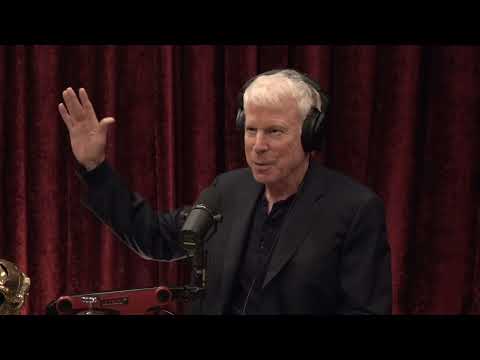
Joe Rogan Experience #1959 - David Buss
David Buss (guest), Joe Rogan (host)
In this episode of The Joe Rogan Experience, featuring David Buss and Joe Rogan, Joe Rogan Experience #1959 - David Buss explores evolutionary psychology, sex differences, and modern mating in chaos Joe Rogan and evolutionary psychologist David Buss explore how sexual selection and evolutionary pressures have shaped male and female mating strategies, jealousy, and violence. Buss explains core theories like Darwin’s sexual selection, parental investment, and paternity uncertainty, and applies them to infidelity, the dark triad, and attachment styles. They connect these longstanding psychological patterns to modern phenomena such as social media, porn, online dating, and hormonal birth control. The conversation also critiques contemporary ideological denial of sex differences in academia and law, arguing that ignoring them harms both science and women.
Evolutionary psychology, sex differences, and modern mating in chaos
Joe Rogan and evolutionary psychologist David Buss explore how sexual selection and evolutionary pressures have shaped male and female mating strategies, jealousy, and violence. Buss explains core theories like Darwin’s sexual selection, parental investment, and paternity uncertainty, and applies them to infidelity, the dark triad, and attachment styles. They connect these longstanding psychological patterns to modern phenomena such as social media, porn, online dating, and hormonal birth control. The conversation also critiques contemporary ideological denial of sex differences in academia and law, arguing that ignoring them harms both science and women.
Key Takeaways
Sexual selection explains many male–female differences better than culture alone.
Darwin’s concepts of intrasexual competition (same-sex rivalry) and intersexual selection (mate choice) predict why traits like male status striving, physical strength, and elaborate displays evolve, and these patterns map strongly onto human sex differences across cultures.
Get the full analysis with uListen AI
Fundamental reproductive asymmetries drive divergent mating strategies.
Women’s high obligatory investment (pregnancy, breastfeeding) and men’s paternity uncertainty create different adaptive problems: men benefit more from sexual variety, while women must be far choosier and often prioritize resource acquisition, protection, and stability.
Get the full analysis with uListen AI
Female infidelity is often about switching mates, not just “good genes.”
Buss has shifted from the dual-mating “good genes” theory toward a mate‑switching hypothesis: data show most unfaithful women fall in love with affair partners and are more likely to cheat when unhappy, suggesting affairs are often a pathway out of bad relationships or a way to “trade up.”
Get the full analysis with uListen AI
Dark triad traits and avoidant attachment predict higher infidelity risk.
Narcissism, Machiavellianism, psychopathy, and avoidant attachment styles are all linked with greater likelihood of cheating and short‑term mating; these traits are more common in men, helping explain why certain “bad boys” attract partners yet behave exploitatively.
Get the full analysis with uListen AI
Jealousy is an adaptive but dangerous “smoke alarm.”
Jealousy functions like a warning system for paternity risk (for men) and partner loss (for women), motivating mate guarding and sometimes escalating to abuse and even homicide; it’s psychologically painful yet has historically helped maintain investment in offspring.
Get the full analysis with uListen AI
Modern technologies are mismatched to our evolved psychology.
Social media, porn, filters, OnlyFans, and dating apps expose people to unlimited, often deceptive mates, inflating standards, creating decision paralysis, sapping motivation to form real relationships, and generating dating and sexual anxiety that our ancestral psychology isn’t built to handle.
Get the full analysis with uListen AI
Denying sex differences undermines science and can hurt women.
Buss argues that ideological claims of “no sex differences” contradict large, cross-cultural, replicable findings and have real costs, such as poorly designed drug dosing, flawed sexual‑harassment standards based on a mythical ‘reasonable person,’ and confusion in policy and law.
Get the full analysis with uListen AI
Notable Quotes
“We are the end results of a long and unbroken chain of ancestors, each of whom succeeded in the mating game.”
— David Buss
“It would be astonishing, and defy all logic, if there were not corresponding sex differences in our psychology given how different male and female reproductive biology is.”
— David Buss
“Jealousy is like a smoke alarm. It feels terrible, but without it, ancestral men couldn’t have solved the paternity problem and we wouldn’t have the long‑term, high‑investment mating we see in humans.”
— David Buss
“You have this evolutionarily unprecedented situation where a young woman working at the post office can take photos of her butt and have four million followers.”
— Joe Rogan
“I have no interest in maintaining a position that is empirically incorrect.”
— David Buss
Questions Answered in This Episode
If social media and dating apps are creating a massive mismatch with our evolved psychology, what concrete steps can individuals take to protect their relationships and mental health?
Joe Rogan and evolutionary psychologist David Buss explore how sexual selection and evolutionary pressures have shaped male and female mating strategies, jealousy, and violence. ...
Get the full analysis with uListen AI
How should legal concepts like the ‘reasonable person’ standard be reformed to account for robust, well‑documented sex differences in perception and experience?
Get the full analysis with uListen AI
Could widespread hormonal birth control be silently reshaping partner choice, relationship stability, and divorce patterns at a population level—and how would we know?
Get the full analysis with uListen AI
Where is the line between understanding jealousy as an evolved adaptation and using evolution to rationalize or excuse abusive behavior?
Get the full analysis with uListen AI
How can universities encourage open discussion of sex differences without sliding into either ideological denialism or simplistic biological determinism?
Get the full analysis with uListen AI
Transcript Preview
(drumming music plays) Joe Rogan podcast. Check it out.
The Joe Rogan Experience. Train by day, Joe Rogan podcast by night. All day. (rock music plays) All right, Dave. Well, thank you very much for being here, man. Appreciate it.
Thank you. Uh, to ... I'm delighted to be here, and it's a great honor to, uh, be here talking to you, man.
Well, it was very nice to meet you, uh, with Jordan. Uh, he speaks so highly of you and we had such a fun conversation at dinner that I said, "Well, we, uh, we definitely should do this publicly."
Yeah. Yeah. It's, uh, terrific. And I've been catching up on your podcast, so it ... you have so many that it's im- ... nearly impossible. But, um, I watched the recent one you did with Jordan when he was here in Austin, and, uh, also the one that you did with, uh, Russell Brand. Um, and I was on ... I was on his, his podcast, and I was just saying, "Man, he talks so fast-"
I know.
"... that it's like, uh ... uh, glad you were kind of a calming influence-"
(laughs)
"... to slow him down a little bit."
And he's sober. The guy's completely clean and sober. You would imagine that he was definitely on Adderall or something.
Yeah.
Just rounding off.
That's what I was thinking that maybe when he was on heroin, maybe it s- ... calming him down a little bit or slowed him down.
Mm. Maybe. Yeah. Maybe that's why he was interested in that stuff. So, uh, what we started talking about was your life's work, which was ... y- your life's work is human mating strategies.
Yes.
As a psychologist, like why ... wha- ... first of all, why was that, uh, so appealing to you? Why did you choose that as a field of study?
Yeah. Well, it wasn't ... it wasn't a field of study when I, when I did choose it, and I, I wasn't like I had a plan going in. But, um, a little bit of backstory on this is, um, uh, I'm a, a psychologist by training. So, trained at UC Berkeley, PhD, uh, and, um, and there was nothing of this sort going on there or no research. But I started reading because I have fairly broad interests. I started reading in different areas, like evolutionary biology, and I was reading evolutionary biology, I came across these amazing theories of evolution like Hamilton's Theory of Inclusive Fitness, uh, Trivers' Theory of Parental Investment, uh, of course, Darwin's Theory of Sexual Selection. That was really ... that's really the one that blew me away, Darwin's Theory of Sexual Selection. Um, and then I realized, man, these, these theories have so much applicability to humans, but nobody is studying them. And they lead to, uh, at least the then-theories lead to some pretty clear predictions that could be tested. And so I was trained as an empirical scientist where, you know, you, you take the hypotheses, generate predictions, do the studies, and if the studies ... if the empirical findings support the predictions, then you say, "Okay, this looks promising. You know, we'll go further." And so I did some initial studies of, uh, human mate preferences. So one of the, the core things, maybe to back up just a second, uh, if I could, Darwin's Theory of Sexual Selection, so this is Darwin, 1871. Um, and it's, it's, it's one of the most brilliant and then unrecognized theory, evolutionary theories in existence. So, most people when they think about evolution, they think about survival of the fittest, you know, nature red in tooth and claw. Um, you know, and of course, that's really what Darwin's first book, On the Origin of Species was all about, um, survival, adaptations to survival, and he came up with this, uh, brilliant phrase, uh, called the hostile forces of nature. And that h- ... and that organisms have these adaptations to deal with these hostile forces of nature in order to survive. So, uh, they were basically threats from the environment, uh, things like you've ... you know, fall off a cliff, you, you drowned in the ocean, uh, uh, food shortages, threats from predators, you know, the lions and tigers and bears, threats from parasites that can eat you from within. Um, and so that's really what his first book was all about. And so people equated natural selection with survival selection. But there were, in fact, phenomena that Darwin could not explain on this theory. Uh, and he was very troubled by them. He has ... uh, he noticed that, uh, (laughs) something that all scientists do, uh, scientists develop, uh, fawns for their pet hypotheses, right, their pet theories. And so ... but he noticed that he had a tendency to forget facts that were inconsistent with his theory of natural selection.
Install uListen to search the full transcript and get AI-powered insights
Get Full TranscriptGet more from every podcast
AI summaries, searchable transcripts, and fact-checking. Free forever.
Add to Chrome