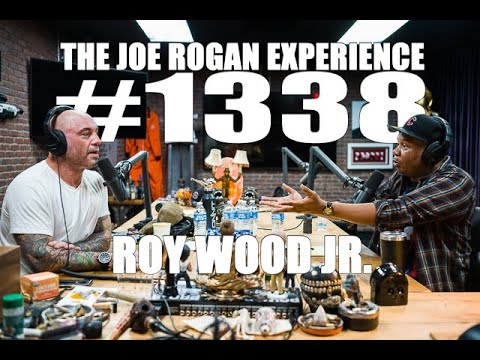
Joe Rogan Experience #1338 - Roy Wood Jr
Joe Rogan (host), Narrator, Roy Wood Jr. (guest), Narrator, Narrator, Narrator, Narrator, Narrator, Narrator
In this episode of The Joe Rogan Experience, featuring Joe Rogan and Narrator, Joe Rogan Experience #1338 - Roy Wood Jr explores roy Wood Jr. and Joe Rogan dissect comedy, tech traps, and hustle Joe Rogan and Roy Wood Jr. spend a long-form conversation bouncing between the practical realities of being a working comic and broader cultural issues. They dig into tech ecosystems and subscription grifts, VR and sensory deprivation, and how comics actually write, refine, and structure material. Roy details his brutal early hustle—day labor gigs, radio scams, long drives—to illustrate what it takes to build a career without gatekeepers, and they compare LA vs. NYC comedy cultures and the rise of internet-born talent.
Roy Wood Jr. and Joe Rogan dissect comedy, tech traps, and hustle
Joe Rogan and Roy Wood Jr. spend a long-form conversation bouncing between the practical realities of being a working comic and broader cultural issues. They dig into tech ecosystems and subscription grifts, VR and sensory deprivation, and how comics actually write, refine, and structure material. Roy details his brutal early hustle—day labor gigs, radio scams, long drives—to illustrate what it takes to build a career without gatekeepers, and they compare LA vs. NYC comedy cultures and the rise of internet-born talent.
The pair also explore parenting, bullying, self‑defense, martial arts, and how early trauma shapes both fighters and comics. They move into heavier territory around veterans, Vietnam, race in cinema, white‑savior versus civil‑rights movies, and the economics of homelessness and neglected inner cities. Threaded throughout is a recurring theme of redemption and second chances, contrasted with today’s online culture that often refuses to let people evolve beyond past mistakes.
Underlying most topics are two big through‑lines: relentless self‑driven work (learning new tools, creating your own opportunities, ignoring jealous gatekeeping) and the craft of stand‑up—how to be original, build black‑belt‑level bits on dangerous subjects, and stay mentally sharp without burning out.
Key Takeaways
Don’t get trapped by tech ecosystems; be willing to relearn tools.
Roy describes how Apple forces repurchases and obsolescence, which pushed him to abandon Final Cut and learn Adobe Premiere. ...
Get the full analysis with uListen AI
Use focused activities and controlled environments to quiet mental noise.
Roy’s mind only really calms down with video games, jigsaw puzzles, and Sudoku; Rogan uses isolation tanks. ...
Get the full analysis with uListen AI
Self‑defense training isn’t just about fighting—it normalizes conflict.
Rogan explains that jiu‑jitsu and martial arts make kids less afraid of confrontation because they regularly experience controlled, physical conflict. ...
Get the full analysis with uListen AI
Relentless hustle and creative leverage can jump‑start a career without gatekeepers.
Roy built PCs, did day‑labor during the day, MC’d at night, and networked via prank calls syndicated to other radio markets so he could leapfrog into feature work. ...
Get the full analysis with uListen AI
Modern comedians must build their own distribution instead of chasing TV.
They note how late‑night sets and cable credits have lost impact, while internet platforms (MySpace for Dane Cook, YouTube/IG/TikTok now) can create direct audiences. ...
Get the full analysis with uListen AI
Great stand‑up on sensitive topics requires research and structural rigor.
Roy outlines how he’s building bits on Vietnam, veterans, and white‑savior versus civil‑rights films: long‑form research (Ken Burns docs, box‑office histories), testing half‑formed ideas onstage, transcribing, and then tightening structure. ...
Get the full analysis with uListen AI
Redemption is essential to a healthy culture, but the internet resists it.
They contrast prison‑to‑success stories (Joey Diaz, Bernard Hopkins) and Christian ideas of forgiveness with social media’s tendency to weaponize decade‑old tweets or jokes. ...
Get the full analysis with uListen AI
Notable Quotes
“Comedy is like a grocery store line—then a new checkout opens, and all these people just cruise through the Instagram line while you’re still waiting for your Tonight Show set.”
— Roy Wood Jr.
“The more sets you do, the tighter your stand‑up is—but the more focus you put on your set, listening and rewriting, it’s almost like doing another half a set.”
— Joe Rogan
“If you stayed off television for 10 years and just crushed, you’d be a legend when you finally showed up—but there’s too much money and too many offers for most comics to do that.”
— Roy Wood Jr.
“You don’t need gatekeepers. The internet has no gatekeepers—podcasts, YouTube, your own content. The only question is whether you decide to become a real comic and put the work in.”
— Joe Rogan
“I feel like New York is a great place to go, but not the best place to start—as a child. It’s a hard place to start life.”
— Roy Wood Jr.
Questions Answered in This Episode
How do comedians ethically balance using strategic lies or hustles early in their careers with the risk of seriously harming others or themselves?
Joe Rogan and Roy Wood Jr. ...
Get the full analysis with uListen AI
In a world where internet platforms dominate, what’s the smartest way for a new comic to mix traditional club work with online content without burning out?
The pair also explore parenting, bullying, self‑defense, martial arts, and how early trauma shapes both fighters and comics. ...
Get the full analysis with uListen AI
How far should comics go when tackling topics like war, race, and veterans—are there personal red lines, or does the audience ultimately decide?
Underlying most topics are two big through‑lines: relentless self‑driven work (learning new tools, creating your own opportunities, ignoring jealous gatekeeping) and the craft of stand‑up—how to be original, build black‑belt‑level bits on dangerous subjects, and stay mentally sharp without burning out.
Get the full analysis with uListen AI
If our culture adopted a more structured concept of redemption, what would fair ‘paths back’ look like for people who’ve done serious wrong versus old bad jokes or tweets?
Get the full analysis with uListen AI
What concrete policies or experiments could cities try that would meaningfully reduce homelessness and inner‑city decay, rather than just managing them indefinitely?
Get the full analysis with uListen AI
Transcript Preview
(laughs) We good?
Yeah.
Roy Wood-
Yo.
... Junior. How are you, sir?
How you doing, man?
Pleasure. A pleasure to have you on here, man. You're one of-
Man, appreciate it.
... the funniest guys alive. Absolutely.
I don't know about that, man.
You are. You're-
Just trying to pay bills, bro.
You're one of the funniest guys out there, man. I'm, uh, very excited to have you in here. Fuck's going... And we were talking shit about Apple and electronics.
Uh-
Apple's fucking you, I hear.
So-
(laughs)
(laughs)
... I got the new MacBook, right? And the new MacBook with the new OS or whatever it is, it doesn't fuck with the old versions of Final Cut. The, the old video editing software I used to use, new MacBook goes, "You gotta buy that shit again." I'm like, "My nigga, I just paid for that shit, hundreds of dollars with my last computer. And now I gotta get ... My ... You're telling me my old software ain't no good with the new..." And you could make the software work with the new OS if you wanted to, but they don't. They get you to buy it again and all that shit.
So dirty.
So now I'm having to learn Adobe Premiere. I was pretty good with Final Cut, but I'm having to relearn-
You're swapping out.
Yeah, I gotta relearn-
Yeah. Good for you.
... a whole new thing. And if I'm gonna do that, then I may as well relearn a whole new piece of electronics. But to do that means I have to gut everything.
Cool.
That means you have to gut the Apple TV, you have to let go of the iPhone, you have to let go of the iPads.
Ooh.
My girlfriend ... And like, the, uh, the whole house-
The ecosystem.
... and, and like that's how the companies get you.
Yeah.
So everybody in the house, even my son, he had a Samsung, uh, he had a Samsung tablet and I was like, "Get that shit out of here."
(laughs)
We gotta get you an iPad. So, so we regifted that and then got him an i- So it's like, no, man.
People get fierce about that Mac versus Android shit as much as they do about like Republicans versus Democrats.
I want something where I don't have to keep paying for the same shit over and over again every three or four years.
Apple makes great shit, but they fuck you.
The interface is so smooth. It's so convenient.
It's so nice. Yeah.
I can check text messages. I can do whatever I want-
Yes.
... on my MacBook.
Yes.
I can talk to my television. I can one click and all the Apple Pay-
Install uListen to search the full transcript and get AI-powered insights
Get Full TranscriptGet more from every podcast
AI summaries, searchable transcripts, and fact-checking. Free forever.
Add to Chrome