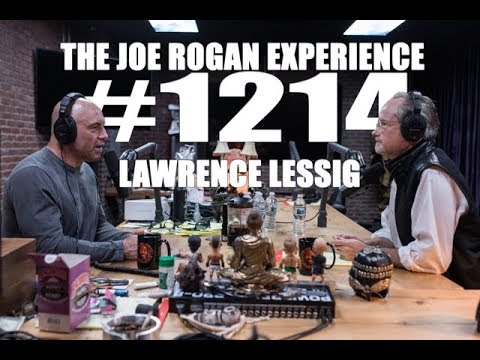
Joe Rogan Experience #1214 - Lawrence Lessig
Joe Rogan (host), Lawrence Lessig (guest)
In this episode of The Joe Rogan Experience, featuring Joe Rogan and Lawrence Lessig, Joe Rogan Experience #1214 - Lawrence Lessig explores lawrence Lessig Explains How Money, Maps, And Media Hijack Democracy Lawrence Lessig outlines how American democracy is structurally corrupted, not by illegal bribery, but by legal dependence on a tiny group of wealthy donors, lobbyists, and partisan map‑makers. He explains “Lesterland,” where about 100–150,000 big donors and roughly 100 super‑PAC funders effectively filter who can run and win, forcing members of Congress to spend most of their time fundraising and catering to funders, not voters.
Lawrence Lessig Explains How Money, Maps, And Media Hijack Democracy
Lawrence Lessig outlines how American democracy is structurally corrupted, not by illegal bribery, but by legal dependence on a tiny group of wealthy donors, lobbyists, and partisan map‑makers. He explains “Lesterland,” where about 100–150,000 big donors and roughly 100 super‑PAC funders effectively filter who can run and win, forcing members of Congress to spend most of their time fundraising and catering to funders, not voters.
He adds gerrymandering and the Electoral College to the picture, arguing they amplify extremist minorities and a handful of swing states while making most citizens’ votes effectively irrelevant. Lessig discusses proposed reforms like public campaign financing via vouchers, a sweeping House reform bill (H.R.1), proportional allocation of electoral votes, and stronger antitrust enforcement against tech giants.
The conversation also covers media fragmentation, the role of Facebook/Google/Twitter, cable news tribalism, and the democratic potential of long‑form podcasts and thoughtful TV as “slow democracy.” Lessig is cautiously hopeful that public anger at corruption, combined with new political leaders and media ecosystems, can build a cross‑partisan movement to “fix democracy first,” though he’s pessimistic about entrenched interests in Washington.
Throughout, he emphasizes that most politicians and lobbyists are playing by the rules of a corrupted system, and that meaningful change requires altering the incentives and funding structures that now reward influence‑peddling and gridlock over representation and problem‑solving.
Key Takeaways
Campaign finance dependence structurally corrupts Congress without breaking any laws.
Members of Congress spend 30–70% of their time fundraising from a tiny pool of wealthy donors and super‑PAC backers, developing a constant “sixth sense” for what funders—not ordinary voters—want. ...
Get the full analysis with uListen AI
A minuscule donor class effectively pre‑screens who can run and win.
In recent cycles, only about 150,000 people gave the maximum donation to any candidate, and roughly 100 people provided over half of super‑PAC money in a presidential race. ...
Get the full analysis with uListen AI
Gerrymandering creates safe seats that empower party extremists over general voters.
About 85% of House seats are “safe,” so incumbents mainly fear primary challenges from their party’s extreme wing, not defeat by the other party. ...
Get the full analysis with uListen AI
Lobbying and the revolving door monetize public office and deepen policy capture.
Congress has become a “farm league for K Street,” where members learn to raise money, then cash out as high‑paid lobbyists. ...
Get the full analysis with uListen AI
Concrete reforms exist that could fix most of the problem without a constitutional amendment.
Lessig highlights H. ...
Get the full analysis with uListen AI
The Electoral College’s winner‑take‑all rules skew campaigns toward a few battleground states.
Because nearly all states give all their electors to the statewide winner, 99% of 2016 campaign spending and 95% of candidate time went to just 14 swing states. ...
Get the full analysis with uListen AI
Media and tech structures amplify polarization, but long‑form formats offer a way to rebuild understanding.
Cable news and ad‑driven social platforms optimize for outrage, tribes, and micro‑targeted ads rather than truth. ...
Get the full analysis with uListen AI
Notable Quotes
“We’ve got a system where we have a money primary and then we have a regular election.”
— Lawrence Lessig
“Capitol Hill has become a kind of farm league for K Street.”
— Lawrence Lessig (quoting Rep. Jim Cooper)
“If we don’t fix this corrupted democracy first, nothing else can happen.”
— Lawrence Lessig
“The Framers didn’t create a constitution to replicate an aristocracy. They were fighting an aristocracy.”
— Lawrence Lessig
“Facebook is a technology to exploit insecurity for the purpose of selling ads.”
— Lawrence Lessig
Questions Answered in This Episode
If changing campaign finance could solve 70–80% of the problem, what specific political strategy is most realistic for forcing Congress to adopt voucher‑based or public funding systems?
Lawrence Lessig outlines how American democracy is structurally corrupted, not by illegal bribery, but by legal dependence on a tiny group of wealthy donors, lobbyists, and partisan map‑makers. ...
Get the full analysis with uListen AI
How can reformers build a genuinely cross‑partisan movement when party leaders and key power brokers in both parties benefit from the current fundraising structure?
He adds gerrymandering and the Electoral College to the picture, arguing they amplify extremist minorities and a handful of swing states while making most citizens’ votes effectively irrelevant. ...
Get the full analysis with uListen AI
What are the trade‑offs between abolishing the Electoral College entirely, adopting a National Popular Vote Compact, and pursuing proportional allocation of electors through the courts?
The conversation also covers media fragmentation, the role of Facebook/Google/Twitter, cable news tribalism, and the democratic potential of long‑form podcasts and thoughtful TV as “slow democracy. ...
Get the full analysis with uListen AI
Given the ad‑driven incentives of social media and cable news, what practical models exist for sustainable, large‑scale “slow democracy” media that don’t just become new echo chambers?
Throughout, he emphasizes that most politicians and lobbyists are playing by the rules of a corrupted system, and that meaningful change requires altering the incentives and funding structures that now reward influence‑peddling and gridlock over representation and problem‑solving.
Get the full analysis with uListen AI
At what point does the political and economic power of tech giants like Facebook and Google become so great that antitrust enforcement alone is insufficient—and what additional safeguards might be needed to prevent them from shaping democratic outcomes?
Get the full analysis with uListen AI
Transcript Preview
Three, two, one. And we're live. How are you, sir?
Hey, I'm great.
Thanks for being here, man. I really appreciate it.
It is the coolest thing I've done.
Really?
Yeah.
Ever?
Well, you know.
(laughs)
I can't remember that far back, but it's pretty cool.
Um, I watched your TED Talk on, um... What was the word that you used? Uh, Lesterland?
Lesterland.
Yeah. And, uh, it felt hopeless.
(laughs)
Like, if, if... For people who don't know what I'm talking about, could you just give like a brief synopsis of... The way you were describing how comple- completely rigged our election system is.
Yeah.
And, and what, what it actually takes to be elected and how much of the time they spend is involved in raising money and why.
Yeah. So we've got a system where we have a money primary and then we have a regular election. And in the money primary, to compete, you gotta raise tons of money to be able to fund your campaign. And when you raise that money, you raise it from a tiny, tiny fraction of the 1%. So in Les... In the, in the TED Talk about Lesterland, I said, you know, "Imagine a place called Lesterland, where, um, basically it's the Lesters who rule." And by the Lesters, I mean the same proportion of people named Lester as in the United States right now. So there's about 150,000 Americans named Lester. I'm one of them, but here we are, the Lesters. So imagine a world ruled by Lesterland. Um, because that's essentially the world we have because of the way we fund our campaigns. Because there's about 150,000 men who give even just the maximum contribution to one political candidate. Um, if you ask who... The number of people who give the maximum contribution over the course of a campaign, meaning in the primary and the general election, it's about 22,000 Americans in, uh, 2014 who gave the maximum (laughs) contribution to one political campaign. So what that means is it's a tiny, tiny fraction who are the most important funders of political campaigns. And candidates for Congress and members of Congress spend 30 to 70% of their time sucking up to this tiny, tiny fraction. And so is it any surprise that you see Congress bending over backwards to keep those guys happy? Because they know without those people, they don't have a shot at getting back into Congress.
And the way you were describing it as... when you were saying it as Lesterland, it was like, imagine if we were this screwed up. That was essentially what you're saying.
Yeah.
But we're more screwed up-
We're more screwed up.
... than Lesterland.
Yeah, we're more screwed up.
That was a disturbing video because, uh, I was realizing, it was emerging as you were speaking, I was like, "Wait a minute. Is it that bad?"
Install uListen to search the full transcript and get AI-powered insights
Get Full TranscriptGet more from every podcast
AI summaries, searchable transcripts, and fact-checking. Free forever.
Add to Chrome