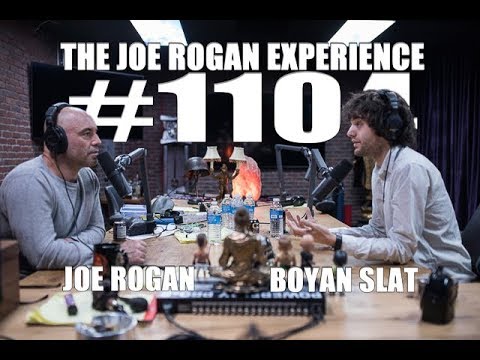
Joe Rogan Experience #1104 - Boyan Slat
Joe Rogan (host), Boyan Slat (guest), Narrator
In this episode of The Joe Rogan Experience, featuring Joe Rogan and Boyan Slat, Joe Rogan Experience #1104 - Boyan Slat explores young Inventor Engineers Ambitious System To Clean Plastic From Oceans Joe Rogan interviews Boyan Slat, the 23‑year‑old founder of The Ocean Cleanup, about his large‑scale technological effort to remove plastic from the Great Pacific Garbage Patch and, eventually, other gyres. Slat explains the environmental, economic, and health impacts of ocean plastics and why ‘turning off the tap’ of new pollution is not enough without also cleaning existing waste. He details his passive cleanup system that uses ocean currents and long U‑shaped floating barriers to concentrate and collect plastics for recycling into consumer products. The conversation also touches on funding, recycling markets, bioplastics, broader environmental innovation, and how individuals can think more ambitiously about solving global problems.
Young Inventor Engineers Ambitious System To Clean Plastic From Oceans
Joe Rogan interviews Boyan Slat, the 23‑year‑old founder of The Ocean Cleanup, about his large‑scale technological effort to remove plastic from the Great Pacific Garbage Patch and, eventually, other gyres. Slat explains the environmental, economic, and health impacts of ocean plastics and why ‘turning off the tap’ of new pollution is not enough without also cleaning existing waste. He details his passive cleanup system that uses ocean currents and long U‑shaped floating barriers to concentrate and collect plastics for recycling into consumer products. The conversation also touches on funding, recycling markets, bioplastics, broader environmental innovation, and how individuals can think more ambitiously about solving global problems.
Key Takeaways
Passive systems that let plastic come to them are vastly more efficient than boats and nets.
Slat’s approach uses long floating U‑shaped barriers that drift with currents, funneling plastic into a central collection point; this avoids the fuel, labor, and time costs of actively chasing debris, which he estimates would take ~79,000 years with traditional methods.
Get the full analysis with uListen AI
Cleaning existing ocean plastic must complement prevention efforts to truly solve the problem.
Unlike some pollutants, plastic persists for decades or centuries; even if all new plastic leakage stopped today, the existing 1. ...
Get the full analysis with uListen AI
Turning waste plastic into branded products can finance large‑scale cleanup.
Because raw recycled plastic from the ocean is expensive to collect, The Ocean Cleanup aims to capture value through the story and branding—turning it into products like sunglasses or car parts where a small material cost can be embedded in a higher‑margin item.
Get the full analysis with uListen AI
Recycled and bioplastic solutions are nuanced and often misunderstood.
Slat distinguishes between bio‑based and biodegradable plastics, and notes that many ‘compostable’ or bio‑based plastics still persist in the ocean; he stresses that performance, application limits, and industrial composting requirements mean there’s no simple ‘holy grail’ material yet.
Get the full analysis with uListen AI
Most plastic in the garbage patch is still relatively large and near the surface, making cleanup timely.
Expeditions showed that over 99% of plastic mass is larger than 1 mm and concentrated in the top ~3 meters of water, suggesting cleanup is physically practical now—but that the same plastic will otherwise fragment into far more dangerous microplastics over coming decades.
Get the full analysis with uListen AI
Creating demand for recycled material is as important as improving collection.
Slat points out that low demand and cheap virgin plastic discourage recycling investment; he argues that policies and consumer behavior need to favor products with recycled content to make recycling economically viable at scale.
Get the full analysis with uListen AI
Effective problem‑solving starts from the full scale of the problem and reasons backward.
He encourages aspiring innovators to first understand what it would actually take to solve 100% of a problem, then work backwards to a realistic first step, instead of only aiming to ‘make a dent’ without a path to full impact.
Get the full analysis with uListen AI
Notable Quotes
“Instead of going after the plastic, we let the plastic come to us.”
— Boyan Slat
“For 60 years man has been putting plastic into the ocean, and from that moment onwards, we're also taking it back out again.”
— Boyan Slat
“Someone has to do it, right? My answer would be: why not? Why isn’t everyone doing this?”
— Boyan Slat
“I don’t think the solution is making an ax out of a piece of rock and living in the woods.”
— Joe Rogan
“I don’t want to be the garbage man of the ocean forever.”
— Boyan Slat
Questions Answered in This Episode
How will The Ocean Cleanup verify and transparently report the effectiveness and unintended impacts of its systems once they’re operating long‑term in the gyres?
Joe Rogan interviews Boyan Slat, the 23‑year‑old founder of The Ocean Cleanup, about his large‑scale technological effort to remove plastic from the Great Pacific Garbage Patch and, eventually, other gyres. ...
Get the full analysis with uListen AI
What regulatory or market mechanisms could most quickly create strong demand for ocean‑recycled plastic in mainstream consumer products?
Get the full analysis with uListen AI
How can developing countries with weak waste infrastructure be engaged so that plastic leakage from rivers and coasts is reduced in parallel with offshore cleanup?
Get the full analysis with uListen AI
What ethical lines should guide the use of powerful new environmental technologies so that ‘solutions’ don’t create new large‑scale side effects, as happened with plastics?
Get the full analysis with uListen AI
How can Boyan Slat’s top‑down, technology‑first approach be adapted by other young innovators tackling different global problems like air pollution or overfishing?
Get the full analysis with uListen AI
Transcript Preview
Three, two, one. Yes. Hello, Boyan.
Hi, there.
Welcome.
Thank you.
Thanks for doing this. I really appreciate it, and I love what you're doing. I've seen your TED Talk. I've seen many- in- numerous conferences that you've appeared at and-
Oh.
... discussions you've given on this. And for people to jump into this right now, what you've done is, uh, think long and hard and devise a method to try to clean up some of the plastic that we have floating around in the ocean, famously the Pacific garbage patch-
Correct.
... which is this enormous patch of garbage that's between California and Hawaii. How did you get involved in this, and what- what- what- you're a young guy. How old are you?
Uh, 23 already. Yeah.
23 already? You sound like- oh, my God, I'm so old.
It's getting old. Yeah. (laughs)
Yeah. How old were you when you started this?
Um, I- I think I started thinking about this when I was 16 and, uh, founded this organization when I was 18.
That's crazy. All you lazy fucks out there-
(laughs)
... that are 16 years old that aren't doing shit with your life, just think about this kid.
(laughs)
That's amazing. I'm so happy there's people like you in the world.
Oh, thank you. Yeah.
So you started thinking about it when you were 16. And, you know, this is something that is extremely disturbing to anybody that's paid attention, especially when you see the birds that have died with all these plastic bottle caps inside their bodies, and you know, you see their carcasses with these multicolored caps in them, and they- they thought these things were food. I mean, it's just one of the many, many, many problems that occur when you have plastic floating around in just enormous numbers in the ocean.
Sure, yeah. I mean, there's really three problems with this plastic. First of all, obviously the ecosystem damage. I think there are around about 800 species that actually could go extinct because of this plastic pollution. Um, then there's the economic threat, uh, in terms of, um, you know, damage to fisheries, damage to tourism and things like that. I think it's around, uh, $13 billion a year according to the UN. And then thirdly, there's the health impact, or the potential health impact, because these tiny plastic pieces, they actually also end up in- in the fish we eat, uh, that take chemicals with it, and, uh, yeah, that ends up on our dinner plate as well.
So, what was it that prompted you to- to dedicate- essentially dedicate your young life to this?
Uh, sure. Yeah. So I've- I've always been very passionate about, uh, technology and just, uh, building things. I think sort of having an idea in your mind and then seeing that become reality and being able to touch it and things like that, I think, uh, there's literally no better feeling in the world than that. So I've- I've been building my own things since I was two years old, I think, um, first starting with things like tree houses and zip lines, but then going into sort of computers and explosives and rockets and things like that, which was a lot of fun, but it wasn't very, uh, useful, I would say. Um, so I was kind of looking for something sort of- um, something that real to- to- to work on a real problem. Um, and that's what I then came across when I was, uh, 16 years old. I was scuba diving in Greece, and I came across more plastic bags than fish, and I wondered, "Why can't we just clean this up?" And, uh, that question sort of s- kept, uh, circling around in my head, and, um, yeah, sort of thought about, well, how could we do this? The ocean is pretty big. Uh, and then eventually came up with this idea to- to use these natural ocean currents, uh, to- to basically let us collect the plastic.
Install uListen to search the full transcript and get AI-powered insights
Get Full TranscriptGet more from every podcast
AI summaries, searchable transcripts, and fact-checking. Free forever.
Add to Chrome