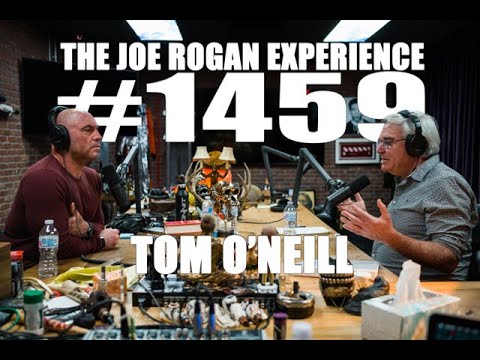
Joe Rogan Experience #1459 - Tom O'Neill
Tom O'Neill (guest), Joe Rogan (host), Jamie Vernon (host), Jamie Vernon (host), Jamie Vernon (host), Jamie Vernon (host)
In this episode of The Joe Rogan Experience, featuring Tom O'Neill and Joe Rogan, Joe Rogan Experience #1459 - Tom O'Neill explores unraveling Manson: CIA Mind Control, Legal Corruption, and Cover‑ups Joe Rogan interviews journalist Tom O’Neill about his 20‑year investigation behind his book *Chaos: Charles Manson, the CIA, and the Secret History of the ’60s*.
Unraveling Manson: CIA Mind Control, Legal Corruption, and Cover‑ups
Joe Rogan interviews journalist Tom O’Neill about his 20‑year investigation behind his book *Chaos: Charles Manson, the CIA, and the Secret History of the ’60s*.
O’Neill details how the official Helter Skelter narrative of the Manson murders collapses under scrutiny, revealing prosecutorial misconduct, protected informants, and unexplained leniency toward Manson and his followers.
He connects Manson’s world to CIA mind‑control programs like MKUltra, covert research at the Haight‑Ashbury Free Medical Clinic, and broader operations such as COINTELPRO and CHAOS aimed at sabotaging the ’60s counterculture.
The conversation widens into related government abuses and possible links to the JFK and RFK assassinations, underscoring how much critical evidence remains buried, destroyed, or sealed.
Key Takeaways
The official Helter Skelter motive is highly unreliable.
O’Neill documents that key witnesses, including producer Terry Melcher, lied under oath and that prosecutor Vincent Bugliosi constructed a race‑war narrative he himself later suggested Manson didn’t genuinely believe, casting doubt on the trial’s central story.
Get the full analysis with uListen AI
Charles Manson appears to have enjoyed de facto immunity before the murders.
Despite repeated parole violations and new crimes from 1967–69, Manson was repeatedly arrested and released; a retired judge examining his file concluded he was being kept out of prison because he was “more valuable on the street,” likely as an informant or asset.
Get the full analysis with uListen AI
Manson’s trajectory overlaps directly with covert mind‑control research.
While Manson evolved into a dominant, violence‑directing cult leader in Haight‑Ashbury, his federal parole officer Roger Smith and CIA‑linked psychiatrist Louis “Jolly” West were simultaneously running drug and behavioral experiments at the nearby free clinic and a fake hippie “crash pad.”
Get the full analysis with uListen AI
CIA programs like MKUltra, COINTELPRO, and CHAOS aggressively targeted U.S. citizens.
O’Neill recounts documented experiments on unwitting prisoners, patients, and “johns,” plus FBI/CIA operations that infiltrated and destabilized leftist and Black organizations—sometimes deliberately provoking deadly violence and aiming to discredit the broader counterculture.
Get the full analysis with uListen AI
Key evidence has been destroyed, redacted, or sealed, but surviving fragments are damning.
Most MKUltra records were ordered destroyed in 1973, yet O’Neill found uncensored correspondence in West’s papers describing successful memory implantation and covert LSD use—directly contradicting the CIA’s sworn claims that nothing “worked” and nothing substantial remained on file.
Get the full analysis with uListen AI
Vincent Bugliosi’s own history shows a pattern of deceit and abuse of power.
Beyond questionable trial tactics, O’Neill reveals Bugliosi stalking a milkman, beating a pregnant mistress, lying to police and under oath, and then paying both parties to settle defamation suits—behavior suggesting he was predisposed to bend law and fact when it suited him.
Get the full analysis with uListen AI
Vital primary sources, like Tex Watson’s 20‑hour confession tapes, remain hidden.
Audio recordings Watson made with his Texas attorney in 1969—reportedly detailing the true motives and additional murders—are now in LAPD custody; courts have blocked their release to defense attorneys, journalists, and the public, implying they may undermine the accepted story.
Get the full analysis with uListen AI
Notable Quotes
““He shouldn’t have gone back the first time. They wanted him out. He was more important to somebody out than in.””
— Tom O’Neill, quoting retired Judge Louis Wachtnick on Manson’s repeated releases
““West had opened what he called the Haight‑Ashbury Project—a laboratory disguised as a hippie crash pad.””
— Tom O’Neill
““If I had had that, my whole book would have been different.””
— Tom O’Neill, quoting MKUltra author John Marks on finding West’s uncensored documents
““A CIA‑contracted mind‑control researcher became the most important witness’s doctor in the Kennedy assassination.””
— Tom O’Neill, on Jolly West treating Jack Ruby
““I kind of spent 20 years of my life doing nothing but investigating this… I just couldn’t let all that end up in the dumpster.””
— Tom O’Neill
Questions Answered in This Episode
If Tex Watson’s tapes were fully released, how might they change our understanding of the Manson murders and their motives?
Joe Rogan interviews journalist Tom O’Neill about his 20‑year investigation behind his book *Chaos: Charles Manson, the CIA, and the Secret History of the ’60s*.
Get the full analysis with uListen AI
To what extent did MKUltra, COINTELPRO, and CHAOS actually shape the public collapse of the ’60s counterculture, versus merely exploiting trends already underway?
O’Neill details how the official Helter Skelter narrative of the Manson murders collapses under scrutiny, revealing prosecutorial misconduct, protected informants, and unexplained leniency toward Manson and his followers.
Get the full analysis with uListen AI
Why would mainstream outlets and local papers be so reluctant to follow up on O’Neill’s documented evidence of prosecutorial misconduct and possible intelligence connections?
He connects Manson’s world to CIA mind‑control programs like MKUltra, covert research at the Haight‑Ashbury Free Medical Clinic, and broader operations such as COINTELPRO and CHAOS aimed at sabotaging the ’60s counterculture.
Get the full analysis with uListen AI
How should the justice system handle historic cases when substantial new evidence suggests the original prosecutions were tainted or politically influenced?
The conversation widens into related government abuses and possible links to the JFK and RFK assassinations, underscoring how much critical evidence remains buried, destroyed, or sealed.
Get the full analysis with uListen AI
What ethical lines, if any, should constrain intelligence agencies in experimenting on citizens—especially when those experiments remain classified for decades?
Get the full analysis with uListen AI
Transcript Preview
I'm ready.
Okay. Tom, how are you?
Good, Joe.
Great to meet you.
You, too.
I've been deep into your book for the last two weeks and, uh, we'll tell everybody what it's called right off the bat. It's called Chaos: Charles Manson, the CIA, and the Secret History of the '60s. And I think it's safe to say that everything that most people believe that happened during the Manson murders is a, a, a tiny fraction of what was going on behind the scenes, and this is what you have ... I mean, you've essentially been obsessed with this for ... How, how many years did it take you to do this?
Yeah, not obsessed by choice. It kinda happened.
(laughs)
But, uh, in the end, exactly 20 years. We turned in the final manuscript, uh, I think a day to the 20th year assignment.
And this wasn't a personal obsession with yours.
Never.
You were writing an article. L- l- let's fill people in.
The, yeah, the beginning was, uh, I was in between magazines, uh, and not working, and I got a call from an editor I'd worked with for years, um, and she was at Premier Magazine at that point, which was a monthly movie magazine. And she wanted me to do a story on the upcoming 30th anniversary of the Manson murders, which was 1999, happened in '69. And I was like, "Eh, no, no thanks." You know, never been interested, hasn't the story been written, you know, to death?
Right.
Uh, and, uh, she said, "Look, once we talk about it, you're gonna see Manson comes up much more often in popular culture than you're aware of. Uh, just trust me on that and I think that if you look into it, you'll find an interesting story." I go, "But, you know, what, what about the 30th anniversary? I, there, there's no angle." And she goes, "You've done it before. You'll find an angle." We had worked together a lot, and that began a spiral into kind of madness that finally ended last, last year in March when we turned the manuscript in.
That is so crazy that it took that long. (laughs)
I know. I know. The magazine shut down five years later.
So you never got the, you never got anything printed in the magazine?
Well, no. I mean, that's also a little bit of a complicated story, too. I got an assignment to do a normal feature, which is about three months, three and a half months, uh, so I got it on the day after my 40th birthday, which is a time in any m- person's life where you're kind of reevaluating things anyway, so I thought I needed the money (clears throat) and, uh, I needed a job and I knew that I could get into Premier Magazine as a contributor on the masthead, which meant a, a yearly contract because all the people from my prior magazine had moved over. And, uh, once I had a good story there, this would have been the first, then I'd be set. So I agreed to do it and long story, very long story short, uh, after a month or two when the story kind of started breaking open and I started finding holes in the official narrative and pursuing them, uh, I met with the editor-in-chief, Jim Miggs, and he agreed, once he saw all of the documentation I had and the evidence which was just, you know, a small portion of what I ended up having in the end, he agreed to blow the deadline for what would have been the anniversary issue of August '99 (clears throat) and he started contracting me by the month. And that continued for a year and a half. All I did was report the story on Premier's dime. He lost his job.
Install uListen to search the full transcript and get AI-powered insights
Get Full TranscriptGet more from every podcast
AI summaries, searchable transcripts, and fact-checking. Free forever.
Add to Chrome