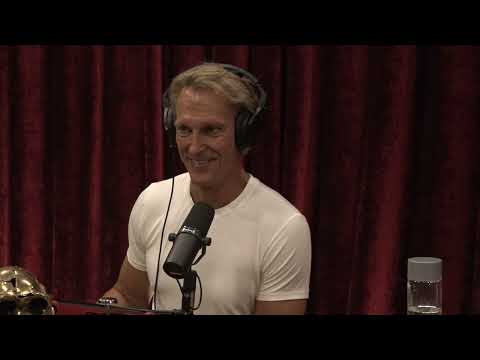
Joe Rogan Experience #1910 - Mark Laita
Narrator, Joe Rogan (host), Mark Laita (guest)
In this episode of The Joe Rogan Experience, featuring Narrator and Joe Rogan, Joe Rogan Experience #1910 - Mark Laita explores joe Rogan and Mark Laita Expose America’s Hidden Human Catastrophe Joe Rogan interviews photographer and Soft White Underbelly creator Mark Laita about his journey from high-end advertising to documenting America’s most marginalized people. Laita explains how decades of creating idealized, manipulative imagery for brands like Apple pushed him toward capturing raw, unvarnished portraits and life stories of addicts, sex workers, gang members, and the homeless. They dig into the roots of addiction, homelessness, and generational trauma—linking them to childhood abuse, broken families, failed institutions, and a lack of unconditional love and opportunity. The conversation also confronts the mental toll on Laita, systemic failures in policing and homelessness policy, and how storytelling and empathy might be one of the few realistic levers for change.
Joe Rogan and Mark Laita Expose America’s Hidden Human Catastrophe
Joe Rogan interviews photographer and Soft White Underbelly creator Mark Laita about his journey from high-end advertising to documenting America’s most marginalized people. Laita explains how decades of creating idealized, manipulative imagery for brands like Apple pushed him toward capturing raw, unvarnished portraits and life stories of addicts, sex workers, gang members, and the homeless. They dig into the roots of addiction, homelessness, and generational trauma—linking them to childhood abuse, broken families, failed institutions, and a lack of unconditional love and opportunity. The conversation also confronts the mental toll on Laita, systemic failures in policing and homelessness policy, and how storytelling and empathy might be one of the few realistic levers for change.
Key Takeaways
The glossy fantasy of advertising helped create Laita’s hunger for brutal honesty.
Years of producing flawless, aspirational images for major brands left Laita feeling complicit in deception; Soft White Underbelly is his deliberate counterweight—showing life at its most broken, unretouched, and uncomfortable.
Get the full analysis with uListen AI
Homelessness is a symptom stacked on top of addiction, mental illness, and childhood trauma.
Laita describes homelessness as the top layer; beneath it are almost universal substance abuse issues, deeper untreated mental health problems, and, under that, early-life abuse, neglect, and chaotic or absent parenting.
Get the full analysis with uListen AI
Self-worth is the invisible fulcrum of recovery—and most people he films don’t have it.
He argues that people who grow up with love and stability feel they “deserve” better lives and can build them, whereas many on Skid Row genuinely don’t believe they deserve anything beyond tents, drugs, and survival.
Get the full analysis with uListen AI
You cannot save someone who doesn’t want to be saved, even with money and effort.
After spending large sums trying to get individuals into rehab, Laita concluded that unless the drive to change comes from the person, outside help—no matter how intensive or expensive—usually fails.
Get the full analysis with uListen AI
Empathy and forgiveness grow from understanding, not from excusing behavior.
By hearing thousands of life stories—from incest survivors to pedophiles and violent criminals—Laita says he’s developed a ‘crash course in empathy,’ seeing how people become monsters or victims without condoning their actions.
Get the full analysis with uListen AI
Institutional responses to homelessness are lucrative industries, not solutions.
Rogan and Laita criticize billions in homelessness spending that mainly funds high-salary administrators and produces more bureaucracy than measurable improvement, with almost no accountability for results.
Get the full analysis with uListen AI
Telling hard stories publicly may do more good than one-on-one rescue attempts.
Laita believes his biggest realistic impact is raising mass awareness—especially about childhood abuse and absent fathers—so parents, communities, and young people can see future consequences and maybe break cycles upstream.
Get the full analysis with uListen AI
Notable Quotes
““Life isn’t perfect. Life is messy. Life can be really messed up.””
— Mark Laita
““Let’s say I never did these videos. Let’s pretend these problems don’t exist. It’s all gonna continue…and it’ll repeat the pattern over and over and over.””
— Mark Laita
““You can’t fix a childhood. How do you fix a childhood?””
— Mark Laita
““If you don’t believe you deserve anything better, you could be handed a million dollars…they’re gonna fuck it up as fast as you can imagine.””
— Mark Laita
““We’re these highly evolved living creatures, and you don’t know how to operate it…we’re living life forms without an instruction manual.””
— Joe Rogan
Questions Answered in This Episode
If you could redesign public education to actually prevent the cycles you document—what specific subjects, skills, or experiences would you add or remove?
Joe Rogan interviews photographer and Soft White Underbelly creator Mark Laita about his journey from high-end advertising to documenting America’s most marginalized people. ...
Get the full analysis with uListen AI
Given what you’ve learned, what would a realistic, effective multi-decade plan to reduce Skid Row‑type suffering actually look like?
Get the full analysis with uListen AI
How do you personally decide when documenting someone’s life crosses the line into exploitation, and where do you draw that line now?
Get the full analysis with uListen AI
Do you think platforms like YouTube have a moral obligation to protect and promote difficult but educational content like yours, even if advertisers are wary?
Get the full analysis with uListen AI
After thousands of interviews, what have you changed your mind about most regarding ‘good’ people, ‘bad’ people, and personal responsibility?
Get the full analysis with uListen AI
Transcript Preview
(drumbeats) Joe Rogan podcast, check it out. The Joe Rogan Experience.
Train by day, Joe Rogan podcast by night, all day. (instrumental music plays) Hello, Mark.
Hey, Joe.
How do you do what you do and maintain any-
Mental health?
Yeah.
(laughs)
(laughs) Let's just tell everybody-
Let's-
... you, uh, you have the YouTube show, Soft White Underbelly, which, uh, I, I found a while back and I, I just watched one video and then I went down the rabbit hole. And now, today I binged a bunch of them preparing for this and poof. Dude, it's so sad and so heartbreaking and, um, you interview all kinds of people, addicts, uh, prostitutes, johns, uh, gang members, and, uh, why Soft White Underbelly? Why'd you come up with that name?
Um, I, you know, I remember my dad when I was in the '60s, '70s, talking on the phone with, you know, I, I heard that ter- that term being used to, you know, it's, it's like a, an al- an analogy for the, the vulnerable part of, of whatever you're talking about. I don't, I don't hear that term anymore, but I remember it back then. And I always thought it was a cool name. Blue Oyster Cult used it as their original name before Blue Oyster Cult, um, so I just ... It was a fun name. Makes people wonder what the hell it's all about.
Well, it's very appropriate.
Yeah, yeah, I think it's fitting for what I'm doing.
Completely. How did you get involved in interviewing all of these people that are sort of downcast from society?
So I'm, uh, I've been an advertising photographer since I was 14 years old, or, or after high school really and went to college for it, but I was always into photography and then I got into advertising and I did that for decades and decades. Had a great career and then what happened is, you know, you do it... My advertising work was so slick and beautiful and perfect and everything's retouched so it's, it's better than life. And you do that for decades and you get burnt out and you, you just get fed up with the perfection and all the aspirational aspects of advertising and I just wanted something that was real. You know, I, I recognize that there are things going on in the world that weren't so perfect and I, I just felt like my life was out, out of balance because e- you know, like I didn't wanna grow old and have my kids say, you know, "What, what did your dad do?" "Oh, he, he shot advertising his whole life." I wanted to do something different and I've always done these side projects even when I was a teenager in Chicago. I, uh, I was always fascinated with the drunks on Madison Avenue on the west side. You see these guys sleeping on park benches and just with a paper bag and a bottle in their hands. It's like, what? It was such a, it's such a interesting lifestyle to me because I didn't grow up like that. I grew up, you know, in a pretty perfect household. Mom and dad, parents loved me, it was great, but I was fascinated with all that dark stuff and, uh, that continued throughout my career. I was always like doing portraits of people like that and, you know, I didn't really do much with it until about 1999 I started, uh, working, you know, while I was doing advertising I would sneak away whenever I had a hole in my schedule which wasn't often but I, you know, for 10, over nine or 10 years I went to each of the lower 48 states and started photographing everything that exists in the US, uh, cowboys in Wyoming, drunken Indians in New Mexico, ballerinas in New York City, repo men in Oklahoma, auto mechanics in Alabama, peda- uh, uh, pedophiles (laughs) in, uh, all over the country, um, polygamists in Utah, Am- the Amish in Pennsylvania. Just everything, like everything that kind of fits for... Oh, that's Pennsylvania, they have Amish there so I would pick that and I'd hunt it down and find it. So I got really good at finding these subcultures that we've all heard about but you didn't really know if, you know... Some of them are easier to find. Drug addicts are easy to find, um, but there's other subcultures that I've found that are, that are more difficult to find and certainly difficult to photograph and now it's really difficult to interview. So I did that book, came out in 2010, cre- it's called Created Equal and I was really proud of it. Put, you know, my heart and soul into it, but it, it didn't really... Like I would, I would sit at, at a table and somebody's looking at it and they would go, "Oh, what did he sound like? What did the cowboy sound like? What did he... How did he get like this? How did, how did he get this career? What was his childhood like?" You know, all these questions. And I didn't, honestly, didn't know it for each of these 200 portraits in that book and I realized if I'm gonna make this really stick the way I wanted it to, I'm gonna have to do it with, with an interview as a backstory. So it's a portrait and then I would just do these interviews that might just exist behind the, the portrait as you're looking at it and that's how I started. And you know, I had, I had... I always had studios like, like on Skid Row like while I was doing advertising in LA at my LA studio I'd had another studio down on Skid Row which was, you know, cheap and, you know, I would just sneak away there on, on s- slow days and just photograph all the cr- the, uh, the drug addicts, the, the prostitutes, the transgenders, the mental health, you know, the people that are off their rockers, everything, gang members and, uh, I loved doing it but I never really did anything with that until I started... Canon came out with a Canon 5D which is a cam- uh, a still camera that did video and I just was playing around. I do- I never shot video in my life and I'm like let me just put this thing on a tripod and interview somebody and there was this girl Caroline who was a, a heroin addict prostitute down on Skid Row and I was like, "Hey." You know, I got to know her and I said, "Hey, would you wanna just sit and tell me your life story?" And she goes, "Sure, I'll do it." So she sat down and did this and it was heartbreaking like Jesus Chri- I just hit a grand slam my first time at bat, like, like a really like horrifying story and she, uh... So I did that and I was like wow, that was, that was amazing. I started doing a few more and they were all interesting in their own way. Every single one was diff- you know, very different and interesting and I'm like, "May- maybe there's something here."And, uh, went through a divorce, went through, you know, my mom, uh, went through a lot of stuff. My mom died. Uh, went through a divorce. Uh, my advertising industry- you know, advertising industry changed a lot in th- in those years. Like, th- this was like f- seven years ago, seven, eight years ago. And I just, I gave up my studio and I just kind of like didn't know what I was doing with my life. And I, I had all these storage units for all my studio equipment and my furniture. I was building a house, so I had all my furniture in the house. Had like four or five different storage units around the city. I'm like, "Let me just consolidate all these into one big space and maybe I'll have room for a studio up front and I'll start doing those portraits and those interviews I was doing on Skid Row before and s- just see if I enjoy doing that." 'Cause I didn't know what I want to do with the rest of my life. You know, I was like, I wasn't doing advertising anymore and, uh, I didn't know what I was. You know, I just, I was just drifting and I started doing these and I just loved it. Just loved it. And I started doing them every day. And I've done it pretty much every day for over three years now.
Install uListen to search the full transcript and get AI-powered insights
Get Full TranscriptGet more from every podcast
AI summaries, searchable transcripts, and fact-checking. Free forever.
Add to Chrome