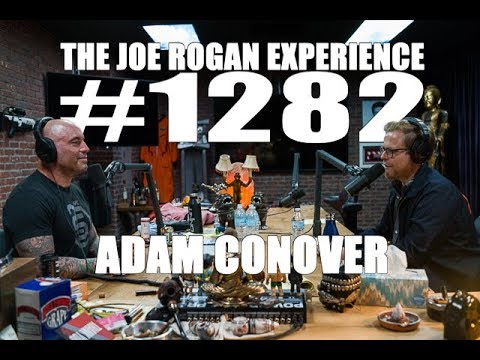
Joe Rogan Experience #1282 - Adam Conover
Narrator, Narrator, Joe Rogan (host), Adam Conover (guest), Joe Rogan (host), Narrator, Narrator
In this episode of The Joe Rogan Experience, featuring Narrator and Narrator, Joe Rogan Experience #1282 - Adam Conover explores adam Conover and Joe Rogan Debate Truth, Identity, and Algorithms Joe Rogan and Adam Conover dive into how Adam’s show “Adam Ruins Everything” tackles popular misconceptions, why debunking feels threatening, and why people react so strongly when cherished beliefs are challenged.
Adam Conover and Joe Rogan Debate Truth, Identity, and Algorithms
Joe Rogan and Adam Conover dive into how Adam’s show “Adam Ruins Everything” tackles popular misconceptions, why debunking feels threatening, and why people react so strongly when cherished beliefs are challenged.
They clash and converge on topics like alpha males, evolutionary psychology, masculinity, men’s mental health, and contentious issues around trans identities, children, and sports fairness.
The conversation broadens into media power: from hunting and conservation ethics to NCAA exploitation, the Olympics, performance‑enhancing drugs, and how platforms like YouTube, Twitter, and Facebook shape behavior with engagement‑driven algorithms.
Throughout, they keep returning to a core tension: balancing empathy and inclusion with scientific evidence and fairness, while resisting ideological echo chambers and learning to tolerate disagreement.
Key Takeaways
Challenging core identity beliefs triggers fierce backlash, not rational debate.
When information threatens beliefs tied to someone’s self‑image (e. ...
Get the full analysis with uListen AI
Labels like “alpha” and “beta” oversimplify complex human social behavior.
Conover argues that dominance and confidence are context‑dependent and not rigid biological castes; anthropologists and sociologists don’t support a strict alpha/beta hierarchy in humans, even if people find the framework motivational.
Get the full analysis with uListen AI
Narrow norms of manliness harm men’s health and relationships.
Expectations to ‘man up’ and avoid vulnerability contribute to male loneliness, high suicide rates, resistance to seeking help (e. ...
Get the full analysis with uListen AI
Fairness in sports is constructed, not absolute.
Rules, categories, and funding structures (e. ...
Get the full analysis with uListen AI
College and Olympic athletes can be heavily exploited economically.
NCAA players generate enormous revenue yet rarely reach the pros and often suffer lasting injuries without pay; Olympic athletes struggle financially while massive organizations and sponsors profit and tightly control branding.
Get the full analysis with uListen AI
Engagement‑driven algorithms systematically amplify outrage and junk content.
Platforms like YouTube and Facebook optimize for time‑on‑site and clicks, so they unknowingly reward content that hacks their systems—whether that’s kids’ nonsense videos, extremist material, or divisive political content—while companies downplay their responsibility.
Get the full analysis with uListen AI
Long‑form, good‑faith conversation can surface nuance on polarizing issues.
Even on loaded subjects like trans kids, bathroom access, and sports categories, Rogan and Conover manage to probe disagreements, acknowledge uncertainty, and reference research needs instead of collapsing into pure tribal fighting.
Get the full analysis with uListen AI
Notable Quotes
“The thesis of the show is that it’s always better to know the truth. It’s momentarily uncomfortable, but you’re better off knowing.”
— Adam Conover
“There’s no such thing as a perfectly fair competition designed by God. We decide what kind of playing field we want.”
— Adam Conover
“A lot of the problems that men have are different than the problems those men’s‑rights guys think men have.”
— Adam Conover
“If a child thinks they’re a girl, let them live as a girl. But when you’re shooting chemicals into a developing baby… show me the research.”
— Joe Rogan
“You guys threw the party. The vase got broken—it’s your fault in the end.”
— Adam Conover (on platforms like YouTube/Facebook and harmful content)
Questions Answered in This Episode
How should we balance respect for people’s identities with the need to question unscientific or oversimplified frameworks like alpha/beta or pop evolutionary psychology?
Joe Rogan and Adam Conover dive into how Adam’s show “Adam Ruins Everything” tackles popular misconceptions, why debunking feels threatening, and why people react so strongly when cherished beliefs are challenged.
Get the full analysis with uListen AI
What practical changes could help men keep deep friendships and emotional openness without losing the benefits of resilience and toughness?
They clash and converge on topics like alpha males, evolutionary psychology, masculinity, men’s mental health, and contentious issues around trans identities, children, and sports fairness.
Get the full analysis with uListen AI
Where should sports organizations draw the line between inclusion (e.g., trans participation, prosthetics) and preserving meaningful competitive fairness?
The conversation broadens into media power: from hunting and conservation ethics to NCAA exploitation, the Olympics, performance‑enhancing drugs, and how platforms like YouTube, Twitter, and Facebook shape behavior with engagement‑driven algorithms.
Get the full analysis with uListen AI
Given engagement‑driven algorithms’ effects on polarization and misinformation, what obligations do tech companies have to redesign their systems, and who decides what’s harmful?
Throughout, they keep returning to a core tension: balancing empathy and inclusion with scientific evidence and fairness, while resisting ideological echo chambers and learning to tolerate disagreement.
Get the full analysis with uListen AI
How can viewers protect themselves from backfire‑effect thinking and become more comfortable updating their beliefs when confronted with new evidence?
Get the full analysis with uListen AI
Transcript Preview
(sighs)
Yes, uh-
Is it good?
Yeah. Yeah, it's fine. Go ahead.
(laughs)
All right.
Cut all this out, so-
Right, right, right, right.
(laughs)
Hello, Adam.
Hey, thanks for having me, Joe.
Hey, thanks for being here, man. I appreciate it.
Of course.
I'm a, a giant fan of your show.
I really appreciate that.
I love the fact that it annoys people too.
(laughs)
(laughs)
It really pisses people off. That's the goal pretty much, you know. I mean, I'm not the kind of person where I'm like, "Ah, if you're pissing people off, you're doing something right." But, eh, there's some truth to that, you know.
There's some truth to that. And also, the way you structured the name. I mean, I don't know if you came up with the name of it, but Adam-
Yeah.
... Ruins Everything.
I, I think I might have to give that to my, to my, uh, former boss, Sam Reich at CollegeHumor, might've, might've, uh... I think, uh, we, we came up with the, with the name together. He might've been the first person to say it, but, uh, yeah.
It's perfect.
Thank you. I'm really... Uh, yeah, it like, lets you know, it lets you know that, hey, this is gonna annoy you a little bit. That like-
(laughs)
... I'm gonna be telling you shit that you don't wanna hear that's gonna make everything a little bit worse, you know. But at the end of the day, it makes it better. It's an optimistic show at the end of the day, where-
Sure.
Yeah.
Yeah, yeah. You, you give them the truth.
I think that l-... Yeah, I mean, the, the, the thesis of the show is that it's always better to know the truth. That it's, uh-
Yeah.
... momentarily uncomfortable, but hopefully, for most people, 99% of people who watch the show, it grinds your gears a little bit to find out something that, "Oh, I thought that was true at the... Ah, crap." You know? But then at the end, we show you why you're actually better off knowing that thing. And you're always better off knowing the truth, in my view.
Yeah, in my view as well.
Yeah.
Is, was there ever an e-... Was there, was there one episode that stands out as being one that people got the most upset about?
(laughs) Uh, y-... There's a bunch of 'em. I mean, people get-
(laughs)
People get upset with us for a lot of different reasons. We did one about how, um, uh, breastfeeding isn't, uh, better than formula feeding. It's, uh, you kn-
It's not?
Uh, no, they're both... Like, formula feeding is fine, you know. And if... The problem is formula feeding has become astigmati- stigmatized now.
Install uListen to search the full transcript and get AI-powered insights
Get Full TranscriptGet more from every podcast
AI summaries, searchable transcripts, and fact-checking. Free forever.
Add to Chrome