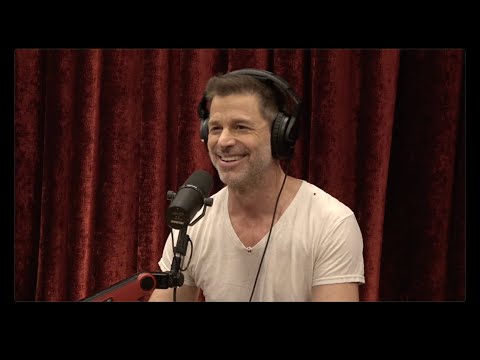
Joe Rogan Experience #2114 - Zack Snyder
Zack Snyder (guest), Joe Rogan (host), Joe Rogan (host), Guest companion (unidentified) (guest), Narrator, Narrator
In this episode of The Joe Rogan Experience, featuring Zack Snyder and Joe Rogan, Joe Rogan Experience #2114 - Zack Snyder explores zack Snyder on 300, Watchmen, Rebel Moon, and Creative Freedom Joe Rogan and Zack Snyder dive into Snyder’s career path from commercials to making stylized, genre-defining films like 300, Watchmen, Man of Steel, and Rebel Moon.
Zack Snyder on 300, Watchmen, Rebel Moon, and Creative Freedom
Joe Rogan and Zack Snyder dive into Snyder’s career path from commercials to making stylized, genre-defining films like 300, Watchmen, Man of Steel, and Rebel Moon.
They discuss the physical preparation and aesthetics behind 300, the deconstruction of superheroes in Watchmen and Batman v Superman, and Snyder’s ongoing push for director’s cuts that reflect his true vision.
The conversation widens into bodybuilding, recovery, Formula 1, Netflix’s impact on distribution, the limits of AI in art, and Snyder’s long-standing dream projects like Heavy Metal–style sci‑fi and an adaptation of Ayn Rand’s The Fountainhead.
Snyder also speaks candidly about losing his daughter, mental health, and how his fandom helped raise money for suicide prevention, giving his work a deeper personal and communal legacy.
Key Takeaways
Hyper‑stylized visions can succeed if you commit fully and prove them visually.
Snyder sold 300 by literally matching shots to Frank Miller’s graphic novel and creating a convincing test reel; when you’re pitching something unconventional, a strong proof‑of‑concept can overcome studio skepticism.
Get the full analysis with uListen AI
Transformational on‑screen physiques are built with pro‑athlete systems, not shortcuts.
The 300 cast used intense, military‑style training with no CGI bodies, supported by tight nutrition and recovery protocols—showing that results require time, structure, and psychologically demanding work, not post‑production fakery.
Get the full analysis with uListen AI
Deconstructing iconic heroes can deepen, not destroy, their mythic power.
By putting Batman and Superman into morally impossible situations (inspired by works like The Dark Knight Returns and Watchmen), Snyder argues you test and reveal why these characters endure, instead of keeping them in safe, idealized boxes.
Get the full analysis with uListen AI
Director’s cuts often contain the creative ‘why’ that studios cut out.
Snyder’s extended versions (Watchmen, Batman v Superman, Justice League, and soon Rebel Moon) restore violence, philosophy, and pace that executives removed for runtime and ratings, giving audiences a truer sense of the original intent.
Get the full analysis with uListen AI
Streaming radically changes what kinds of stories can find an audience.
With Rebel Moon reaching tens of millions of accounts on Netflix, Snyder notes that niche, heavy‑metal‑style sci‑fi or F1 documentaries can now achieve massive viewership that would’ve been impossible in a purely theatrical model.
Get the full analysis with uListen AI
Mental health advocacy can organically grow out of fan communities.
After his daughter’s suicide, Snyder saw fans of the Snyder Cut raise over a million dollars for suicide prevention, showing how passionate fandoms can be steered toward real‑world impact when creators are open about their struggles.
Get the full analysis with uListen AI
Human fingerprints in art will always matter more than algorithmic perfection.
Both Rogan and Snyder believe audiences ultimately respond to the visible ‘chisel marks’ of a filmmaker’s hand—the subjective choices, flaws, and risks—which AI‑generated content, however slick, can’t authentically replicate.
Get the full analysis with uListen AI
Notable Quotes
“If you do Watchmen and Dark Knight Returns, your legacy is set.”
— Zack Snyder
“The one thing about movies is Mark would say, ‘I’m gonna put you in your pain cave, and you’re gonna find out a lot about yourself in there.’”
— Zack Snyder (on trainer Mark Twight and the 300 cast)
“I always say I’m a genre filmmaker. In genre you can explore philosophy and mythology—movies are modern myth.”
— Zack Snyder
“No one knows the formula. If they did, they would’ve gotten rid of directors and writers a long time ago.”
— Zack Snyder (on why AI can’t replace filmmaking)
“Those kids you call toxic fans also raised over a million dollars to save lives.”
— Zack Snyder (on the Snyder Cut fandom and suicide prevention)
Questions Answered in This Episode
How much should filmmakers prioritize fidelity to source material versus reimagining it for new audiences, especially with properties like 300 or Watchmen?
Joe Rogan and Zack Snyder dive into Snyder’s career path from commercials to making stylized, genre-defining films like 300, Watchmen, Man of Steel, and Rebel Moon.
Get the full analysis with uListen AI
Where is the ethical line between physically transforming actors for roles and potentially pushing them into unhealthy extremes to achieve a certain aesthetic?
They discuss the physical preparation and aesthetics behind 300, the deconstruction of superheroes in Watchmen and Batman v Superman, and Snyder’s ongoing push for director’s cuts that reflect his true vision.
Get the full analysis with uListen AI
Does deconstructing superheroes—making them traumatized, flawed, and morally conflicted—enhance their cultural relevance, or risk undermining the escapism people seek?
The conversation widens into bodybuilding, recovery, Formula 1, Netflix’s impact on distribution, the limits of AI in art, and Snyder’s long-standing dream projects like Heavy Metal–style sci‑fi and an adaptation of Ayn Rand’s The Fountainhead.
Get the full analysis with uListen AI
In a streaming‑dominated world, how should we meaningfully measure success: box‑office revenue, view counts, completion rates, or cultural impact over time?
Snyder also speaks candidly about losing his daughter, mental health, and how his fandom helped raise money for suicide prevention, giving his work a deeper personal and communal legacy.
Get the full analysis with uListen AI
How can fan communities be better guided toward constructive activism and mental‑health advocacy rather than online toxicity when they feel ownership over a creator’s work?
Get the full analysis with uListen AI
Transcript Preview
(drumbeats) Joe Rogan podcast, check it out. The Joe Rogan Experience.
Train by day, Joe Rogan podcast by night, all day. (instrumental music) We're up. What's going on, man? How are you?
I'm good. I'm-
Welcome aboard. Thank you for being here.
No, thanks for having me.
My pleasure. You, you made two of my all-time favorite movies.
Right.
The Watchmen-
Okay.
... which I fucking love.
Okay, awesome.
And 300.
Okay, awesome.
Those are two ... I have like a top 20 list, I've never like formally put together a top 20 list, but those are in there-
Oh, that's cool.
... for sure.
Well, uh, first of all, I appreciate that 'cause, uh, you know, 300 was a complete labor of love and an insane ... Like, you know, 300 was ... I wa- I, I was a Frank Miller fan for a long time, right? And I, I thought the fr- I thought I would do another. I thought I would do Dark Knight Returns, frankly. That was the movie I wanted. I still wanna do it. I, I always tell everyone, like, Dark Knight Returns. If I could do Dark Knight Returns, I'd be done with comic book movies.
Really?
'Cause ... Well, because, like, if you've done Watchmen. Oh, sorry, I'm banging the mic.
That's okay.
If, if, if you do Watchmen and Dark Knight Returns, like, for me, your g- your g- your legacy is set.
Mm-hmm.
So, like Batman v Superman literally steals a lot of Dark Knight Returns. I'm not gonna say it didn't, it did. But it's still not Dark Knight Returns, so-
Hm.
... I think that's still out there, but I always ... You know, for a long time, I had that. I had 300, like, on my coffee table at my house when I was making TV commercials, you know, and I'd have my friends over. I'd be like, "I'm gonna make this one day. It's gonna look exactly like this comic book."
(laughs)
And they'd be like, "Yeah, yeah." You're- (laughs) "Sure it is." And, uh, yeah, I was having a, a general meeting with Gianni Nunnari, who was one of the producers, and he was asking me about what I like, and he had that graphic novel in his office.
Oh, wow.
Like, on his table, and I went, "Well, okay, you know what? If I could do anything, that book right there, I would make that." And he goes, "Well, what do you mean? How would you make it?" And I literally just opened it up, and I go, "We'd make ... We'd film this. We'd film these pictures. It would look like this." And he goes, "Okay, that's cool. Like, so you're saying you would just shoot the movie and it would look like this graphic novel?" I go, "That's what I'm saying." And I think ... And that's what ... But, but at the time, we couldn't sell it. We tried. We went around town with it. We tried to ... I literally ... We went to all the studios. Um, you know, they were all kind of, um, kind of like, "Yeah, sword and sandals? Eh."
Install uListen to search the full transcript and get AI-powered insights
Get Full TranscriptGet more from every podcast
AI summaries, searchable transcripts, and fact-checking. Free forever.
Add to Chrome