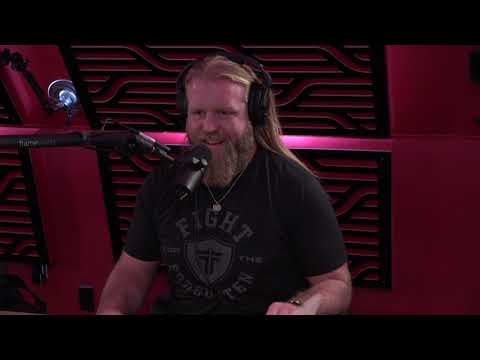
Joe Rogan Experience #1602 - Justin Wren
Joe Rogan (host), Narrator, Justin Wren (guest)
In this episode of The Joe Rogan Experience, featuring Joe Rogan and Narrator, Joe Rogan Experience #1602 - Justin Wren explores justin Wren Shares Addiction, Healing, and Fighting for the Forgotten Joe Rogan and Justin Wren begin with a Buffalo Trace charity collaboration that benefits Wren’s nonprofit, Fight for the Forgotten, which drills wells and builds homes for displaced Pygmy communities in Africa.
Justin Wren Shares Addiction, Healing, and Fighting for the Forgotten
Joe Rogan and Justin Wren begin with a Buffalo Trace charity collaboration that benefits Wren’s nonprofit, Fight for the Forgotten, which drills wells and builds homes for displaced Pygmy communities in Africa.
The conversation quickly turns deeply personal as Wren details his relapses into addiction, a near-fatal drug cocktail in Mexico, his time in a brutal rehab, and how childhood bullying and self-worth issues fueled his substance abuse.
Wren describes his work in Congo and Uganda—securing land, clean water, farming training, and housing for Pygmies—while also recounting traumatic experiences like witnessing mob killings, rape survivors, and child deaths, and the PTSD that followed.
They close by discussing brain health (CTE, parasites, stem cells, psilocybin research), the pressures on fighters, and Wren’s renewed focus on healing himself through meditation, breathwork, and boundaries so he can continue his service work sustainably.
Key Takeaways
Purpose-driven work can be powerful but won’t replace inner healing.
Wren found deep purpose helping Pygmy communities, yet unresolved childhood trauma and self-worth issues still pulled him back into addiction; meaningful service must be paired with self-care and emotional work.
Get the full analysis with uListen AI
Relapse often follows when daily disciplines quietly slip away.
He notes that his major relapses came after he stopped meditating, journaling, and maintaining structure—highlighting the importance of consistent routines for people vulnerable to addiction.
Get the full analysis with uListen AI
Addiction involves both biology and belief—understanding the cycle matters.
Wren describes an ‘allergy’ to substances, dopamine receptor differences, and the loop of remorse → firm resolve → restlessness → first use → spree; mapping this cycle helped him see why willpower alone wasn’t enough.
Get the full analysis with uListen AI
Radical honesty and community support are critical for sustainable recovery.
His board, friends, and groups like Fit for Service backed him through rehab instead of abandoning him, and he committed to a “rigorously honest personal inventory,” showing how transparent relationships can stabilize recovery.
Get the full analysis with uListen AI
Boundaries and saying ‘no’ protect mental health and purpose.
Rogan challenges Wren on overcommitting and “creating new problems,” and Wren describes learning to decline meetings, limit phone use, and schedule time for solitude and reflection as a form of self-preservation.
Get the full analysis with uListen AI
Breathwork and meditation can catalyze profound psychological shifts.
Through intense breathwork in Sedona, Wren experienced a vivid ‘vision’ of his heart sinking and being restored, which he interprets as a turning point toward self-love and emotional healing.
Get the full analysis with uListen AI
Health crises can be hidden drivers of psychological and behavioral collapse.
Years of malaria, parasites, brain inflammation, and gut damage left Wren cognitively foggy and depleted, contributing to his spiral; targeted medical care, lab work, and regenerative treatments have been key to rebuilding his stability.
Get the full analysis with uListen AI
Notable Quotes
“I felt like the addiction had snagged me… this time it’s got me in a stranglehold that I can’t get out of.”
— Justin Wren
“It’s like you’re distracting yourself with activity where you’re always having new challenges and new problems, but you’re in the middle of other challenges and problems that aren’t sorted out yet.”
— Joe Rogan
“I’m not just gonna fight against people, I’m gonna fight for people.”
— Justin Wren
“Self-care is not selfish. You just gotta stay on the path.”
— Joe Rogan
“I don’t think I ever allowed myself to love myself… this is a season of healing through self-love.”
— Justin Wren
Questions Answered in This Episode
How can people with high-purpose careers recognize when they’re using ‘doing good’ to avoid dealing with their own unresolved trauma?
Joe Rogan and Justin Wren begin with a Buffalo Trace charity collaboration that benefits Wren’s nonprofit, Fight for the Forgotten, which drills wells and builds homes for displaced Pygmy communities in Africa.
Get the full analysis with uListen AI
What practical daily practices (like Wren’s journaling and meditation) are most effective for someone trying to prevent relapse or burnout?
The conversation quickly turns deeply personal as Wren details his relapses into addiction, a near-fatal drug cocktail in Mexico, his time in a brutal rehab, and how childhood bullying and self-worth issues fueled his substance abuse.
Get the full analysis with uListen AI
How should fight sports and football evolve in light of what we’re learning about CTE, psilocybin, and brain regeneration?
Wren describes his work in Congo and Uganda—securing land, clean water, farming training, and housing for Pygmies—while also recounting traumatic experiences like witnessing mob killings, rape survivors, and child deaths, and the PTSD that followed.
Get the full analysis with uListen AI
What ethical boundaries should aid workers and activists set to avoid sacrificing their health while working in extreme environments like Congo?
They close by discussing brain health (CTE, parasites, stem cells, psilocybin research), the pressures on fighters, and Wren’s renewed focus on healing himself through meditation, breathwork, and boundaries so he can continue his service work sustainably.
Get the full analysis with uListen AI
How can friends and families better support a loved one who appears outwardly successful but is secretly struggling with addiction or suicidal thoughts?
Get the full analysis with uListen AI
Transcript Preview
(drumming music) Joe Rogan podcast, check it out.
The Joe Rogan Experience.
Train by day, Joe Rogan podcast by night. All day. (rock music plays) Oh hey, Justin. What's up, my man?
What's up, buddy? You got a, a, a whole book of stuff to talk about.
Yeah, my-
You're prepared.
I'm prepared a little bit.
You're like a professional.
Like, there's something special. There's something special and we're gonna kick this off with a bang.
Uh-oh.
Yeah.
Something I don't know about?
Something you don't know about.
Uh-oh.
But we'll get into it.
Okay.
Yeah.
Special.
Yeah.
Tell me.
You wanna do it now?
Sure.
Awesome. Let's do it.
What's happening?
Well, you and your team, you, uh, picked Fight for the Forgotten, uh, my non-profit, as charity of choice with Buffalo Trace.
Yes.
And we're gonna do something really special for all your fans.
Oh.
But first, um, (smacks lips) I wanted to do something ni- ... I talked with Bo Beckman. His great-grandfather's great-grandfather, I think his name's like T-H, I don't know, uh, Eckert or something like that. He, um, (smacks lips) he started basically the modern day bourbon in America. So, anyways, I asked him, I was talking with Bo and said, "Could we do something special for Joe?" And he was like, "Yeah. What are you, what are you thinking?" And so I talked with my buddy Ryan, who's the vice president of our board, and we thought about it and we were like, "What if we could get a barrel from Buffalo Trace and we could give it to Joe?"
Oh, Jesus.
And so we thought we'd do a sample tasting for you.
Okay.
And you get to pick a single barrel select, basically I guess ... I'm not a whiskey connoisseur, but basically you're about to be able to do a wine, or not wine, but whiskey tasting.
Really?
And you're gonna be able to pick out your own Buffalo Trace barrel that doesn't taste like any of the rest. What I didn't know about barrels of whiskey is that ... What is it? They come from, like, 70 to 90 year old trees and then each one of them starts off as kind of like this moonshine looking. It's clear when they put it in the barrels. But then the, the taste of whiskey comes from like, 67% of the taste comes from the barrel itself.
Really?
Yeah. But the trees are all different trees, right? So there's things, I think they call them staves or something, it's like, uh, 28 to 35 of those things that make the barrel.
Right.
But they come from all these different trees.
The wood slats?
Yeah, the wood slats.
Yeah. Mm-hmm.
Um, and so they all taste different, every barrel, whenever it's a single select barrel. So, I guess, like, what they do at Buffalo Trace is they take a bunch of those barrels and they put them all in there together so it has one consistent taste. But whenever you just take one barrel, it's always a unique flavor.
Install uListen to search the full transcript and get AI-powered insights
Get Full TranscriptGet more from every podcast
AI summaries, searchable transcripts, and fact-checking. Free forever.
Add to Chrome