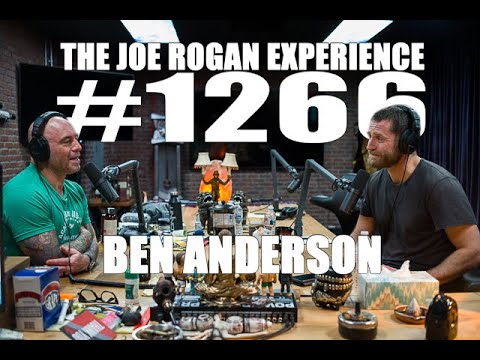
Joe Rogan Experience #1266 - Ben Anderson
Ben Anderson (guest), Joe Rogan (host), Jamie Vernon (guest), Narrator
In this episode of The Joe Rogan Experience, featuring Ben Anderson and Joe Rogan, Joe Rogan Experience #1266 - Ben Anderson explores war Reporter Ben Anderson Confronts Conflict, Trauma, And Numbed Humanity Ben Anderson, a veteran war correspondent and filmmaker, discusses his frontline experiences in Afghanistan, Iraq, Syria, Yemen, Brazil and beyond, and how years of exposure to violence left him dangerously numb to both physical danger and normal life.
War Reporter Ben Anderson Confronts Conflict, Trauma, And Numbed Humanity
Ben Anderson, a veteran war correspondent and filmmaker, discusses his frontline experiences in Afghanistan, Iraq, Syria, Yemen, Brazil and beyond, and how years of exposure to violence left him dangerously numb to both physical danger and normal life.
He explains how MDMA‑assisted therapy and ketamine treatment helped him understand underlying guilt, PTSD, and his compulsion to keep returning to war zones, even as he questions the impact of his work in an age of information overload and distrust.
The conversation ranges from U.S. foreign policy failures and the ethics of intervention, to media fragmentation, conspiracy thinking, refugees, mass shootings, racism, and mass incarceration, highlighting how disconnected comfortable societies are from the suffering he documents.
Despite burnout and moral exhaustion, Anderson feels compelled to continue reporting on conflicts and their civilian toll, while exploring psychedelics as tools for personal healing and potentially broader social change.
Key Takeaways
Long-term exposure to war can produce dangerous emotional numbness rather than fear.
Anderson describes calmly sitting next to IEDs and under fire, not out of bravery but because repeated exposure eroded his instinct for self-preservation and later dulled his capacity to feel pleasure or curiosity back home.
Get the full analysis with uListen AI
MDMA‑assisted therapy can unlock buried beliefs and reframe survivor guilt.
In clinical sessions, MDMA helped Anderson uncover subconscious ideas like feeling 'not important enough' to be hurt and allowed him to consider having a family and normal life, while veterans reported powerful releases from guilt after imagining fallen comrades granting them 'permission' to live.
Get the full analysis with uListen AI
Even the best war reporting often fails to produce political change—but still deeply affects individuals.
He notes Syria’s atrocities are meticulously documented yet policy outcomes remain grim, but individual viewers do get inspired to become doctors, photographers, or aid workers, suggesting impact is real but diffuse and hard to measure.
Get the full analysis with uListen AI
Modern media amplifies noise and partisan comfort rather than verified depth.
They argue that people increasingly seek headlines that confirm gut feelings, can always find professional‑looking partisan sites, often never read longform investigative work, and that even video evidence is undermined by deepfakes and mistrust.
Get the full analysis with uListen AI
Refugee and immigration debates ignore both moral obligations and actual benefits.
Anderson cites Afghan interpreters in Houston as hardworking, community‑minded contributors, and compares today’s refugee rejection to turning away Jews during WWII, pointing out that Christian and democratic values would demand the opposite.
Get the full analysis with uListen AI
Systemic injustices at home—prisons, plea bargains, racism, segregation—mirror moral blind spots abroad.
They touch on U. ...
Get the full analysis with uListen AI
Psychedelics and MDMA could become scalable tools for mental health and societal empathy—if not captured by profiteers.
They discuss promising trial data, near‑term FDA approval for MDMA therapy, ketamine’s effects on depression, Fox News supporting MDMA for veterans, and warn how corporate moves like $15,000 esketamine sprays could distort access and intent.
Get the full analysis with uListen AI
Notable Quotes
“I wasn’t scared and then did it anyway. I wasn’t scared. I was just numb.”
— Ben Anderson
“You’re not important enough to have something as dramatic as getting shot or blown up happen to you.”
— Ben Anderson, describing a belief uncovered in MDMA therapy
“The Syrian war has been very well covered… Has it made any difference whatsoever? I’m not sure.”
— Ben Anderson
“If people spent as much time as they spend arguing on Twitter reading, there are people you can trust.”
— Ben Anderson
“It’s so difficult to change who you are. People rarely change… Psychedelics give you a brief break from that conflict.”
— Joe Rogan
Questions Answered in This Episode
If war reporting rarely shifts policy, what should its primary purpose be in the 21st century?
Ben Anderson, a veteran war correspondent and filmmaker, discusses his frontline experiences in Afghanistan, Iraq, Syria, Yemen, Brazil and beyond, and how years of exposure to violence left him dangerously numb to both physical danger and normal life.
Get the full analysis with uListen AI
How can MDMA and psychedelic therapies be integrated into mainstream mental health care without being captured by pharmaceutical profit motives?
He explains how MDMA‑assisted therapy and ketamine treatment helped him understand underlying guilt, PTSD, and his compulsion to keep returning to war zones, even as he questions the impact of his work in an age of information overload and distrust.
Get the full analysis with uListen AI
What concrete media habits could an average person adopt to escape confirmation bias and engage meaningfully with complex foreign conflicts?
The conversation ranges from U. ...
Get the full analysis with uListen AI
Given the failures of intervention in Iraq, Afghanistan, Libya, and Syria, is there any ethically and practically sound model for responding to mass atrocities abroad?
Despite burnout and moral exhaustion, Anderson feels compelled to continue reporting on conflicts and their civilian toll, while exploring psychedelics as tools for personal healing and potentially broader social change.
Get the full analysis with uListen AI
How might societies redesign systems like prisons, refugee processing, and drug policy if they truly centered rehabilitation, empathy, and long‑term social health rather than punishment and fear?
Get the full analysis with uListen AI
Transcript Preview
... chain on.
It's been a while. Working? Live? We're live. Do you wanna talk about that? Or no?
I-
The chain thing, did you have something to say?
Ev- ev- everyone sent me the clip and, uh-
Oh.
... and I think you said something about taking a knee i- in the middle of a gunfight, and he said, "Yeah, that was Ben. He's a fucking savage."
What did you do?
And, uh-
What happened? Refresh my memory.
We're in Afghanistan.
Right.
And the guys I'm with, the Afghan soldiers I'm with, get ambushed by the Taliban. And I just went down on one knee and carried on talking.
Ugh.
Um, and Shane said, "Yeah, he's a fucking savage."
(laughs)
And that... Apparently, that's a compliment. (laughs) I wasn't sure.
War journalists are very fascinating people to me because, uh, oftentimes, you guys move towards the gunfire with the camera to get the shot. And, y- you know, I've talked to folks before who have worked as a, a war journalist and they say you almost don't think you're... Y- y- you, you, you're f- so concentrated on getting the shot, you don't think about the fact that you might get shot.
Oh, it's, it's a safety mechanism, yeah. You think you're protected by looking at it on a screen rather than realizing it's, it's actually happening in real life right now.
That's-
I mean, it's stupid. (laughs)
That is so... It's so strange.
There was a-
Try, try to keep this, uh, like a, like a fist from your face. Perfect. There we go.
I was with, um, the US Marines for Operation Moshtarak, like the biggest operation of the Afghan war. Um, and there was a town called Marja that was controlled by the Taliban. And I met up with this one group of Marines. I, I used to love going out with the Marines 'cause they'd... If you were willing to run the same risks as them, they'd let you film everything. Um, and their mission was to get dropped by helicopter in the middle of this town at 3:00 AM on day one, and then just fight their way out from the middle of the town. And as soon as the sun came up, all of the speakers on the mosques were saying, "The infidels are here, the infidels are here. Get your weapons, get your weapons." And General McChrystal had introduced this rule of courageous restraint saying you're not allowed to shoot unless you're shot at, or unless you see someone preparing a hostile act. And the Taliban had figured out how to use this. So, I'm sitting in this field with about 28 Marines watching the Taliban drop off guys in buildings all around us with their weapons wrapped in blankets, knowing the Marines can't shoot them. So they're setting up the perfect ambush. Um, and as soon as we started walking across the field, it started and it's like nothing I've ever heard or experienced before. And we ran and dived into a ditch. The guys either side of me got, got hit, one of them badly. A guy was killed on the other side of the field almost straight away. Um, and I was there alone filming it myself. And because I was watching the whole thing through this tiny little screen on my camera, it felt like I wasn't, you know, in, in as much danger as, as they were. And I, I was so f- afraid... And the adrenaline runs out after a while and you just become numb, and you... I mean, then I'd resigned myself. I thought we were all gonna get killed. We were completely surrounded and outnumbered, and there were RPGs and snipers. Um, and I watched it back, and the footage is pretty good.
Install uListen to search the full transcript and get AI-powered insights
Get Full TranscriptGet more from every podcast
AI summaries, searchable transcripts, and fact-checking. Free forever.
Add to Chrome