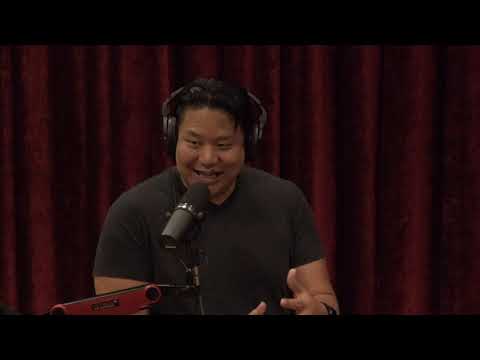
Joe Rogan Experience #1704 - C.K. Chin
Narrator, Joe Rogan (host), C.K. Chin (guest), Narrator, Narrator
In this episode of The Joe Rogan Experience, featuring Narrator and Joe Rogan, Joe Rogan Experience #1704 - C.K. Chin explores joe Rogan And C.K. Chin On Food, Hospitality, Art, And Tribalism Joe Rogan talks with Austin restaurateur C.K. Chin about how he grew from teenage bartender to multi-venue hospitality operator, and how his love of cooking, community, and culture shapes his businesses. They dive deep into food: burgers, barbecue, Chinese-American dishes, fried rice, hot sauce, vegetarianism, and why comfort food and nostalgia are so powerful. The conversation branches into broader themes—pandemic pivots, the economics of restaurants, homelessness and charity incentives, social media toxicity, tribal politics, and why open-minded conversation matters. Throughout, Chin comes back to hospitality as a philosophy: making people comfortable, respecting different tastes and beliefs, and using food and art to bring people together.
Joe Rogan And C.K. Chin On Food, Hospitality, Art, And Tribalism
Joe Rogan talks with Austin restaurateur C.K. Chin about how he grew from teenage bartender to multi-venue hospitality operator, and how his love of cooking, community, and culture shapes his businesses. They dive deep into food: burgers, barbecue, Chinese-American dishes, fried rice, hot sauce, vegetarianism, and why comfort food and nostalgia are so powerful. The conversation branches into broader themes—pandemic pivots, the economics of restaurants, homelessness and charity incentives, social media toxicity, tribal politics, and why open-minded conversation matters. Throughout, Chin comes back to hospitality as a philosophy: making people comfortable, respecting different tastes and beliefs, and using food and art to bring people together.
Key Takeaways
Hospitality works best when you prioritize guest happiness over being “right.”
Chin argues that in restaurants you often gain more by giving the annoying birthday customer a free drink than by proving a point; the goal is to create memorable experiences, not win arguments.
Get the full analysis with uListen AI
Comfort and nostalgia are as important as pure flavor in how we experience food.
They note that foods like bologna sandwiches or McDonald’s may be objectively simple, but feel deeply satisfying because they connect to childhood memories and emotional comfort.
Get the full analysis with uListen AI
True cooking mastery comes from long, slow, often frustrating trial and error.
Whether it’s Texas brisket or sourdough bread, Chin stresses that you only learn subtle adjustments—heat, timing, moisture—through repeated failures, mentorship, and patience.
Get the full analysis with uListen AI
Immigrant cuisines constantly adapt to local tastes and ingredients.
General Tso’s chicken, American broccoli in “Chinese” dishes, and Chinese-American fried rice as a leftovers dish show how food labeled “ethnic” often originates in the diaspora, not the home country.
Get the full analysis with uListen AI
Incentive structures quietly shape social problems like homelessness and charity.
They discuss how salaried “solutions” can actually rely on a problem persisting—e. ...
Get the full analysis with uListen AI
Our ideas shouldn’t be our identity; changing your mind shouldn’t feel like physical pain.
Rogan and Chin highlight how people fuse political or dietary choices with self-worth, making disagreement feel like an attack; they advocate curiosity—asking “why do you believe that? ...
Get the full analysis with uListen AI
We need a new ‘tribe’ built around open-minded, kind conversation.
In contrast to social media echo chambers and ideological purity tests, they suggest consciously avoiding polarization, listening to opposing views, and leading with kindness—much like good hospitality.
Get the full analysis with uListen AI
Notable Quotes
“If somebody hands you a roadmap on how to make them happy, use it.”
— C.K. Chin
“I cannot distinguish delicious and nostalgic. I think that scratches the same itch in my brain.”
— C.K. Chin
“Don’t yuck my yum.”
— C.K. Chin (citing a saying about respecting others’ tastes)
“I want this charity to end next year… I want this to be the last board I sit on.”
— C.K. Chin
“Most people are probably idea‑connected… they identify with their ideas instead of just examining them.”
— Joe Rogan
Questions Answered in This Episode
How can restaurants and hospitality businesses balance profitability with genuine care for people, rather than treating guests as transactions?
Joe Rogan talks with Austin restaurateur C. ...
Get the full analysis with uListen AI
In your own life, which foods are truly ‘delicious’ and which you mainly love because they’re nostalgic—and how might that change your eating habits?
Get the full analysis with uListen AI
What examples can you see in your city where incentives (money, jobs, politics) work against actually solving problems like homelessness or healthcare?
Get the full analysis with uListen AI
Where do you notice yourself identifying with ideas so strongly that changing your mind would feel threatening, and how could you practice loosening that attachment?
Get the full analysis with uListen AI
If we tried to consciously build a “tribe of open-minded conversation,” what concrete behaviors—in person and online—would need to change first?
Get the full analysis with uListen AI
Transcript Preview
(drumming) Joe Rogan podcast, check it out.
The Joe Rogan Experience. Train by day, Joe Rogan podcast by night, all day. (rock music) Happy birthday, my friend.
(laughs) Thank you.
I did-
Appreciate that.
... not know it was your birthday when we scheduled this.
Yeah, it's, uh-
So it's exciting.
... uh, you know, my, uh, my sister's birthday is today's as well. She's ... we're five years apart, exactly, to the day.
What?
Yeah. To the day.
How weird.
Yeah. My mom had great timing. (clears throat)
That's amazing timing.
And so, yeah, so forever ... probably since I was, like, 10, it's been her birthday. Like, I wake up and say happy birthday.
That's crazy odds.
Yeah.
Like, what are the odds? Like, five years apart on the same day.
Yeah. I guess I thought about that before. I mean, I guess the odds are just one out of 365. I mean, at the end of the day, that's ... it doesn't matter.
Are they really?
Because 25 years apart, and 10 ... It's still ... We only have 365 days a year, so it has to be one of those days.
I guess.
Mathematically speaking (laughs) , I think.
I feel like there's something missing in that equation.
(laughs) Right.
You know what I mean? It's like one of them trick problems.
Right, right, right, right.
What ... Uh ...
Right.
... about that?
It's way higher than that.
Yeah.
Probability is a little less than one in 500,000 of a family with two children who aren't twins that share the same birthday.
Really?
Ooh. See.
Maybe this is actually for two years ... Well, okay. I think it's just ... that's what it was. Sorry. Yeah. They were looking for two kids that were born two years apart on the same day.
Yeah, that might actually ... Actually, I think as, as you get closer, probably because there's some sort of rebound rate that you can't-
Yeah.
... you know, where you can't just ... Five years apart, it's like, all right. But, like, even-
It's still wild.
It is wild. No, and, and she waited. She was, she was, she was due in August, mid-August, and then she just chilled and hit the snooze until my birthday.
(laughs)
Yeah. (laughs) It was, it was great.
Wow.
I was saying the only thing I remember, um, really of that whole situation was that my mom missed my fifth birthday party. And I was like, "Where's mom?" They're like, "Well, she's having your sister." And I'm like, "Well, why can't she be at my birthday party? (laughs) It doesn't have anything to do with anything. It's kinda like-"
(laughs) That's hilarious that that's what you remember.
Install uListen to search the full transcript and get AI-powered insights
Get Full TranscriptGet more from every podcast
AI summaries, searchable transcripts, and fact-checking. Free forever.
Add to Chrome