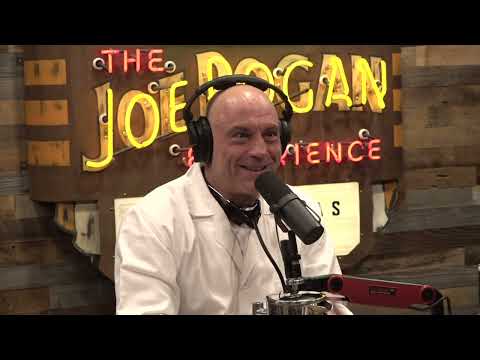
Joe Rogan Experience #2009 - Duncan Trussell
Narrator, Narrator, Narrator, Joe Rogan (host), Duncan Trussell (guest), Joe Rogan (host), Duncan Trussell (guest), Duncan Trussell (guest), Duncan Trussell (guest), Joe Rogan (host)
In this episode of The Joe Rogan Experience, featuring Narrator and Narrator, Joe Rogan Experience #2009 - Duncan Trussell explores joe Rogan and Duncan Trussell Explore Cults, Fitness, Aliens, And Reality Joe Rogan and Duncan Trussell have a wide-ranging, often comedic conversation that jumps from costumes and social authority to cult psychology, cognitive biases, and unusual expressions of intelligence. They dive deeply into self-sabotage, discipline, fitness, and the mental health benefits of physical training, contrasting harmonious and chaotic life patterns. The discussion then veers into spirituality, religious texts, psychedelics, and the nature of ideas, treating inspiration as a quasi-living force that uses humans to manifest itself. They also examine darker societal corners—child exploitation online, financial corruption, deep-state secrecy, UFO whistleblowers—before landing back on friendship, community, and how conversation, games, and shared laughter keep people sane in an accelerating, tech-driven world.
Joe Rogan and Duncan Trussell Explore Cults, Fitness, Aliens, And Reality
Joe Rogan and Duncan Trussell have a wide-ranging, often comedic conversation that jumps from costumes and social authority to cult psychology, cognitive biases, and unusual expressions of intelligence. They dive deeply into self-sabotage, discipline, fitness, and the mental health benefits of physical training, contrasting harmonious and chaotic life patterns. The discussion then veers into spirituality, religious texts, psychedelics, and the nature of ideas, treating inspiration as a quasi-living force that uses humans to manifest itself. They also examine darker societal corners—child exploitation online, financial corruption, deep-state secrecy, UFO whistleblowers—before landing back on friendship, community, and how conversation, games, and shared laughter keep people sane in an accelerating, tech-driven world.
Key Takeaways
Symbols and costumes quietly shape how we grant authority.
Lab coats, judge’s robes, police uniforms, and even business suits function like ceremonial garb: they trigger trust and deference, regardless of the actual competence beneath them. ...
Get the full analysis with uListen AI
Cults are just extreme versions of everyday groupthink.
Rogan and Trussell note that when a belief system grows large enough it stops being called a cult, even though it can still revolve around a central doctrine and leader. ...
Get the full analysis with uListen AI
Procrastination feels safer than work but creates far more suffering.
They frame procrastination as a gravity well: it spreads low-level anxiety and self-loathing across your days, while the avoided task is often fun or energizing once started. ...
Get the full analysis with uListen AI
Consistent physical training is “medicine” for mental health and longevity.
Rogan describes exercise, diet, sleep, and low-drama relationships as non-negotiable maintenance—like changing your car’s oil—if you want energy, mobility, and a clear mind as you age. ...
Get the full analysis with uListen AI
Stress and fear often drive self-sabotage and distraction.
When faced with big goals, the brain may over-emphasize petty drama, doom-scrolling, junk food, or addictions to protect you from the stress of trying and possibly failing. ...
Get the full analysis with uListen AI
Ideas and inspirations can be treated like independent lifeforms.
They toy with the notion that ideas “use” humans to enter reality, much like parasites influence hosts: inspirations appear mysteriously, often in visions or sudden clarity, then compel years of effort. ...
Get the full analysis with uListen AI
Not all authority is benevolent; skepticism is part of being a citizen.
From misallocated billions in military aid to MKUltra, child exploitation on YouTube, and opaque UFO programs, they argue that powerful institutions demonstrably misbehave. ...
Get the full analysis with uListen AI
Notable Quotes
“A successful cult passes that barrier between, ‘What the fuck, you believe that shit?’ to, ‘What the fuck, you don’t believe that shit?’”
— Duncan Trussell
“If you wanna enjoy life, you wanna have as much energy as possible, and the best way to have as much energy as possible is to be really fit.”
— Joe Rogan
“Procrastination, you spread it out across your life… it’s exponentially more anxiety than just doing the thing.”
— Duncan Trussell
“What if ideas are a life form, and the way they manifest in reality is they get into a person’s brain and then influence that person to take action to create them?”
— Duncan Trussell
“You steal the kid’s childhood and turn it into money.”
— Joe Rogan (on child YouTube influencers and stage kids)
Questions Answered in This Episode
How much of your respect for experts or leaders comes from their clothing, titles, and presentation rather than their demonstrated competence?
Joe Rogan and Duncan Trussell have a wide-ranging, often comedic conversation that jumps from costumes and social authority to cult psychology, cognitive biases, and unusual expressions of intelligence. ...
Get the full analysis with uListen AI
In what areas of your life might you be experiencing a Dunning–Kruger effect—either underestimating yourself or overestimating your expertise?
Get the full analysis with uListen AI
Which specific habits or distractions are absorbing your “bandwidth” and protecting you from the stress of pursuing harder, more meaningful goals?
Get the full analysis with uListen AI
How would your view of creativity change if you treated ideas as quasi-independent beings that choose people who are disciplined and receptive?
Get the full analysis with uListen AI
Where do you personally draw the line between healthy skepticism of institutions and paralyzing conspiracy thinking in areas like finance, social media, or UFOs?
Get the full analysis with uListen AI
Transcript Preview
(drumming music) Joe Rogan podcast, check it out.
The Joe Rogan Experience.
Train by day, Joe Rogan podcast by night, all day. (rock music)
All right, let's go play. Let's go. What's happening? Hello, doctor. Hello, doctor. Hello. I feel good to be in a lab coat. It feels like, um, my opinion means more. Dude, it does. I mean, I l- this is freaking incredible. Like, the, you don't realize the power in costumes until you got a lab coat on. Like, if we were walking around a CVS... Right. ... people would ask us for advice. Yes. They'd probably be like, "Is this the right spray for me?" Isn't it amazing? It's amazing. Like, what is the purpose of a lab coat? Like, why this particular coat? What does this... Does this provide any protection? Is it, uh, good for the act? You want monkey blood? You want monkey blood on your good shirt? Like... Oh. ... you gotta, like, wear the lab coat 'cause, like, you get blood. Right. In the late 19th and 20th, early 20th centuries, when many scientific breakthroughs happened, the white lab coat started to symbolize cleanliness and scientific rigor. Not only it made doctors and scientists easily distinguishable, but it also made spotting any contamination easier. That makes sense. Was that a problem back then, mixing up your doctor with your scientist? Is that a real problem? Was that what they're saying? It says it makes doctors and scientists more easily dis-... Oh, together. Yeah. 'Cause they're both wearing- They're both wearing lab coats. ... oh, it's not like costumes, like doctor costumes- (laughs) No. ... scientist... (laughs) Right. You go to the doctor, "Doctor, help me." "I'm not that kinda doctor." (laughs) "I'm a PhD." (laughs) "I study nuclear atoms." I like that that acknowledges that this is a kind of, uh, ceremonial outfit. Yeah. Right. It's a priest's robe because it's, like, symbolic more than practical for some people. Well, there's a bunch of those, right? Like the judge's robe. Oh my God, that's so weird. How weird is that? Because if you had a guy who was dressed, like, in a golf shirt with, like, shorts on- Yeah. ... and a pair of Nikes, and he's, like, ruling judgment on things, you'd be like, "Fuck that guy. Who's that guy?" Yeah. "He's a regular guy." (laughs) Yeah, like a tan- (laughs) Like a tank top. (laughs) Yeah. A dude in a tank top sending you to life. With a mullet. (laughs) A dude who's dressed like Joe Dirt. Also, the hammer. Right. They bang the hammer to, like, signify that justice has been served. What a weird trick. That is a we-... I mean, this is... When you realize how all of society has got occult aspects to it. Like, those are people in ceremonial clothes- Yes, yeah. ... banging a ceremonial hammer. Y- if not occult, definitely cult. Well, yeah. Yeah. Yeah, cu- it's like... Yeah. Yeah, what is the d- what's the v-... well, the root of cult and occult? Like, what is the, the, the connection to those to- those two words? The devil. Satan. (laughs) Satan. There's, uh, gotta be some kind of connection, right? Doesn't it-
Install uListen to search the full transcript and get AI-powered insights
Get Full TranscriptGet more from every podcast
AI summaries, searchable transcripts, and fact-checking. Free forever.
Add to Chrome