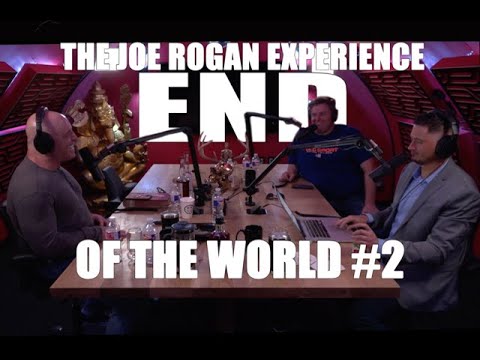
JRE End Of The World #2
Joe Rogan (host), Jamie Vernon (guest), Kyle Kulinski (guest), Tim Dillon (guest), Guest (guest), Guest (guest), Guest (guest), Guest (guest), Guest (guest), Guest (guest), Guest (guest), Donald Trump (guest), Guest (guest), Guest (guest), Guest (guest), Guest (guest), Guest (guest), Guest (guest), Guest (guest)
In this episode of The Joe Rogan Experience, featuring Joe Rogan and Jamie Vernon, JRE End Of The World #2 explores joe Rogan, Dillon, Kulinski dissect 2020 chaos and crumbling trust This long-form JRE election-night special with Tim Dillon and Kyle Kulinski bounces between real-time 2020 results and a broad critique of American politics, media, war, surveillance, and corporate power. Kulinski provides data-driven political analysis while Rogan and Dillon oscillate between dark comedy and genuine concern about institutional decay and social unrest. They question polling accuracy, media bias, the Iraq War and “fake news,” NSA overreach, private prisons, the drug war, and the structure of the U.S. economy. The episode ends without a clear electoral outcome but with a clear through-line: deep skepticism of elites, corporate media, and the stability of the current system.
Joe Rogan, Dillon, Kulinski dissect 2020 chaos and crumbling trust
This long-form JRE election-night special with Tim Dillon and Kyle Kulinski bounces between real-time 2020 results and a broad critique of American politics, media, war, surveillance, and corporate power. Kulinski provides data-driven political analysis while Rogan and Dillon oscillate between dark comedy and genuine concern about institutional decay and social unrest. They question polling accuracy, media bias, the Iraq War and “fake news,” NSA overreach, private prisons, the drug war, and the structure of the U.S. economy. The episode ends without a clear electoral outcome but with a clear through-line: deep skepticism of elites, corporate media, and the stability of the current system.
Key Takeaways
Polling and media narratives can be wildly out of sync with outcomes.
Kulinski explains how national and swing-state polls favored Biden, yet Trump overperformed expectations in key states, echoing 2016 and undermining confidence in polling as a predictive tool.
Get the full analysis with uListen AI
Corporate media often functions as a megaphone for power, not a watchdog.
Using examples like Iraq War coverage, Russia-gate, and CNN’s coziness with political figures, they argue outlets prioritize establishment narratives and advertiser interests over truth-seeking.
Get the full analysis with uListen AI
The national security state accumulates tools that are dangerous regardless of who’s in office.
Patriot Act powers, NSA mass surveillance, and FISA courts persist from Bush to Obama to Trump, showing that once authoritarian tools exist, they’re rarely rolled back and can be turned on anyone.
Get the full analysis with uListen AI
U.S. foreign policy and endless wars are deeply tied to economic interests.
They connect Afghanistan’s mineral wealth, the military‑industrial complex, and arms sales to Saudi Arabia to a war system that generates profit while resisting any attempt to withdraw or de-escalate.
Get the full analysis with uListen AI
The U.S. economy looked strong on paper but was structurally fragile pre-COVID.
Kulinski notes that even before the pandemic, most Americans lived paycheck to paycheck, wages stagnated, and stock-market performance primarily reflected the fortunes of the wealthy, not broad prosperity.
Get the full analysis with uListen AI
The drug war and private prisons distort justice and policy incentives.
They highlight how criminalizing drugs and maintaining private prisons create financial incentives to keep people incarcerated, with harsh sentences for nonviolent offenders and perverse lobbying against reform.
Get the full analysis with uListen AI
Big Tech’s gatekeeping over speech and news is a serious democratic risk.
Cases like Twitter and Facebook throttling the Hunter Biden story, YouTube de-prioritizing independent outlets, and algorithmic favoritism toward legacy media show how platform decisions can shape political reality.
Get the full analysis with uListen AI
Notable Quotes
““The political establishment has brought about the destruction of our factories and our jobs… It’s a global power structure.” (quoting Trump’s 2016 ad)”
— Kyle Kulinski (quoting Donald Trump)
““If you legalize drugs, you would essentially take the legs off of organized crime.””
— Joe Rogan
““You can’t be a sane person when your job is to follow this stuff every single day.””
— Kyle Kulinski
““The media in this country lied us into the Iraq War. That is the definition of fake news.””
— Kyle Kulinski
““We bail out bankers and Wall Street. If we’re gonna bail out anybody, it should be students.””
— Kyle Kulinski
Questions Answered in This Episode
How did media and polling misreads in 2020 further erode public trust in institutions?
This long-form JRE election-night special with Tim Dillon and Kyle Kulinski bounces between real-time 2020 results and a broad critique of American politics, media, war, surveillance, and corporate power. ...
Get the full analysis with uListen AI
What structural reforms to surveillance and intelligence agencies would meaningfully protect civil liberties without sacrificing security?
Get the full analysis with uListen AI
To what extent is U.S. foreign policy still driven by corporate and resource interests rather than stated values?
Get the full analysis with uListen AI
How should democracies regulate Big Tech platforms without simply shifting censorship power to the state?
Get the full analysis with uListen AI
What would a realistic path toward ending the drug war and private prisons in the U.S. actually look like in policy and politics?
Get the full analysis with uListen AI
Transcript Preview
Three, two, one.
Hold on.
Is it real?
I think so.
(clears throat)
It's live. That's it. End of the World, Part Two. Tim Dillon, you savage. It's good to see you, my friend.
Thank you for having me. We're back.
Kyle Kulinski, voice of reason, a person who actually understands politics.
That's debatable. (laughs)
Debatable? It is debatable, but-
We'll see how much the voice of reason I am.
I will say, uh, I will lean towards you knowing what you're talking about.
Ah.
Um-
Hold on.
What's going on?
Yeah, put the chat on.
Oh.
Sorry for that.
So, do you, do you have an opinion about how this is gonna go down? Yeah, do I, yeah, do I have-
Yeah.
... a prediction?
Yes.
Yes. Uh, it's very likely to be Joe Biden winning.
And what, what, what makes you say this?
First of all, let me just, let me just make clear so you, we don't get mass down-voted, I'm not saying that because I necessarily-
Let's get mass down-voted.
... want that to happen. I'm saying that empirically, I think it's very likely that he's gonna win. And the reason I say that is, I, I actually sent this to you, Jamie, if you, uh, wanna pull it up, but, um, when you look at the polls, and I know we get into whether or not you should even believe the polls, right?
Right.
Because you don't think so, right?
2016. Well, my thing with polls, I, I even have a bit on it, is like, who answers polls? Morons. So, if you're listening to morons, like 46% of morons believe this. But nobody, a normal person with like a regular life says, "Hey, Kyle, may I have a few minutes of your time to ask you about politics?" You don't say yes to that. Morons say yes to that. So, the people that you're polling are almost all morons.
Yeah.
Or lonely or sad or-
(laughs) Lonely or sad, right?
It's true. I, I wanna get polled.
I can talk to a pollster. (laughs) Nobody polls me. I'm waiting every night for a call. I wanna talk for hours about, and no one cares. (laughs)
Yeah. Have you, have you ever answered a poll?
I've never answered a poll, no.
Never.
Have you?
I've never been called.
Jamie, have you ever answered a poll?
Not like a real one, no.
(laughs) Not a real one.
I don't know any-
For, for like Kleenex. (laughs) Kleenex reach out to you or something. (laughs)
I don't, I don't know who they call, I don't know who they call and why they call them.
I don't believe in polls, and I don't believe in Nielsen families. I don't think they're real.
Install uListen to search the full transcript and get AI-powered insights
Get Full TranscriptGet more from every podcast
AI summaries, searchable transcripts, and fact-checking. Free forever.
Add to Chrome