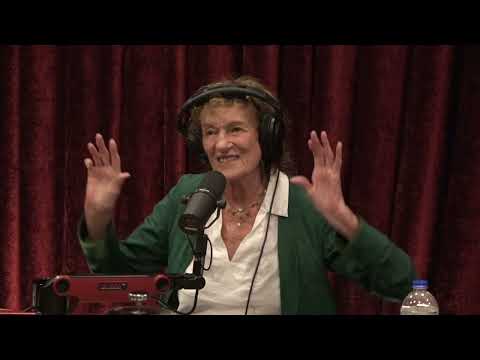
Joe Rogan Experience #2002 - Amanda Feilding
Narrator, Joe Rogan (host), Amanda Feilding (guest)
In this episode of The Joe Rogan Experience, featuring Narrator and Joe Rogan, Joe Rogan Experience #2002 - Amanda Feilding explores psychedelics, Trepanation, And Rewiring The Mind For Healing And Insight Joe Rogan and psychedelic researcher Amanda Feilding explore her six-decade journey studying altered states, from childhood mysticism and LSD self-experiments to founding the Beckley Foundation.
Psychedelics, Trepanation, And Rewiring The Mind For Healing And Insight
Joe Rogan and psychedelic researcher Amanda Feilding explore her six-decade journey studying altered states, from childhood mysticism and LSD self-experiments to founding the Beckley Foundation.
Feilding details how psychedelics like LSD, psilocybin, cannabis, and ayahuasca alter brain blood flow, loosen the ego, enhance connectivity, and can catalyze mystical experiences linked to profound therapeutic outcomes.
They discuss promising research and case reports on microdosing for depression, addiction, Parkinson’s, autism, and especially Alzheimer’s, while criticizing prohibition-era drug policy for blocking science and causing immense social harm.
Feilding also explains the ancient and controversial practice of trepanation, her own self-trepanation, and her hypothesis that both psychedelics and skull-opening techniques increase cerebral energy and may support mental health and cognitive resilience.
Key Takeaways
Psychedelics can quiet the ego and catalyze healing mystical states.
Imaging work from Feilding’s Beckley Foundation shows psilocybin reduces blood flow in the brain’s default mode network (linked to ego and rumination), while people who experience classic ‘mystical’ states often have the strongest and most durable reductions in depression.
Get the full analysis with uListen AI
Increased brain connectivity under psychedelics appears to be a core mechanism.
Functional MRI studies reveal that LSD and psilocybin massively increase cross-talk between brain regions, creating a more globally integrated network; this likely underpins enhanced creativity, emotional processing, and new perspectives that can be therapeutically leveraged.
Get the full analysis with uListen AI
Microdosing may offer powerful, low-disruption therapeutic benefits.
Feilding cites early data and vivid case reports of very low LSD doses improving mood, increasing neuroplasticity, reducing inflammation and pain, and even temporarily reversing severe Alzheimer’s symptoms, all without overt intoxication.
Get the full analysis with uListen AI
Effective drug policy must be evidence-based, not ideological.
She argues that Schedule I prohibition caused 50+ “lost years” of research, fueled mass incarceration (especially of minorities), and blocked access to non-toxic therapies—despite growing evidence psychedelics can outperform current treatments for conditions like PTSD, addiction, and depression.
Get the full analysis with uListen AI
Trepanation may modestly boost cerebral energy but needs real science.
Feilding’s theory is that opening a small hole in the skull restores childhood-like cranial ‘pulsation’ and blood dynamics, possibly reducing headaches and neurosis; she insists no one should self-trepan and calls for controlled clinical studies using modern imaging.
Get the full analysis with uListen AI
Human culture and spirituality are likely entwined with altered states.
They link psychedelic use to ancient cave art, Greek Eleusinian mysteries, early Christian rites, and the ‘psychedelic’ flourishing of the 1960s, suggesting that visionary states have repeatedly fueled breakthroughs in art, religion, and social evolution.
Get the full analysis with uListen AI
Future care models could integrate microdosing into humane eldercare.
Feilding envisions ‘Beckley Harbor’–style care homes where elders with dementia receive personalized microdoses alongside warm, social environments (children, animals, poetry) to restore lucidity and quality of life, backed by rigorous data collection.
Get the full analysis with uListen AI
Notable Quotes
“I see psychedelics as our route to healing, not as damaging to humanity as they were advertised.”
— Amanda Feilding
“What psychedelics do is make the mind more fertile for mystical experiences by loosening the grip of the ego.”
— Amanda Feilding
“It’s really criminal not to throw money at this research so we can get it out to the people quicker.”
— Amanda Feilding
“LSD is actually the purest and cleanest of the compounds… as it is completely non-toxic, you can give it to people forever.”
— Amanda Feilding
“I call it the psychedelic age, not because everyone should be taking psychedelics, but because we’re finally learning how to control our level of consciousness.”
— Amanda Feilding
Questions Answered in This Episode
How strong is the current clinical evidence for microdosing in conditions like Alzheimer’s, autism, and Parkinson’s, and what trials are most urgently needed?
Joe Rogan and psychedelic researcher Amanda Feilding explore her six-decade journey studying altered states, from childhood mysticism and LSD self-experiments to founding the Beckley Foundation.
Get the full analysis with uListen AI
Could Feilding’s cerebral blood-flow hypothesis and trepanation theory be integrated or falsified using today’s best imaging and neurophysiology tools?
Feilding details how psychedelics like LSD, psilocybin, cannabis, and ayahuasca alter brain blood flow, loosen the ego, enhance connectivity, and can catalyze mystical experiences linked to profound therapeutic outcomes.
Get the full analysis with uListen AI
What regulatory or ethical frameworks would be required to safely implement psychedelic- and microdose-based care homes for the elderly at scale?
They discuss promising research and case reports on microdosing for depression, addiction, Parkinson’s, autism, and especially Alzheimer’s, while criticizing prohibition-era drug policy for blocking science and causing immense social harm.
Get the full analysis with uListen AI
To what extent might entity encounters, telepathy, and other anomalous experiences under psychedelics be explained by brain dynamics versus something genuinely ‘non-local’?
Feilding also explains the ancient and controversial practice of trepanation, her own self-trepanation, and her hypothesis that both psychedelics and skull-opening techniques increase cerebral energy and may support mental health and cognitive resilience.
Get the full analysis with uListen AI
If psychedelics significantly shaped past cultural and spiritual revolutions, how might a modern, legally integrated ‘psychedelic age’ transform our politics, education, and technology?
Get the full analysis with uListen AI
Transcript Preview
(drum music) Joe Rogan podcast, check it out. The Joe Rogan Experience.
Train by day, Joe Rogan podcast by night, all day. (energetic music) Thank you very much for doing this, I really appreciate it.
Thank you.
It's lovely to meet you, and, uh, I really, really appreciate your life's work. I mean, I think what you've done has been really remarkable, particularly because of the time period in which you embarked in it. I mean, you sort of got involved in psychedelics and psychedelic research at the very beginning of it and when it was extremely controversial and very difficult t- to do research.
Well, I actually got involved in it when it was incredible fun. And, um, I was incredibly lucky with my timing, I think.
Hmm.
Because I was very attracted to, um, the other side, if you like, the mystical, because I lived in this very, very isolated spot and one had nothing much to do but kind of mooch around in a beautiful place, have mystical experiences, dream of the future.
Is that your phone?
Yes.
There we go. (laughs)
Oh. (laughs)
When did you first get involved or even interested in, uh, what you would call mystical experiences? I'll let you sh-
Ah, sorry, sorry, sorry.
No worries, no worries.
Whoopsie. I don't know how to turn these things off.
Do you want me to turn it on mute for you?
Yes, please.
Okay. These wacky kids today and their devices. All right, here you go.
Oh, yes, sorry about that.
No worries. No worries at all. Um, so-
Uh, yes.
... how old were you when you first got interested in...
Um, very young, I should say. Um, I came, uh, I had a kind of in the... I, I w- grew up in this very isolated place. Um, I was very, very close to my father, who came back from the war a diabetic, and he was a very eccentric person. And so from three, I was his carer. So I was like-
Three years old?
Yeah, which was a lovely role. I mean, I was his little pet dog. I went everywhere with him. (laughs) I adored him, and he adored me. And so... And he was a very, um, out of the... He wasn't in normal society at all.
How so?
He just wasn't. He was a eccentric and a charming, um, did his own thing.
Hmm.
Artist, um, a farmer, but not really a farmer. He couldn't bear really farming, but, um, yeah. Anyway, so, um, and I suppose spiritually, I had three... my mother was a Catholic, so I grew up a Catholic. And then he was whatever agnostic is. Yes, just nothing except a thinker. And, um, then his best friend, who was his kind of... he picked up as, um, he... the person who did all his work when he was at university called Bertie, um, was... became a Buddhist monk, a rather famous Buddhist monk. But... So he was a big influence in the absence 'cause he was my godfather. And so I had these three influences. And so I kind of dreamt of doing magic, mystical things in the world.
Install uListen to search the full transcript and get AI-powered insights
Get Full TranscriptGet more from every podcast
AI summaries, searchable transcripts, and fact-checking. Free forever.
Add to Chrome