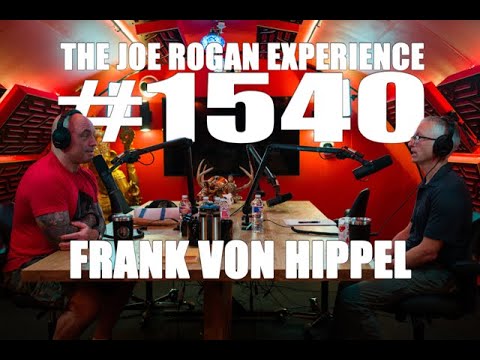
Joe Rogan Experience #1540 - Frank von Hippel
Narrator, Frank von Hippel (guest), Joe Rogan (host), Narrator, Narrator
In this episode of The Joe Rogan Experience, featuring Narrator and Frank von Hippel, Joe Rogan Experience #1540 - Frank von Hippel explores hidden Toxins, Deadly Diseases: How Chemicals Rewired Our Planet Joe Rogan and biologist Frank von Hippel explore how modern chemicals, pesticides, and warfare agents have transformed ecosystems, public health, and even global politics over the past century and a half.
Hidden Toxins, Deadly Diseases: How Chemicals Rewired Our Planet
Joe Rogan and biologist Frank von Hippel explore how modern chemicals, pesticides, and warfare agents have transformed ecosystems, public health, and even global politics over the past century and a half.
Von Hippel explains how persistent pollutants travel to the poles, poison indigenous communities, and bioaccumulate in top predators, while newer pesticides shift risks from consumers to farm workers and wildlife.
They trace the historical arc from DDT and leaded gasoline to organophosphates, neonicotinoids, and glyphosate, showing repeated patterns of "solutions" that create new crises.
The conversation broadens into invasive species, pandemics, malaria, traditional plant medicines, and the political failures that keep hazardous chemicals in widespread use despite clear evidence of harm.
Key Takeaways
Persistent pollutants travel globally and concentrate in polar food webs.
Chemicals like DDT, PCBs, and certain pesticides volatilize in warm regions, then condense and accumulate in cold polar areas via the "grasshopper effect," leading to some of the highest contaminant levels on Earth in Arctic predators like polar bears and killer whales.
Get the full analysis with uListen AI
Indigenous Arctic communities bear disproportionate chemical burdens.
Subsistence hunters who never used these products ingest high doses of industrial pollutants through marine mammals and rendered blubber oil, resulting in elevated cancer rates and developmental problems—an acute case of environmental injustice.
Get the full analysis with uListen AI
We repeatedly replace one hazardous chemical with another.
DDT was phased out for wildlife and human health reasons, replaced by organophosphates (nerve‑gas‑like farm chemicals), then by neonicotinoids that devastate bees; glyphosate has become ubiquitous despite mounting concerns, showing a pattern of "regrettable substitutions" rather than true solutions.
Get the full analysis with uListen AI
Lead, pesticides, and other neurotoxins quietly reshape behavior and society.
Historic leaded gasoline and widespread pesticide use impaired brain development in children, likely increasing impulsivity and crime rates; atmospheric lead levels have since dropped to under 1% of peak, paralleling declines in violent crime, illustrating how chemical policy can alter social outcomes.
Get the full analysis with uListen AI
Many modern disease and inequality patterns are rooted in ecology.
Malaria and yellow fever shaped colonial settlement patterns, entrenched racial segregation in Africa, and favored the enslavement of Africans with partial genetic resistance—demonstrating how vector-borne diseases have driven major political and economic structures.
Get the full analysis with uListen AI
Industrial agriculture’s monocultures make us dependent on heavy chemical use.
Vast single‑crop landscapes invite pest explosions and encourage mass herbicide and pesticide application; integrated pest management, biological controls, and diversified crop rotations can dramatically cut chemical use while maintaining yields, but require policy and market support for farmers.
Get the full analysis with uListen AI
Regulation can work—but only when it’s insulated from corporate pressure.
U. ...
Get the full analysis with uListen AI
Notable Quotes
“There really isn’t anywhere on the Earth that’s not polluted, unfortunately.”
— Frank von Hippel
“It’s a really sad case of environmental injustice… they never used these chemicals, they didn’t benefit economically from them, and yet they’re subject to some of the highest concentrations in the world.”
— Frank von Hippel (on Arctic indigenous peoples)
“We fucked things up pretty fast, because now we have a world that is… anywhere you go, you’re going to find contaminated animals.”
— Joe Rogan
“Why is it that a corporation should have more say and more influence with politicians than you do or I do?”
— Frank von Hippel
“We know a lot more, but are we any wiser than people were thousands of years ago?”
— Frank von Hippel
Questions Answered in This Episode
If we know glyphosate and similar chemicals pose risks, what concrete policy and market changes would be needed to transition U.S. agriculture toward safer, more diversified systems without bankrupting farmers?
Joe Rogan and biologist Frank von Hippel explore how modern chemicals, pesticides, and warfare agents have transformed ecosystems, public health, and even global politics over the past century and a half.
Get the full analysis with uListen AI
How should wealthy nations compensate or support Arctic and indigenous communities that suffer health damage from pollutants they never used and did not profit from?
Von Hippel explains how persistent pollutants travel to the poles, poison indigenous communities, and bioaccumulate in top predators, while newer pesticides shift risks from consumers to farm workers and wildlife.
Get the full analysis with uListen AI
Given our history of "regrettable replacements," what criteria and testing frameworks should be mandatory before any new pesticide or herbicide is approved for large‑scale use?
They trace the historical arc from DDT and leaded gasoline to organophosphates, neonicotinoids, and glyphosate, showing repeated patterns of "solutions" that create new crises.
Get the full analysis with uListen AI
Where is the ethical line between using powerful tools like genetic engineering (e.g., modified mosquitoes) to save lives and the risk of triggering irreversible ecological cascades we don’t fully understand?
The conversation broadens into invasive species, pandemics, malaria, traditional plant medicines, and the political failures that keep hazardous chemicals in widespread use despite clear evidence of harm.
Get the full analysis with uListen AI
What governance models could realistically reduce corporate influence over environmental and public‑health regulation so that scientific evidence has priority in chemical policy decisions?
Get the full analysis with uListen AI
Transcript Preview
(drumming music) Joe Rogan podcast, check it out.
The Joe Rogan Experience.
Train by day, Joe Rogan podcast by night, all day. (rock music) Boom. Hello, Frank.
Hi.
This was a false start. That's why it's, like, weird.
(laughs)
Right? I have to go, "Ready and go!" Welcome to our polarizing studio. A lot of people don't like it here. A lot of complaints, Jamie.
Yeah.
That's what I'm, I'm hearing from people that read the comments. Folks, relax. We had to bang this together in a month because we moved here. Like, literally, I, from the time I was saying, "Maybe I should move to Austin," to we're in Austin in studio, it was, like, two months?
Less. Six-
Less.
I think it was six weeks.
Six weeks. So all this was created, shout out to Matt Alvarez, all this was created in, like, two weeks. So if you think it sucks, that's okay. I like it. (laughs)
I think it's awesome.
It's definitely weird. It's just a big shock from people that saw... Like, your brother was, uh, at the old studio, and the old studio was, you know, very conventional. It was like a curtain and a brick wall and the American flag. It was, like, pretty, pretty normal. This is, uh, there's a big difference. Some people are bad with change.
Well, you have this lovely, uh, Asian, uh-
That's Ganesh.
Ganesh, that's right, from India.
Remover of obstacles.
Yeah, my daughter actually went to her last year of high school in India.
I bought that in Thailand, actually.
Oh, okay.
Yeah, I bought it in Thailand and had it shipped over. Y- so what did your daughter do in India?
She did her last years of high school there.
That's crazy.
Yeah.
Why'd she do that?
Uh, my oldest went to his last years of high school in Costa Rica and loved it.
Wow.
And, and so she wanted to do something similar, and, uh, she went to this great school called, called Woodstock School, which is in the foothills of the Himalayas. Had a great time.
That's pretty cool.
Yeah, pretty awesome experience.
Did you visit her out there?
We did, yeah. Multiple times.
Whew. That's gotta be weird too to be the last two years of high school, 15 or 16 and 17?
Yeah.
And just leave your family and be in another continent.
But don't you remember being that age and you just wanted to have some independence and head out?
Yeah. Yeah, I guess so. I think. (laughs)
(laughs)
I'm so old. It's hard to r- look back when I'm 16. I mean, I have some vague memories.
Well, if you're so old, I'm so old. I think we were born the same year.
Install uListen to search the full transcript and get AI-powered insights
Get Full TranscriptGet more from every podcast
AI summaries, searchable transcripts, and fact-checking. Free forever.
Add to Chrome