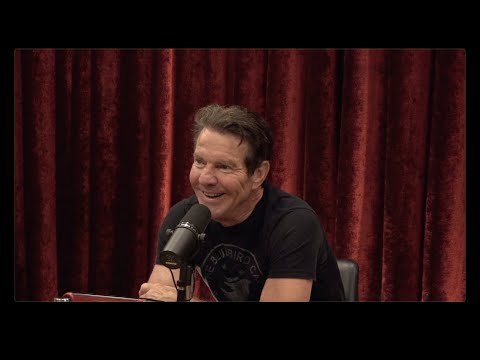
Joe Rogan Experience #2189 - Dennis Quaid
Narrator, Dennis Quaid (guest), Joe Rogan (host), Narrator, Narrator
In this episode of The Joe Rogan Experience, featuring Narrator and Dennis Quaid, Joe Rogan Experience #2189 - Dennis Quaid explores dennis Quaid, Reagan, and Rogan: Politics, Propaganda, and Paranoia Collide Joe Rogan and Dennis Quaid cover Quaid’s gospel album, early Hollywood days, and his new biopic ‘Reagan,’ then spend most of the conversation on modern U.S. politics, media bias, and institutional distrust.
Dennis Quaid, Reagan, and Rogan: Politics, Propaganda, and Paranoia Collide
Joe Rogan and Dennis Quaid cover Quaid’s gospel album, early Hollywood days, and his new biopic ‘Reagan,’ then spend most of the conversation on modern U.S. politics, media bias, and institutional distrust.
They argue that Hollywood and tech are ideologically captured by the left, that Trump is being targeted through weaponized lawfare, and that media/Big Tech censorship is actively shaping elections and public opinion.
They draw parallels between the Cold War and today’s climate, discuss CIA/Deep State conspiracy theories (JFK, Trump assassination attempt), COVID, Big Pharma, and the southern border crisis as signs of systemic decay.
Quaid openly endorses Trump, says he no longer cares if it hurts his career, and frames both Reagan and Trump as necessary ‘strong leaders’ against hostile foreign powers and domestic overreach.
Key Takeaways
Quaid is repositioning his public image as openly conservative and pro‑Trump.
He endorses Trump explicitly, says weaponized prosecutions changed his mind, and states he’s willing to risk career repercussions to speak out politically.
Get the full analysis with uListen AI
He frames ‘Reagan’ as a straight biopic, but understands its political impact.
The film follows Reagan from childhood to Alzheimer’s, emphasizing his lifelong anti‑communism and Cold War strategy; Quaid notes Facebook initially blocked their ads as ‘election interference,’ then called it a mistake.
Get the full analysis with uListen AI
They view media and tech as partisan actors, not neutral platforms.
Rogan and Quaid argue that CNN and others openly favor Democrats, while Google and social media curate search results, suppress stories (e. ...
Get the full analysis with uListen AI
They consider Trump’s legal cases a constitutional red line.
Both believe misdemeanors were stretched into felonies to ‘get’ Trump, warning that normalizing lawfare against political opponents will be used by both parties and could turn the U. ...
Get the full analysis with uListen AI
Conspiracy thinking around the ‘Deep State’ has gone mainstream in their view.
They treat CIA involvement in JFK’s assassination and possible government involvement in the Trump assassination attempt as plausible, pointing to secrecy, lack of transparent investigation, and historical precedents like MKUltra and the Gulf of Tonkin.
Get the full analysis with uListen AI
They see the border crisis as deliberate destabilization, not incompetence.
Rogan and Quaid highlight cartel control, Venezuelan gangs, overwhelmed systems, and generous benefits for illegal entrants while citizens struggle, questioning the political endgame and linking it to potential voter manipulation and chaos creation.
Get the full analysis with uListen AI
They argue identity politics and trans activism have become a quasi‑religion.
Using women’s sports and child transition as flashpoints, they say biological reality is being denied, dissent is punished, and a small activist minority is driving policy through institutional capture and social intimidation.
Get the full analysis with uListen AI
Notable Quotes
““Really, the only thing I liked about Trump was everything that he did.””
— Dennis Quaid
““If you normalize weaponizing the judicial system against a political candidate, that can be used against your party too.””
— Joe Rogan
““We’re like the last hope for this whole idea of this experiment in self‑government… these freedoms can be lost in a generation.””
— Dennis Quaid (invoking Ronald Reagan)
““Tech oligarchy… that’s really what it is, right?””
— Dennis Quaid
““People might call him an asshole, but he’s my asshole.””
— Dennis Quaid, on supporting Trump
Questions Answered in This Episode
How much responsibility do major tech platforms bear for ensuring politically neutral search results and content moderation during elections?
Joe Rogan and Dennis Quaid cover Quaid’s gospel album, early Hollywood days, and his new biopic ‘Reagan,’ then spend most of the conversation on modern U. ...
Get the full analysis with uListen AI
Where should the legal line be drawn between legitimate prosecution and politically motivated ‘lawfare’ against candidates?
They argue that Hollywood and tech are ideologically captured by the left, that Trump is being targeted through weaponized lawfare, and that media/Big Tech censorship is actively shaping elections and public opinion.
Get the full analysis with uListen AI
How can citizens distinguish between legitimate investigative secrecy and dangerous government cover‑ups when it comes to events like the JFK and Trump assassination attempts?
They draw parallels between the Cold War and today’s climate, discuss CIA/Deep State conspiracy theories (JFK, Trump assassination attempt), COVID, Big Pharma, and the southern border crisis as signs of systemic decay.
Get the full analysis with uListen AI
Is there a realistic policy path that balances strict border control, humane treatment of migrants, and a fair route to citizenship?
Quaid openly endorses Trump, says he no longer cares if it hurts his career, and frames both Reagan and Trump as necessary ‘strong leaders’ against hostile foreign powers and domestic overreach.
Get the full analysis with uListen AI
What concrete safeguards, if any, should be imposed on AI, deepfakes, and digital likeness rights to prevent large‑scale manipulation of voters and public opinion?
Get the full analysis with uListen AI
Transcript Preview
(drumming music) Joe Rogan podcast. Check it out.
The Joe Rogan Experience.
Train by day, Joe Rogan podcast by night, all day. (rock music)
Nice to meet you, man.
You too, man. Really.
It's been a pleasure. I've- I've seen so many of your fucking movies. It's always weird when you meet someone that you've seen so many times in movies, you know.
Yeah.
It's like, "All right. There he is."
Yeah, yeah.
"A real person."
Yeah, there, there they are.
(laughs)
That's... (laughs)
I didn't know you do, uh, you're- you released a gospel album though.
Yeah, last, uh, last year.
That's wild.
Yeah, it's, uh, called Fallen: A Gospel Record for Sinners-
How-
... because I wanted the biggest possible audience
(laughs)
(laughs)
I could get.
Gospel Record for Sinners?
Yeah. (laughs)
How long you been singing gospel?
Well, you know, basically I grew up at the Baptist Church, and so it's five songs that I grew up with, and it's five songs that I wrote before and during the making of the record. It's kind of like my spiritual journey, I guess. That's the way it turned out in the end. My wife, she put the, uh, order together, and that's what it seems to be, kind of my journey in life.
Was this something that you had thought about for a while, or did it just kinda...
Yeah, uh, yeah, I wrote this song, uh, called On My Way to Heaven, and, uh, I wrote it for my mom to let her know that I was okay after I got out of, like, rehab and for cocaine in 1990. And, um, then, uh, w- uh, then I wrote the Fallen, which is kinda, like, taken from, um... Remember that movie Thunder Road-
Mm-hmm.
... with Robert Mitchum? You know?
Yeah.
It's kind of like in that vein or that- that kind of feel to it, and there- there's this highway called the Devil's Backbone up near Bandera. And so it's- it's a ride with the devil.
Wow.
And you wind up getting left for dead on the side of the road.
So, this is just something that you felt like- like, "Fuck it. I've done everything else. Why not do a gospel album?"
Yeah, I- I've, you know, I've- I've recorded. I've always been a songwriter. I got a guitar when I was 12 years old. My grandfather bought me at, you know, at Western Auto. It's a great place to buy guitars.
(laughs)
And, uh, uh, you know, I- I realized I was never gonna shred a guitar, so I... A songwriting became like a defense, you know, something you could bring to a band.
Right.
And, uh, so I've always done it, and, uh, but I got this offer from, uh, Gaither, uh, 'cause they heard, Bill Gaither had heard the song On My Way to Heaven, uh, asked me to do a gospel record, so said yeah.
Install uListen to search the full transcript and get AI-powered insights
Get Full TranscriptGet more from every podcast
AI summaries, searchable transcripts, and fact-checking. Free forever.
Add to Chrome