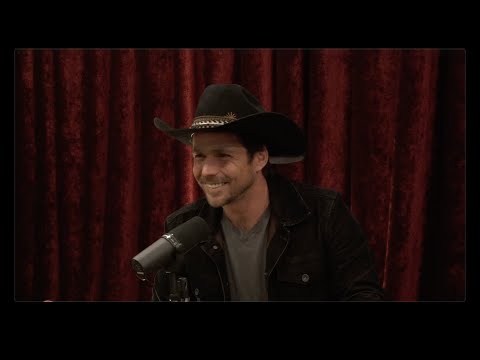
Joe Rogan Experience #2348 - Lukas Nelson
Narrator, Joe Rogan (host), Lukas Nelson (guest), Narrator, Narrator
In this episode of The Joe Rogan Experience, featuring Narrator and Joe Rogan, Joe Rogan Experience #2348 - Lukas Nelson explores lukas Nelson on purpose, sobriety, UFOs, and music’s healing power Joe Rogan and Lukas Nelson discuss growing up as Willie Nelson’s son, Lukas’ quest to build his own identity, and how music became both his career and spiritual practice. They explore purpose, discipline, sobriety, meditation, psychedelics, and the dangers of social media and constant news consumption. Lukas performs and dissects his song “Turn Off the News and Build a Garden,” emphasizing community, local action, and compassion over online outrage. The conversation ranges into empathy, evil, UFOs, AI, and how art, exercise, and service can anchor a meaningful life in a confusing world.
Lukas Nelson on purpose, sobriety, UFOs, and music’s healing power
Joe Rogan and Lukas Nelson discuss growing up as Willie Nelson’s son, Lukas’ quest to build his own identity, and how music became both his career and spiritual practice. They explore purpose, discipline, sobriety, meditation, psychedelics, and the dangers of social media and constant news consumption. Lukas performs and dissects his song “Turn Off the News and Build a Garden,” emphasizing community, local action, and compassion over online outrage. The conversation ranges into empathy, evil, UFOs, AI, and how art, exercise, and service can anchor a meaningful life in a confusing world.
Key Takeaways
Purpose comes from meaning you define for yourself, not external validation.
Lukas frames life through Viktor Frankl’s lens: the goal is to know what you mean to yourself so that, at death, you can say you lived with purpose and joy, regardless of others’ expectations or comparisons to famous parents.
Get the full analysis with uListen AI
Discipline and delayed gratification compound into freedom and self-respect.
As a kid, Lukas chose to practice guitar and songwriting for 8–10 hours a day instead of partying, aiming to build a career where he’d never have to rely on his father, which now lets him live independently and make his parents proud.
Get the full analysis with uListen AI
Sobriety and mindfulness can unlock a deeper, steadier creativity.
He quit alcohol and weed around the pandemic, doubled down on meditation, and uses mushrooms only occasionally for introspection; he says his new record is his clearest work, created without chasing long solos or altered states.
Get the full analysis with uListen AI
Limit news and social media; invest that energy into real community.
Through his song “Turn Off the News and Build a Garden,” Lukas argues there’s a difference between being informed and being captured by the outrage cycle, advocating for knowing neighbors, local agriculture, and town engagement instead.
Get the full analysis with uListen AI
Empathy can be manipulated, but shutting it off is more dangerous.
They note psychological warfare and propaganda can hijack empathy, yet argue it remains essential for cooperation and humanity; the goal is to stay compassionate while resisting being emotionally weaponized.
Get the full analysis with uListen AI
Character matters as much as policy in leadership and institutions.
Lukas stresses that history shows the danger of trusting policy over the moral character of those implementing it, given how money and influence shape laws and enforcement behind the scenes.
Get the full analysis with uListen AI
Exercise and doing hard things physically strengthens mental resilience.
They reference Andrew Huberman’s work on the anterior mid-cingulate cortex and discuss how forcing yourself to do difficult tasks—ice baths, running, workouts—literally grows brain regions tied to willpower and tenacity.
Get the full analysis with uListen AI
Notable Quotes
“My whole goal in life is to discover who I am as an individual.”
— Lukas Nelson
“Meaning is everything in life. Nothing really has any meaning except the meaning we give it.”
— Lukas Nelson
“I got addicted to the high that I get from exercising discipline.”
— Lukas Nelson
“Empathy can be manipulated through psychological warfare, but it’s never a good idea to shut it off.”
— Lukas Nelson
“Music is a win‑win. I’m so lucky to do something that’s good for me and good for other people.”
— Lukas Nelson
Questions Answered in This Episode
How can someone without Lukas Nelson’s early advantages practically apply his approach to discipline and purpose in their own life?
Joe Rogan and Lukas Nelson discuss growing up as Willie Nelson’s son, Lukas’ quest to build his own identity, and how music became both his career and spiritual practice. ...
Get the full analysis with uListen AI
Where is the line between staying informed and being psychologically harmed by news and social media, and how do you set that boundary?
Get the full analysis with uListen AI
In what ways can empathy be protected from manipulation while still remaining open and active in political and social issues?
Get the full analysis with uListen AI
How might psychedelics like mushrooms be safely integrated into a life that also values sobriety and mental clarity, as Lukas describes?
Get the full analysis with uListen AI
If some UFO phenomena are advanced human tech and some might not be, how should governments responsibly communicate that ambiguity to the public?
Get the full analysis with uListen AI
Transcript Preview
(drumming music plays) Joe Rogan podcast. Check it out. The Joe Rogan Experience.
Train by day, Joe Rogan podcast by night. All day. (rock music plays) We're up. Lucas, what's up?
Hey, man.
Good to talk to you, man. Thanks for being here.
Good to be here. Yeah, I appreciate you having me.
I gotta tell you, you know, when I heard Willie Nelson's kid-
Mm-hmm.
... plays music, there's a thing that you always do, and I, I have to admit it. You do it, like, when the son of a great man, you always assume, "Well-"
Yeah.
"... he's probably mediocre." You know what I mean? And then you performed at McConaughey's ... that charity function thing, and you fucking killed it, man. You blew me away.
Thank you.
It was incredible, and I was like, "Wow." It was really cool to see, man. It was really exciting. It was really fun.
Well, I appreciate that, you know.
You were the highlight of the night, man. You really were.
It's moments like those where I started to gain confidence, you know. I'd have, over the years, I'd go out and play, and I'd play my songs that I've written, and, I mean, I'd get crowds that would do that, you know. And so that gave me the confidence to keep going. And it ... and, and, I first started playing music in order to get closer to my father.
Oh, wow.
You know what I mean? So I, I, I ... he would be gone all the time.
Right.
And I'd be missing him. And, uh, and so, in order to get close to him, I figured I, I need to speak the same musical language. And, uh, and so I learned young, and I wrote a song young, uh, that's on the new album, actually, I got. It's called You Were It. It's the first song I ever wrote when I was 11.
Wow.
And my dad loved it so much that he covered it at the time, and he put it out on his album back in 2004, called It Always Will Be. The, the album was called It Always Will Be, and that gave me the confidence at a young age. Kris Kristofferson came up to me, and he's like, "Man, you don't have a choice but to be a songwriter."
(laughs)
And so I had all this inspiration at a young age. Kind of like an athlete at a certain point, you kind of have to look at, like, oh, well, if I have a talent at this, I have opp- like, I have connections in the industry, I need to work like I was gonna go to the Olympics on this, because it's something that I can do that will make it so that I never have to rely on my family or my father for anything.
Install uListen to search the full transcript and get AI-powered insights
Get Full TranscriptGet more from every podcast
AI summaries, searchable transcripts, and fact-checking. Free forever.
Add to Chrome