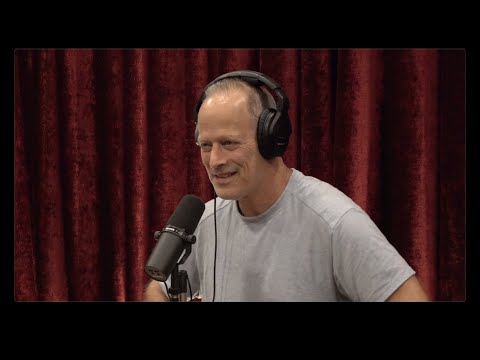
Joe Rogan Experience #2172 - Sebastian Junger
Sebastian Junger (guest), Joe Rogan (host), Narrator
In this episode of The Joe Rogan Experience, featuring Sebastian Junger and Joe Rogan, Joe Rogan Experience #2172 - Sebastian Junger explores near-Death, War, and God: Sebastian Junger Reconsiders Life’s Meaning Joe Rogan and Sebastian Junger open with technology, parenting, and relationships, then spend most of the conversation on mental illness, war, mortality, and spirituality.
Near-Death, War, and God: Sebastian Junger Reconsiders Life’s Meaning
Joe Rogan and Sebastian Junger open with technology, parenting, and relationships, then spend most of the conversation on mental illness, war, mortality, and spirituality.
Junger recounts in detail his sudden near‑fatal internal hemorrhage, the medical race to save him, and the vivid near‑death experience of seeing his late father and a terrifying black abyss.
They explore how trauma, bipolar disorder, and depression shape lives and creativity, and then pivot into whether near‑death experiences point to an afterlife or are purely neurochemical.
Drawing on neuroscience, hospice stories, and quantum physics, they debate God, consciousness, the soul, and why uncertainty about an afterlife may actually give life its meaning.
Key Takeaways
Parenting demands full presence in a distracted world.
Both men criticize parents glued to phones while kids risk injury on playgrounds, arguing that digital distraction undermines the basic duty to protect and truly experience time with children.
Get the full analysis with uListen AI
Toxic relationships can literally endanger your health and sanity.
Stories of people fleeing destructive partners, including bipolar or highly dysregulated ones, highlight that staying can escalate stress, anxiety, and even physical illness—sometimes the only rational move is to leave.
Get the full analysis with uListen AI
Severe mental illness is often invisible and catastrophically misunderstood.
Junger’s accounts of friends with bipolar disorder, depression, and schizoaffective disorder show how brilliance can coexist with unbearable suffering, and how diagnoses that patients reject are extremely hard to treat.
Get the full analysis with uListen AI
Physical fitness and decisive advocacy can make the difference in a medical crisis.
Junger likely survived his catastrophic internal bleed partly because of his fitness and because his wife overruled EMTs who wanted to leave him home, underscoring the value of conditioning and assertive advocates in emergencies.
Get the full analysis with uListen AI
Near‑death experiences raise profound questions science hasn’t fully answered.
Consistent global reports of seeing deceased relatives or hovering over one’s body don’t conclusively prove an afterlife, but Junger argues they also aren’t fully explained by brain chemistry alone and deserve serious, open‑minded study.
Get the full analysis with uListen AI
You can be rigorously rational and still humble about the unknown.
Junger remains an atheist yet concedes that quantum physics and consciousness research suggest reality is stranger than we grasp; he’s open to a post‑death existence at some quantum level even without invoking a traditional God.
Get the full analysis with uListen AI
Living as if today could be your last can clarify your values.
After nearly dying on an ordinary day, Junger now asks who he’d want to be if he knew he had 12 hours to live—and tries to live that way daily, prioritizing love, presence, and integrity over trivial distractions and grudges.
Get the full analysis with uListen AI
Notable Quotes
“I was literally a human hourglass.”
— Sebastian Junger
“You don’t know that today isn’t your last day, so who do you want to be today?”
— Sebastian Junger
“We might understand reality about as well as a dog understands a TV screen.”
— Sebastian Junger
“I think the soul is real… Your soul is your connection to consciousness.”
— Joe Rogan
“All that survives of us is love.”
— Sebastian Junger (quoting a veteran’s gravestone)
Questions Answered in This Episode
How should we interpret near‑death experiences: as evidence of an afterlife, as brain phenomena, or as something in between we lack language for?
Joe Rogan and Sebastian Junger open with technology, parenting, and relationships, then spend most of the conversation on mental illness, war, mortality, and spirituality.
Get the full analysis with uListen AI
Does adopting a belief in a universal consciousness or ‘soul’ change how we treat one another, even if we remain skeptical of organized religion?
Junger recounts in detail his sudden near‑fatal internal hemorrhage, the medical race to save him, and the vivid near‑death experience of seeing his late father and a terrifying black abyss.
Get the full analysis with uListen AI
Given the evolutionary rewards of aggression, how realistically can human societies restrain violence without becoming vulnerable to more aggressive actors?
They explore how trauma, bipolar disorder, and depression shape lives and creativity, and then pivot into whether near‑death experiences point to an afterlife or are purely neurochemical.
Get the full analysis with uListen AI
What practical changes should someone make in their daily life after realizing, as Junger did, that any day could be their last?
Drawing on neuroscience, hospice stories, and quantum physics, they debate God, consciousness, the soul, and why uncertainty about an afterlife may actually give life its meaning.
Get the full analysis with uListen AI
How can we better support people with severe mental illness when their conditions make them unreliable narrators of their own suffering and resistant to treatment?
Get the full analysis with uListen AI
Transcript Preview
(drumming) Joe Rogan podcast, check it out. The Joe Rogan Experience.
Train by day, Joe Rogan podcast by night. All day. (rock music)
Joe Rogan.
As I was saying, you're one of the last of the Mohicans, rocking that flip phone.
Yeah. That's right. I'm proud of it.
D- do you text people?
Yeah, yeah, I text.
Do you do the (beeping) where it takes a bunch of times to...
Well, it's T- something called T9.
Yeah.
It's predictive texting so, you know, it gives you a bunch of alternatives. You just have to do it all on a keypad with your thumb rather than with an iPhone which you have the full alphabet.
But I bet that battery lasts, like, a week.
I don't even travel with a charger, man.
Really?
Yeah, I mean, unless I'm gone for a week. But, uh, if I'm just gone for a couple days and I don't have any long conversations planned, I- I don't even bother.
Wow.
Yeah.
All email, everything's handled at home?
Yeah. Plus-
All on the laptop, right?
Yeah, plus chicks they get bit and it's crazy.
They do?
No. (laughs)
(laughs) Like what kind of chicks are you hanging around with?
(laughs) Yeah. Right.
Savages.
No. No, at one point I was- I was at CNN waiting for a, um, to go on and- and these two young women, they kept looking at me. And this was like 10 years ago, so I plausi- plausibly could say to myself, "Well, maybe I still got it," right? Like, who knew, right? Right?
(laughs)
And then one of them noticed that I had noticed them looking at me and she goes, "Oh, excuse me sir, we were just... We can't believe that you have a p- flip phone." So I was like, "Well, that's the end of an era." (laughs)
10 years ago?
Yeah.
Wow.
Yeah. So...
10 years ago, there was a few people out there that were hanging... Uh, uh, my friend Ari still had a flip phone 10 years ago. Yeah. And the only p- people I know now are you and Dave Attell, so you're in good company.
Ah, yeah, that's right. It's cool. I'm telling you it's cool, it's coming back. It's the ne- next big thing.
Well, I know a lot of people, you know, they switched to what's called, um... I think it's called a Simple Phone. Is that what it's called, Jamie? What is that thing called? Airphone? What's that? Airphone? No, the little tin- the one that's... It just gives you nothing but, like, text message... I think you can get music on it too. Think it's called a Simple Phone. It's like a, like... Yo- yo- you ever, uh, do you read on a tablet? You know, like one of those, um, Kindles?
Install uListen to search the full transcript and get AI-powered insights
Get Full TranscriptGet more from every podcast
AI summaries, searchable transcripts, and fact-checking. Free forever.
Add to Chrome