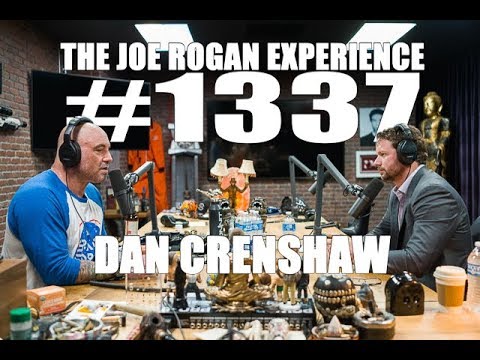
Joe Rogan Experience #1337 - Dan Crenshaw
Dan Crenshaw (guest), Joe Rogan (host), Narrator, Narrator, Narrator, Narrator
In this episode of The Joe Rogan Experience, featuring Dan Crenshaw and Joe Rogan, Joe Rogan Experience #1337 - Dan Crenshaw explores dan Crenshaw Talks Outrage Culture, War, Guns, and Free Speech Joe Rogan and congressman/former Navy SEAL Dan Crenshaw discuss how he became nationally known after a controversial Saturday Night Live joke, and why he chose not to be publicly outraged or play the victim. They spend substantial time on foreign policy, particularly U.S. military presence in the Middle East, terrorism, and why Crenshaw rejects isolationism while acknowledging public mistrust after Iraq and Vietnam.
Dan Crenshaw Talks Outrage Culture, War, Guns, and Free Speech
Joe Rogan and congressman/former Navy SEAL Dan Crenshaw discuss how he became nationally known after a controversial Saturday Night Live joke, and why he chose not to be publicly outraged or play the victim. They spend substantial time on foreign policy, particularly U.S. military presence in the Middle East, terrorism, and why Crenshaw rejects isolationism while acknowledging public mistrust after Iraq and Vietnam.
The conversation moves into domestic polarization, social media, and outrage culture—covering how identity politics, algorithm-driven anger, and the misuse of labels like “Nazi” are degrading civic discourse. They also debate gun policy and mass shootings, government’s limits in preventing evil acts, and what interventions (like threat assessment, armed school security, and red-flag laws with due process) might realistically help.
Later, Rogan and Crenshaw clash constructively over marijuana legalization, opioid addiction, and the war on drugs, with Crenshaw open to medical marijuana but cautious on full federal legalization. They close on climate and energy policy (critiquing the Green New Deal, advocating nuclear and carbon capture) and immigration/trade issues, including the U.S.–China trade war, Chinese IP theft, and how to manage asylum flows and border security humanely but sustainably.
Key Takeaways
Choose not to be a professional victim, even when insulted.
Crenshaw’s handling of the SNL joke—calling it offensive but saying he wasn’t personally offended and declining to demand an apology—showed that you can condemn bad behavior without centering yourself as a victim, which in turn reduced escalation and broadened his appeal.
Get the full analysis with uListen AI
Demand deeper explanations from politicians, not just talking points.
Crenshaw argues that Americans are ready for nuance and “why” behind policies, and that politicians lose trust when they only repeat surface-level lines; Rogan’s long-form podcast is presented as a model for how to understand leaders beyond soundbites.
Get the full analysis with uListen AI
Hardship, competition, and failure are essential for resilience.
Drawing on SEAL training and psychology research, Crenshaw and Rogan emphasize that facing loss, physical hardship, and humiliation—whether in sports, martial arts, or BUD/S—builds confidence and mental toughness if you tell yourself an empowering story about the experience.
Get the full analysis with uListen AI
Be wary of simplistic blame narratives in foreign and domestic policy.
On terrorism, climate, healthcare, and capitalism, Crenshaw warns against the reflex that “it’s always America’s fault” or “it’s all corporate greed,” arguing that such narratives are emotionally satisfying but ignore complex incentives, trade-offs, and unintended consequences.
Get the full analysis with uListen AI
Evaluate gun policies by both rights impact and real-world effect.
Crenshaw proposes a two-part test for gun-control ideas: do they unduly infringe on law-abiding citizens’ rights, and would they actually change outcomes (e. ...
Get the full analysis with uListen AI
Guard free speech norms even on private platforms.
While recognizing that companies like Twitter and Facebook are private, Crenshaw argues they wield government-like power over speech and should voluntarily approximate First Amendment standards—banning only direct incitement to violence—rather than vague, politically biased “hate speech” rules.
Get the full analysis with uListen AI
Design solutions around sustainability, not feel-good symbolism.
On climate (Green New Deal vs. ...
Get the full analysis with uListen AI
Notable Quotes
““It’s offensive, doesn’t mean I’m offended… We should try hard not to offend people and try hard not to be offended.””
— Dan Crenshaw
““We send guys like me over there so that they don’t come here.””
— Dan Crenshaw
““If you’re half in, those people that are all in, you become their highlight reel.””
— Joe Rogan
““Everything is your fault.””
— Dan Crenshaw (quoting Jocko Willink’s ‘Extreme Ownership’ principle)
““If you want to create civil war, that’s a really quick way to do it—when you really disenfranchise people and tell them their opinions are utterly unacceptable.””
— Dan Crenshaw
Questions Answered in This Episode
How should we balance civil liberties with proactive threat assessment and red-flag laws to prevent mass shootings without eroding due process?
Joe Rogan and congressman/former Navy SEAL Dan Crenshaw discuss how he became nationally known after a controversial Saturday Night Live joke, and why he chose not to be publicly outraged or play the victim. ...
Get the full analysis with uListen AI
To what extent can U.S. troop deployments abroad truly prevent terrorism at home, and how do we decide when the benefits no longer justify the costs?
The conversation moves into domestic polarization, social media, and outrage culture—covering how identity politics, algorithm-driven anger, and the misuse of labels like “Nazi” are degrading civic discourse. ...
Get the full analysis with uListen AI
Are social media companies morally obligated to follow First Amendment–like standards, or should they retain full editorial control even if it skews political discourse?
Later, Rogan and Crenshaw clash constructively over marijuana legalization, opioid addiction, and the war on drugs, with Crenshaw open to medical marijuana but cautious on full federal legalization. ...
Get the full analysis with uListen AI
What is the most realistic, evidence-based pathway to cutting global emissions: aggressive domestic lifestyle changes, technological innovation (nuclear/carbon capture), or international enforcement of IP and trade rules?
Get the full analysis with uListen AI
How far should the U.S. go in reshaping asylum and immigration laws to close loopholes, and what responsibilities do we have to address root causes in Central America versus enforcing strict border sovereignty?
Get the full analysis with uListen AI
Transcript Preview
Yeah. Trident there.
Yeah, this one is from, uh, Goggins. David Goggins gave me this one.
That's his coin?
Yeah, he's got his own coin.
Okay, so he's got-
You need a Dan Crenshaw coin, bro.
I do. This is kind of a big coin.
It's a fat one. It's not one you can really carry in your pocket.
No, no.
So it stays on the desk.
He's, he's really trying to outdo everybody else's-
(laughs) That's David-
... coin.
That's David Goggins. (laughs)
(laughs)
(laughs) The uncommon amongst uncommon men, even with your fucking coins. (laughs)
Oh, dude. Jesus.
So what's-
That coin, that coin's not gonna be that big. I'm still working on it.
Are you gonna get a coin for real?
W- we are, yeah. We-
Yeah.
... we're way behind the power curve on this. We need one. It's all about, you know, you gotta get the right symbology in there. You got the right amount of Texas, right amount of SEAL, the right amount of Congress.
Yeah.
It's all, you know, pack that into the right symbology, so...
Yeah. Test different ingredients.
Yeah.
Try it over and over again-
Yeah.
... till you get the bacon right.
Basically.
Yeah.
Basically.
Well, thanks for being here, man. Appreciate it.
I'm glad to be here. This is pretty cool.
You, uh, rose to prominence through a joke. Isn't that strange? Like the Saturday Night Live-
Yeah, I mean, a form- form of a joke, yeah. (laughs)
Yeah, Saturday Night Live.
Yeah.
That was a weird moment, and I was like, "Woo."
It was, um-
You handled it really well, though.
Well, thank you. Um, when that happened, it was a Saturday night, obviously, Saturday Night Live, and, uh, we heard about it the next morning. I got a lot of texts, and everybody's like, "Oh, hey man, you made it." It's a, there's a bunch of, bunch of SEALs too. So the, the SEAL community is not prone to, you know, this, this righteous indignation kind of reaction.
Mm-hmm.
They're, they're more likely... They're, they, they were more likely in private to just double down and make fun of me more.
Right.
Right? Which I love about them. Um, but here's what they would say, "Only we're allowed to make fun of you."
(laughs)
(laughs) Not, not, not this guy. Um, so that's how we found out about it. We watched it, and we were, we were right in the middle of the campaign. Well, the, the, the election was about two days away, so you're, you're struggling just to do all your last minute things to get the vote out. And so this was... It, it was, it did not dawn upon me how big of a deal this was going to be. At the time, it, it felt more like an annoyance. It felt more like, "Okay, I've gotta, I've got to come up with a statement. I'm, I'm seeing people really upset about this, but I'm not gonna lie to them and tell them that I'm emotionally upset, like I'm emotionally triggered by this." That would be a, a false reaction on my part. Um, so we crafted, I think, the, the right statement, which was, "Listen, like, it's offensive, doesn't mean I'm offended. And you don't have to be e- you don't have to choose to be offended here. And as just a general rule, we should try hard not to offend people and try hard not to be offended. Okay there, that's it. I'm not gonna demand some apology, uh, and, and, and kinda stand on my high horse and play this, play this aggrieved victim role," which is, which is the expected role to play these days. We, we don't wanna do that, and then-
Install uListen to search the full transcript and get AI-powered insights
Get Full TranscriptGet more from every podcast
AI summaries, searchable transcripts, and fact-checking. Free forever.
Add to Chrome