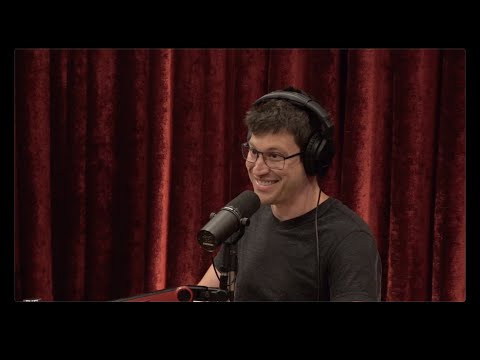
Joe Rogan Experience #2185 - Bob Gymlan
Narrator, Narrator, Joe Rogan (host), Bob Gymlan (guest), Narrator, Narrator, Narrator, Narrator, Narrator, Narrator
In this episode of The Joe Rogan Experience, featuring Narrator and Narrator, Joe Rogan Experience #2185 - Bob Gymlan explores bigfoot, Aliens, Sharks, and Secret Tech: Reality’s Weirdest Edges Explored Joe Rogan and YouTuber Bob Gymlan (Brian Gagnon) dive into cryptids, UFOs, and the blurry line between paranormal folklore and plausible reality, using Bigfoot as a central case study. They explore interdimensional theories, spiritual interpretations of phenomena, and how fear, consciousness, and the unknown shape human perception. The conversation branches into sharks, crocodiles, invasive species, ancient civilizations, and government secrecy around UFOs, fact-checking, and political narratives. Underneath the wild stories, they repeatedly return to how limited human senses are, how easily we’re gaslit, and how much of history, biology, and consciousness might be deeply misunderstood.
Bigfoot, Aliens, Sharks, and Secret Tech: Reality’s Weirdest Edges Explored
Joe Rogan and YouTuber Bob Gymlan (Brian Gagnon) dive into cryptids, UFOs, and the blurry line between paranormal folklore and plausible reality, using Bigfoot as a central case study. They explore interdimensional theories, spiritual interpretations of phenomena, and how fear, consciousness, and the unknown shape human perception. The conversation branches into sharks, crocodiles, invasive species, ancient civilizations, and government secrecy around UFOs, fact-checking, and political narratives. Underneath the wild stories, they repeatedly return to how limited human senses are, how easily we’re gaslit, and how much of history, biology, and consciousness might be deeply misunderstood.
Key Takeaways
Bigfoot stories persist because they tap into deeper fears and mysteries, not just belief in a literal ape.
Rogan and Gymlan argue that Bigfoot resonates because it embodies our sense that reality is incomplete, the woods are unknowable, and there may be entities or dimensions our senses can’t fully access.
Get the full analysis with uListen AI
Human perception is profoundly limited and easily distorted, especially under fear, darkness, and stress.
They compare us to ants oblivious to threats above them, and suggest that anxiety, night, and extreme experiences may briefly open access to other “layers” of reality—or at least create equally convincing illusions.
Get the full analysis with uListen AI
Predators we already know (sharks, crocodiles, big cats, bears) are as monstrous as any cryptid—and often misunderstood.
From under-reported shark attacks to century‑old crocodiles and invasive pythons erasing Everglades mammals, they show how real animals, their behavior, and our statistics about them are far stranger and darker than most people realize.
Get the full analysis with uListen AI
Government and institutional “fact-checking” around UFOs, health, and politics often functions as narrative control, not neutral truth.
They discuss disinformation agents like Richard Doty, skewed shark-attack databases, COVID messaging, and biased fact-check sites as examples of strategic gaslighting that erodes trust and obscures uncomfortable realities.
Get the full analysis with uListen AI
UFO phenomena may be tied to secret human technology and/or nonhuman intelligences—and both possibilities are unsettling.
Rogan leans toward advanced gravity-based drones reverse-engineered from alien tech (Bob Lazar–style), while Gymlan is open to spiritual or interdimensional entities; either way, the Nimitz and other cases suggest physics we don’t publicly understand.
Get the full analysis with uListen AI
Human origins and consciousness likely involve factors mainstream narratives barely address.
They entertain ideas from McKenna’s “Stoned Ape” theory to Sumerian Anunnaki genetic engineering and the notion that humans might be “containers” for souls—highlighting how abrupt brain expansion, culture, and spirituality remain poorly explained.
Get the full analysis with uListen AI
Our craving for mystery content—cryptids, aliens, true crime, high fantasy—is a clue to how we process the unknown.
Gymlan’s slow, radio-style storytelling and his own high-fantasy novel reflect a broader human need to narrativize fear, power, and the inexplicable, often blending horror, myth, and speculative science to make sense of a chaotic world.
Get the full analysis with uListen AI
Notable Quotes
“I think the boundaries between this dimension and other ones are permeable.”
— Joe Rogan
“My talent... is I am so ready to believe that everything we know is BS.”
— Bob Gymlan
“If a grizzly bear didn’t exist and there were reports of this enormous dog-like creature that eats everything and can kill a moose and lives in the woods, it would be way scarier than Bigfoot.”
— Joe Rogan
“I think extraterrestrials, if they exist, are evil.”
— Bob Gymlan
“If we found a planet filled with monkeys, you don’t think we’d take a few of them and shoot our stuff into it? Like, ‘Let’s see.’”
— Joe Rogan
Questions Answered in This Episode
If some cryptid encounters are interdimensional or spiritual rather than physical, how would we ever design science to study them?
Joe Rogan and YouTuber Bob Gymlan (Brian Gagnon) dive into cryptids, UFOs, and the blurry line between paranormal folklore and plausible reality, using Bigfoot as a central case study. ...
Get the full analysis with uListen AI
How should we distinguish between genuine whistleblowing and conspiracy thinking when institutions have documented histories of lying or suppressing information?
Get the full analysis with uListen AI
What ethical lines—if any—should exist around resurrecting extinct species or radically altering animals and humans with genetic and surgical experimentation?
Get the full analysis with uListen AI
If humans are, as some theories suggest, “containers for souls,” how would that change our views on morality, religion, and what it means to damage or protect a person?
Get the full analysis with uListen AI
Why do stories of monsters, aliens, and true crime appeal so strongly across cultures—and what does that say about how we cope with fear and uncertainty?
Get the full analysis with uListen AI
Transcript Preview
(drumming music) Joe Rogan podcast, check it out.
The Joe Rogan Experience.
Train by day, Joe Rogan podcast by night. All day. (rock music) Yep. Okay. Salud, Bob.
Salud.
Pleasure to meet you, man.
Pleasure to meet you, too.
How'd you start doing this, uh, YouTube channel?
Um, I've always, uh, enjoyed doing, talking about those things, 'cause who doesn't?
Right.
And I was always kinda surprised at how shitty they are usually talked about. I just saw the shooting star.
(laughs) There it goes. Yeah.
Yeah.
It'll trick you.
Like, so often, you see this type of content. It's like, "Is there a monster in the woods?"
Right.
And it's like, that's not the question. The question is more complex than that, and I often don't see it brought up that way.
There's something about these st- like today, I listened to the creepiest Bigfoot story one, that one that you had with the- the one where the guy wrote in a story about the Bigfoot-
Burying stuff in the backyard?
Yeah, that one.
Oh.
And there's something about those that, like, even if you don't believe in Bigfoot, 'cause I n- don't necessarily believe in Bigfoot, there's something about it that's so compelling. There's something about things that you don't know out there in the woods that n- y- 'cause you don't have an accurate, a, a real good account of everything that's in the forest.
Of course.
You know, you look out there, it's dark. And the mind is always looking for some weirdness. The mind is always looking for something that n- s- other people don't know about, or perhaps there's, like, a secret that the sheriffs know about that they don't share with everybody else. Like, why is that so, why does that resonate so much with people? With Stephen King movies, like, or Stephen King books, it's like that kind of a thing. There's something about it that's, like, exciting.
Right. Um, (laughs) I'm more of a Dean Koontz fan than Stephen King.
Oh, okay.
To be-
Yeah, he's great, too.
Yeah. Um.
You don't like Stephen King? Is that what you're try- you trying to throw shade?
He's, his politics ruined it for me.
That's the problem, right?
That's the problem.
His problem is his Twitter feed.
(laughs) Yeah.
His Twitter feed's fucking brutal.
Right.
It's like, dude, stop.
Right. That's nuts.
These are, like, the goofiest, low testosterone boomer takes I've ever heard on anything. Like, stop.
It's very true.
But he's such a brilliant writer. I also think, uh, he's a different guy, 'cause the car accident, I think that was a big one. You know, when you get hit by a, a van.
That'll do it.
Yeah. Shit. He, he was really, really fucked up from that. And I also think it's getting off coke. Getting off coke and booze?
Install uListen to search the full transcript and get AI-powered insights
Get Full TranscriptGet more from every podcast
AI summaries, searchable transcripts, and fact-checking. Free forever.
Add to Chrome