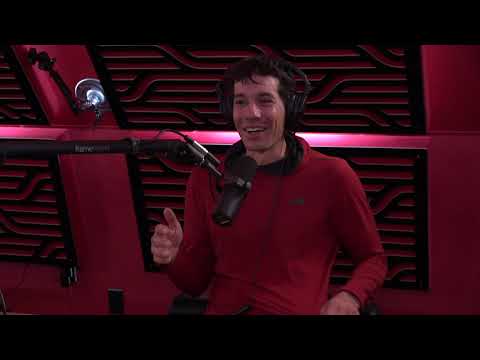
Joe Rogan Experience #1626 - Alex Honnold
Narrator, Narrator, Joe Rogan (host), Alex Honnold (guest)
In this episode of The Joe Rogan Experience, featuring Narrator and Narrator, Joe Rogan Experience #1626 - Alex Honnold explores alex Honnold Explores Climbing’s Evolution, Risk, and Life Beyond El Cap Alex Honnold joins Joe Rogan to talk about his new podcast "Climbing Gold," using it to document climbing’s history and the sport’s evolution as it enters the Olympics. He explains the competition formats, route setting, and how gym-born athletes are reshaping what “elite” climbing looks like compared to traditional adventure alpinism.
Alex Honnold Explores Climbing’s Evolution, Risk, and Life Beyond El Cap
Alex Honnold joins Joe Rogan to talk about his new podcast "Climbing Gold," using it to document climbing’s history and the sport’s evolution as it enters the Olympics. He explains the competition formats, route setting, and how gym-born athletes are reshaping what “elite” climbing looks like compared to traditional adventure alpinism.
The conversation ranges widely into expedition stories from Guyana’s jungle tepuis, indigenous expertise, injury and training, the realities of risk in free soloing, and how living close to nature changes one’s perspective on modern comfort and “survival” culture.
They also touch on technology and the future—electric adventure vehicles, VR climbing, longevity research, and even Mars exploration—contrasting analog, physical challenge with increasingly immersive digital experiences.
Throughout, Honnold’s calm approach to extreme risk and his methodical training, recovery, and lifestyle choices reveal why he’s become both a top climber and an articulate spokesperson for the sport.
Key Takeaways
Climbing’s Olympic debut is forcing the sport to define itself.
The combined format (speed, lead, bouldering) and formal route setting highlight tensions between pure adventure climbing and highly trained indoor ‘gym kids,’ pushing organizers and athletes to clarify what excellence in climbing really means.
Get the full analysis with uListen AI
Tendon and ligament adaptation severely lag muscle gains in new climbers.
Honnold notes that young climbers can quickly build pulling strength but risk serious finger and elbow injuries if they don’t use structured, progressive fingerboard protocols that respect connective tissue timelines.
Get the full analysis with uListen AI
Storytelling can preserve climbing’s adventurous roots amid rapid commercialization.
Through "Climbing Gold," Honnold is trying to capture first-ascent stories and cultural history (e. ...
Get the full analysis with uListen AI
Indigenous ‘survival’ makes TV survival shows look contrived.
Living with Amerindian porters in Guyana, Honnold saw how quickly they could build camps and live comfortably with just machetes, underscoring how entertainment survival narratives often romanticize what is daily work for millions.
Get the full analysis with uListen AI
Body maintenance and recovery are as critical as raw training volume.
Since settling in Las Vegas, Honnold credits regular bodywork, structured training, and stable living (vs. ...
Get the full analysis with uListen AI
Deliberate exposure to real risk recalibrates everyday anxiety.
Honnold describes days hypothermic, lost, and cactus-stuck on stormy ridges as “normal,” which makes suburban discomforts feel trivial; channeling fight-or-flight into genuine physical challenges can reduce misplaced modern anxiety.
Get the full analysis with uListen AI
VR and immersive tech will expand climbing’s audience but won’t replace the real thing.
He’s experimenting with VR Everest-style climbing films and sees them as powerful, educational, and inspiring—but still fundamentally different from the tactile, uncertain, analog reality of rock and weather.
Get the full analysis with uListen AI
Notable Quotes
““A big part of the podcast was basically to save some of the best stories of climbing… like preserve some of that adventure.””
— Alex Honnold
““It’s funny to celebrate survival stuff when hundreds of millions of humans on Earth live like that every day.””
— Alex Honnold
““Anything you’ve done for 25 years is going to feel pretty relaxed when you do it.””
— Alex Honnold
““If I felt like there was something useful I could contribute by going to Mars, I would definitely go.””
— Alex Honnold
““You get worked by nature so often that when you’re in normal life, everything feels pretty relaxed.””
— Alex Honnold
Questions Answered in This Episode
How will the influx of Olympic-focused, gym-trained climbers change outdoor climbing ethics and access over the next decade?
Alex Honnold joins Joe Rogan to talk about his new podcast "Climbing Gold," using it to document climbing’s history and the sport’s evolution as it enters the Olympics. ...
Get the full analysis with uListen AI
Should elite climbers have a responsibility to document and preserve the ‘old stories’ of the sport for new generations?
The conversation ranges widely into expedition stories from Guyana’s jungle tepuis, indigenous expertise, injury and training, the realities of risk in free soloing, and how living close to nature changes one’s perspective on modern comfort and “survival” culture.
Get the full analysis with uListen AI
Where is the line between meaningful risk and unnecessary danger in pursuits like free soloing, and who gets to draw it?
They also touch on technology and the future—electric adventure vehicles, VR climbing, longevity research, and even Mars exploration—contrasting analog, physical challenge with increasingly immersive digital experiences.
Get the full analysis with uListen AI
Could VR or AR ever meaningfully teach real-world climbing skills, or will it always be a separate, entertainment-only experience?
Throughout, Honnold’s calm approach to extreme risk and his methodical training, recovery, and lifestyle choices reveal why he’s become both a top climber and an articulate spokesperson for the sport.
Get the full analysis with uListen AI
As climate change threatens snow packs and mountain environments, how should the climbing community adapt its goals and traditions?
Get the full analysis with uListen AI
Transcript Preview
(drumming music) Joe Rogan podcast, check it out.
The Joe Rogan Experience.
Train by day, Joe Rogan podcast by night, all day. (rock music plays) All right. Hello, Alex.
Hello.
Good to see you again, man.
Yeah, good to see you.
What's happening? How you doing?
I'm, I'm just living. I'm doing the same stuff as always.
Just living? Crawling giant shit that freaks people out?
Yep. Yep.
(laughs)
That's, that's what I'm trying to do.
What is the, the latest? What have you been up to? I know you're doing a podcast now, right?
Yeah. No, no. I know... Do you feel a certain, uh, satisfaction about that?
I do.
Yeah, I don't know if you remember but you went off for like quite a long time and you were like, "You should do a podcast. You should do a podcast." And sure enough, so yeah, I did a podcast.
(laughs) Well, I mean, you have an interesting perspective and you have a fascinating life, you know.
Yeah. Th- they're actually, um... We don't really get into it that much. It, I, I don't actually talk about myself very much. It's, um... It was sort of leading up to the Olympics. Uh, I don't... You know climbing's in the Olympics this year?
No, I did not.
Yeah, so climbing's in the Olympics for the first time this summer, and so the podcast was supposed to be sort of a primer leading up to the Olympics. More as like a, like here is the state of the sport leading up to this singular moment in climbing. But, um, but then the Olympics got canceled last summer, well pushed.
Mm-hmm.
And so then we decided to sort of go a little deeper in backstory stuff, and so that's the first season. This basically premiered right now.
So you... Did you record them all in advance?
Uh, no, it's, it's ongoing. We've done, uh, we've done 10 of them and, uh, and now we're gonna do the ones leading up to the Olympics, like over the next, you know, four months or whatever.
So you've got kind of a structure planned out though?
Yeah. Yeah, the idea is that we wanted to... Well, I mean, you know, as you can imagine, climbing is a very broad sport, you know, starting from sort of classical alpinism in, in the Alps and, and like mountain climbing, now to Olympic climbing, where the people who win the Olympics this summer, most of them are super young and they're, they're basically like gym kids, sort of like gymnasts who just train indoors nonstop. And so the podcast is sort of an exploration of this spectrum of full adventure to full athleticism and like where climbing has moved in between. You see what I'm saying?
Mm-hmm.
Like it's, um... I don't know, because, you know, when I grew up as a... Like I, I was one of the first climbers in America to sort of grow up climbing in a climbing gym. And so that's part of the reason I wound up as a professional climber is I sort of had access to better training facilities than like the generation before me. And now we're looking at the next generation who's going to the Olympics and it's like even more of that athletic background and it's like, you know, it changes the sport. And so a big part of the, the podcast that we started was basically to, to see how it changes the sport and, and to try to, you know, save some of the best stories of climbing, you know what I mean? Like preserve some of that adventure.
Install uListen to search the full transcript and get AI-powered insights
Get Full TranscriptGet more from every podcast
AI summaries, searchable transcripts, and fact-checking. Free forever.
Add to Chrome