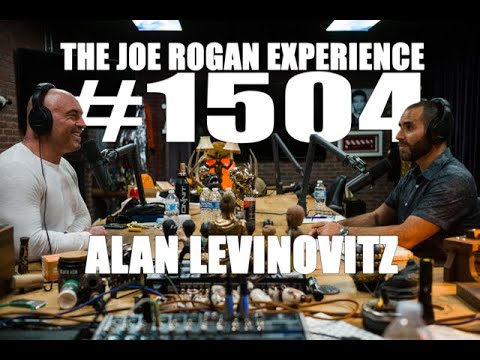
Joe Rogan Experience #1504 - Alan Levinovitz
Joe Rogan (host), Alan Levinovitz (guest), Jamie Vernon (guest), Jamie Vernon (guest)
In this episode of The Joe Rogan Experience, featuring Joe Rogan and Alan Levinovitz, Joe Rogan Experience #1504 - Alan Levinovitz explores joe Rogan and Alan Levinovitz Deconstruct the Myth of ‘Natural’ Goodness Joe Rogan and religion scholar Alan Levinovitz explore how the word “natural” is misused as a moral stamp of approval in everything from parenting and food to medicine, economics, and environmentalism.
Joe Rogan and Alan Levinovitz Deconstruct the Myth of ‘Natural’ Goodness
Joe Rogan and religion scholar Alan Levinovitz explore how the word “natural” is misused as a moral stamp of approval in everything from parenting and food to medicine, economics, and environmentalism.
Levinovitz explains how he began wanting to debunk naturalness entirely, but instead concluded that while nature matters, worshiping it as inherently good leads to bad science, bad policy, and bad personal choices.
They connect this to ultra‑processed food and “ultra‑processed information” on social media, arguing that modern platforms exploit our emotional instincts the same way junk food exploits our taste buds.
The conversation ranges through topics like hunting, factory farming, religion, childbirth, sports technology, transgender athletes, charlatan healers, political polarization, and the importance of kindness and intellectual humility.
Key Takeaways
Stop treating “natural” as a synonym for “good.”
Many harmful things—slavery, pedophilia, deadly childbirth, cyanide, pandemics—are perfectly natural. ...
Get the full analysis with uListen AI
Use nature as a warning light, not a commandment.
Levinovitz suggests nature should be a heuristic: if something is novel or far from our evolutionary environment, ask what might go wrong—but don’t assume it’s bad. ...
Get the full analysis with uListen AI
Recognize “ultra‑processed information” and limit your intake.
Social media content is engineered like junk food: highly palatable, oversimplified, demonizing an enemy, and giving you a sense of belonging. ...
Get the full analysis with uListen AI
Be wary of health and spirituality charlatans selling certainty.
From wheatgrass cancer cures to chiropractic “zone healing” and reiki, many quasi‑religious healers exploit people in pain by offering simple, natural‑sounding stories. ...
Get the full analysis with uListen AI
Sports require a nuanced view of fairness and technology.
Debates over Nike’s super‑shoes, carbon‑fiber blades, testosterone levels, and transgender/intersex athletes show that we do care about “natural talent” in sport—but drawing lines is messy, sport‑specific, and cannot be reduced to one simple rule.
Get the full analysis with uListen AI
Cultivate global uncertainty and local conviction.
Both men emphasize the value of admitting “I don’t know,” changing your mind, and rejecting rigid ideological identities. ...
Get the full analysis with uListen AI
Choose kindness over being right when people are suffering.
Rogan and Levinovitz end up stressing that relentless truth‑telling isn’t always the most ethical response, especially with people in pain. ...
Get the full analysis with uListen AI
Transcript Preview
Hello, Alan.
Hello, Joe.
Good to see you. Um, first of all, thank you for this. This, uh, piece of pyrite that's embedded into stone. And, um, we, we just started talking. I said, "Just don't say another word. Let's start talking about this on the podcast." Because this ... It kind of ... It's interesting. I started your book, which, um, I very rarely read books.
(laughs)
I mostly do audiobooks. Uh, but, uh, I was forced to read yours. But, uh, one of the things, uh, that I, I found interesting is the concept of what is natural. And I've, I've gone over this many times myself. I'm like, poison's natural. Like, everything's natural. Computers are natural, really, because they come from the ground. They're made by people. They're essentially like, you know, a human's version of, uh, anything, like, a bird would create, right?
Yeah.
Birds create birds nests. Are those natural? But this pyrite, this is pyrite, right?
Yup.
Which is fool's gold, right?
Fool's gold.
But it's naturally in these cubes, in these, this, this square form, this perfect, these perfect angles, which you would never believe.
I-
You would think somebody left this shit there.
I, I didn't believe it. It looks like, it looks like aliens left them.
Yeah.
And they're even in, like, what that's called is it's in the matrix.
Oh, wow.
So sometimes you can just get the cubes. They're just the cube, but they call the rock that it's in the matrix, which I think is-
Dude, that-
... kind of a- kind of appropriate. (laughs)
That is going to have a permanent spot on this desk with all this other craziness here.
Cool.
Thank you so much. That was really cool. I did not know that it came like that. I found pyrite when I was a kid in rocks, you know, when they call it fool's gold. Oh, Jamie's gonna bring that up to you there. Um-
Perfect.
Fool's gold, but it's, you, you know, it's usually like specks and flecks and stuff.
There's another one called, I for- I forget, they're called, like, Illinois miner's dollars or something. This is another form that pyrite takes. Uh, I- I'm kind of obsessed with weird rocks. Um, but they look just like sand dollars, but they're gold.
Oh, wow.
Like, they look like they're golden. And so these are, you know ... I think one of the things... I actually changed my mind over writing, uh, like, over the course of writing this book.
Oh, there they are. Jamie, pull up some full size.
Yeah. That's what I-
That's crazy.
They're incredible, right?
What i- what causes it to take on these different completely unusual forms?
So I tried, I tried to find out. There's, like, a local rock store where I live, and I asked the guy, and apparently, I don't understand how it works at all, but the way all crystals work is they have different kinds of structures, and the way those structures come together determines whether, you know, it makes like a quartz crystal or what shape it takes. Um, it's very, it's, it's very surreal.
Install uListen to search the full transcript and get AI-powered insights
Get Full TranscriptGet more from every podcast
AI summaries, searchable transcripts, and fact-checking. Free forever.
Add to Chrome