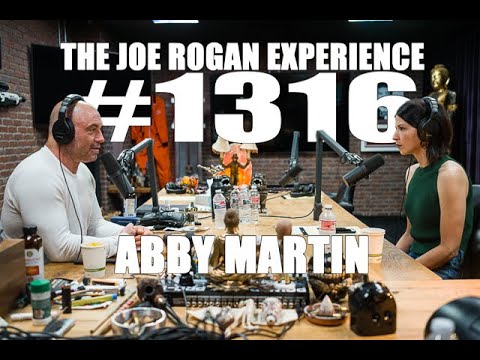
Joe Rogan Experience #1316 - Abby Martin
Joe Rogan (host), Abby Martin (guest), Narrator, Narrator, Narrator, Narrator, Narrator
In this episode of The Joe Rogan Experience, featuring Joe Rogan and Abby Martin, Joe Rogan Experience #1316 - Abby Martin explores abby Martin Dissects U.S. Empire, Media Control, and Modern Warfare Joe Rogan and journalist Abby Martin discuss U.S. foreign policy, focusing on historical and current examples of regime change, sanctions, drone warfare, and the push for war with Iran and Venezuela.
Abby Martin Dissects U.S. Empire, Media Control, and Modern Warfare
Joe Rogan and journalist Abby Martin discuss U.S. foreign policy, focusing on historical and current examples of regime change, sanctions, drone warfare, and the push for war with Iran and Venezuela.
They examine how corporate media and tech platforms shape public perception, censor dissenting or ‘radical’ views, and increasingly curate reality through algorithms and deplatforming.
The conversation also covers domestic issues like reparations, student debt, healthcare, automation, and the 2020 Democratic field, highlighting Bernie Sanders and Tulsi Gabbard as the only candidates Martin views as meaningfully anti-war or anti-establishment.
Martin promotes her independent work, especially her film on Gaza, arguing that U.S. support for Israel and broader empire-building are central drivers of global suffering and environmental destruction.
Key Takeaways
Sanctions and drone strikes are not ‘soft’ tools but lethal acts of war.
Martin argues that U. ...
Get the full analysis with uListen AI
Corporate and legacy media largely serve state and corporate power.
She contends that major outlets mostly echo U. ...
Get the full analysis with uListen AI
Big Tech platforms are quietly curating political reality through algorithms.
Rogan and Martin describe how Google, YouTube, Facebook, and Twitter can down-rank, demonetize, age-restrict, or deplatform content—often targeting ‘extreme’ or system-challenging views—while privileging establishment sources, all under opaque rules.
Get the full analysis with uListen AI
Identity politics can mask continuity of neoliberal, pro-war policy.
They criticize slogans like ‘we need a woman president’ or blanket rejections of ‘straight white men’ as distractions that allow corporate-friendly candidates (e. ...
Get the full analysis with uListen AI
Economic injustice in the U.S. is structurally tied to empire and capitalism.
The discussion links reparations, mass incarceration, student debt, and crumbling infrastructure to historic slavery, systemic racism, and a political economy that prioritizes military spending and corporate profit over healthcare, education, and public welfare.
Get the full analysis with uListen AI
Independent media requires public funding to escape advertiser and state capture.
Martin explains that The Empire Files survives via Patreon, GoFundMe, and small donors after sanctions on Venezuela cut former funding, arguing that avoiding corporate and government money is essential to maintain editorial freedom.
Get the full analysis with uListen AI
Lasting change will come from mass movements, not just elections.
While she sees Bernie Sanders as a rare hopeful candidate, Martin insists that only organized, sustained pressure from people in the streets and in labor/grassroots movements can actually roll back U. ...
Get the full analysis with uListen AI
Notable Quotes
“Sanctions are an act of war. They’re killing people right now.”
— Abby Martin
“We don’t have a place we can go for clear, unbiased, emotion‑free, objective analysis of any international issue.”
— Joe Rogan
“The Pentagon is the largest polluter in the world—more than about 140 countries combined.”
— Abby Martin
“We have all the information at our fingertips, but we still keep reverting back to the myths that underpin our society.”
— Abby Martin
“I don’t think hope is going to come from within Congress. It’s going to come from a grassroots, mobilized effort.”
— Abby Martin
Questions Answered in This Episode
How should we weigh the strategic arguments for sanctions and drone strikes against the civilian deaths and long-term blowback they cause?
Joe Rogan and journalist Abby Martin discuss U. ...
Get the full analysis with uListen AI
What practical mechanisms could ensure that major tech platforms don’t quietly shape political reality while still addressing genuine harms like coordinated disinformation?
They examine how corporate media and tech platforms shape public perception, censor dissenting or ‘radical’ views, and increasingly curate reality through algorithms and deplatforming.
Get the full analysis with uListen AI
If corporate media largely reinforces U.S. foreign policy, what would a truly independent, mass-reach news ecosystem need in terms of funding and governance?
The conversation also covers domestic issues like reparations, student debt, healthcare, automation, and the 2020 Democratic field, highlighting Bernie Sanders and Tulsi Gabbard as the only candidates Martin views as meaningfully anti-war or anti-establishment.
Get the full analysis with uListen AI
Can identity-based representation in politics be reconciled with a serious challenge to militarism and neoliberal economics, or are those projects fundamentally at odds?
Martin promotes her independent work, especially her film on Gaza, arguing that U. ...
Get the full analysis with uListen AI
What concrete steps could an average viewer take—beyond voting—to meaningfully oppose U.S. empire and support the kind of mass movement Martin argues is necessary?
Get the full analysis with uListen AI
Transcript Preview
Three, two, one, boom. Hello, Abby.
Hello, Joe.
What's going on?
Nothing much.
I saw you chilling with Oliver Stone the other day. Ooh.
Yeah.
What was that like? (laughs)
(laughs) It was pretty cool.
He's a interesting guy.
Very interesting guy, yeah. He likes to support radical politics, so he came out for the screening of, uh, the new film that we did.
(sighs) Yeah, he's a very unusual character in that regard, right? 'Cause he's like this blockbuster movie maker guy, but he's also a pretty radical guy in the way... in his politics and what he supports, and-
Yeah, he was kind of like the black sheep of Hollywood for a while, you know, doing all the radical, kind of the radical outlier of Hollywood basically.
Yeah, but th- d- you saw the JFK movie, right?
Yeah, of course.
What... That was a weird one, right? It's like, I kind of like it, but I'm kind of like, "Hey, man, that fucking general wasn't even a real person." Like, you m- you made up a real person. Like, you put him in there.
Yeah.
Like, that guy didn't exist. Like, the- the Donald Sutherland guy.
A lot of the movie's really good. Yeah.
Very good. Yeah.
Very, very good.
But I get it, that he kind of needed to move it along for a 90-minute or two-hour movie, whatever it was.
Mm-hmm.
I get it. He kind of needed, like, this little character to, like, be d- dishing out the inside scoop, the Donald Sutherland character.
Yeah.
But in real life, there was no guy.
I didn't know that.
Yeah. Goddamn it, Oliver.
(laughs)
If you knew, would you-
Tricked again.
... would you be like, "Hey, motherfucker, what'd you do?" (laughs)
(laughs)
"Why'd you add that guy?"
(laughs)
Because it's weird because, like, people talk about that. They say, "Hey, you know, in the Oliver Stone movie, they d- d- detailed all these things-"
Mm-hmm.
"... that happened." Like, yeah, yeah, yeah, but they also added a guy-
Right.
... that wasn't a real guy.
Right. Well, I guess at the end of the day, it's a fictional, you know, film.
(sighs) But how is it, if it's a real president who was shot by someone and you're trying to explain who in your r- your movie, and you have all these real characters-
Mm-hmm.
... but then you got this one guy you just kind of shoved in there?
Mm-hmm. You gotta fill... The, the professor... What, what was, what did he call himself in the movie again? The Donald Sutherland character?
The Donald Sutherland character? I do not remember.
Yeah.
I haven't seen it in years.
Yeah.
Install uListen to search the full transcript and get AI-powered insights
Get Full TranscriptGet more from every podcast
AI summaries, searchable transcripts, and fact-checking. Free forever.
Add to Chrome